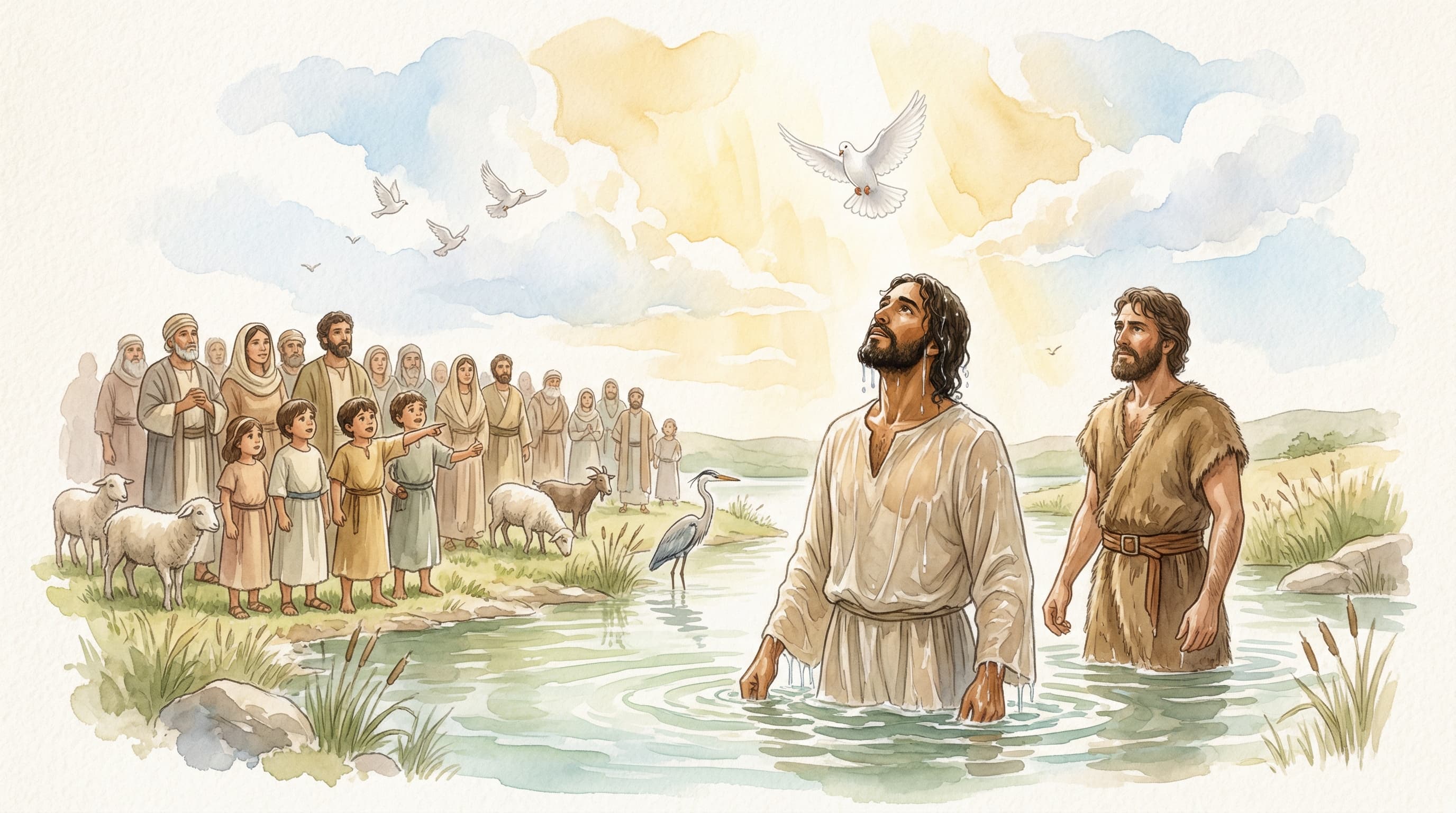
The Baptism of Jesus
A lesson preparation guide for teaching 5–10 year olds
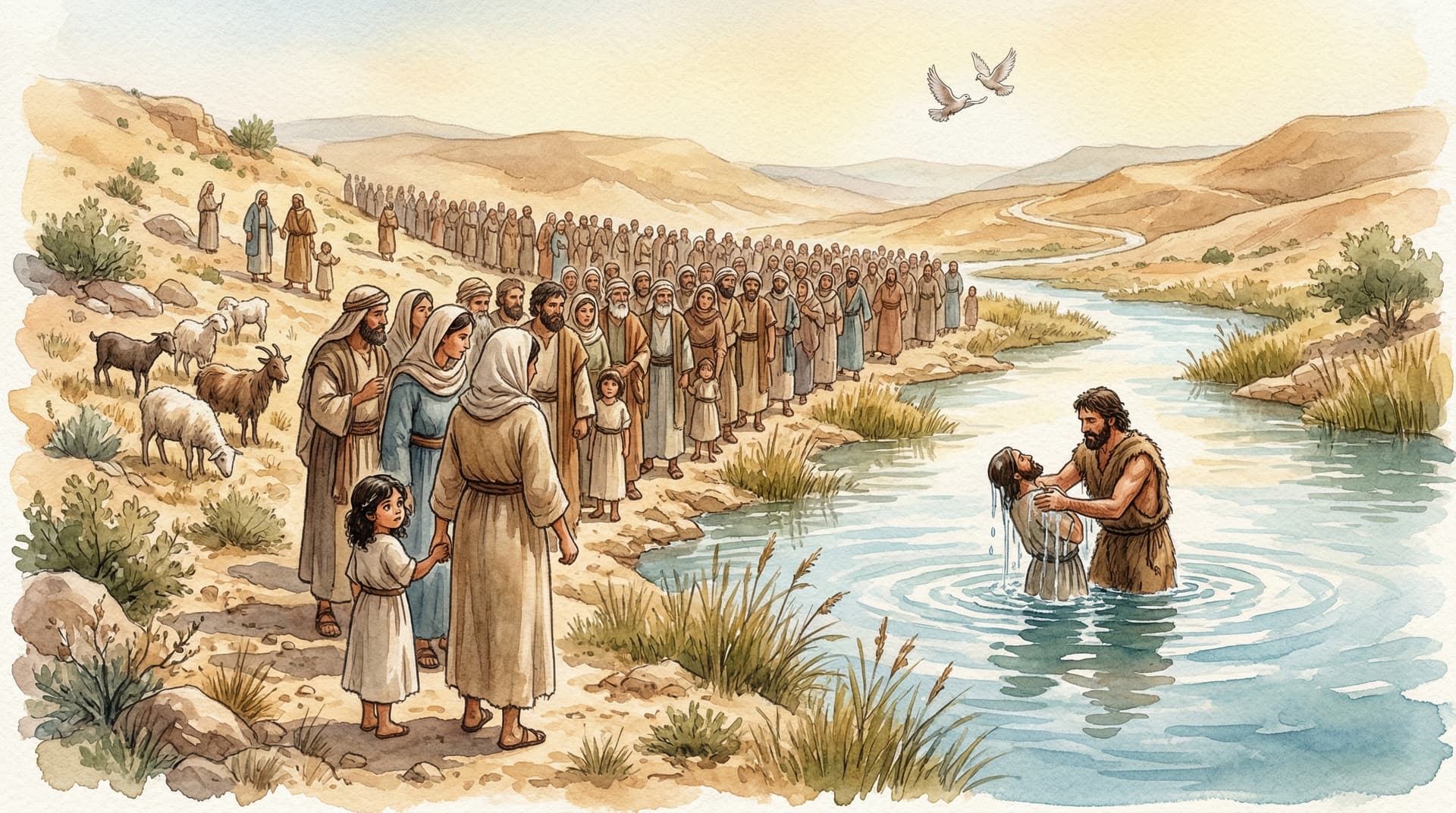
The Original Audience
What did this mean to the people who first heard it?
Movement 1: The Original Audience
Passages: Matthew 3:13-17; Mark 1:9-11; Luke 3:21-22; John 1:29-34
"What did this mean to the people who first heard it?"
The Scene at the Jordan: The First Prophet in 400 Years
The previous lesson ended with a baby born to point. Now that baby is grown -- a wild man in the desert, wearing camel hair, eating locusts and wild honey. And he is the most important person in Israel.
John the Baptist is the first prophetic voice since Malachi. Four hundred years of silence, and now someone is speaking with authority again. The effect was seismic. Matthew says "Jerusalem, all Judea, and the entire region around the Jordan" came out to him (3:5). Luke adds that "crowds" came, along with tax collectors and soldiers -- the whole cross-section of society. People walked days to reach the wilderness. Something was happening, and everyone could feel it.
John's message was blunt: "Rethink everything -- God's kingdom is closing in" (Matthew 3:2, NGET). He was not gentle. He called the religious leaders a "nest of vipers" (3:7). He warned that the axe was already at the root of the trees. This was not a comforting revival. This was an alarm.
Why Submersion Was Shocking
Here is what modern readers miss entirely: submersion (baptism) was a ritual for Gentile converts to Judaism. When a pagan wanted to become Jewish, they were submerged in water as a sign of washing away their old identity and entering the covenant. It was for outsiders. It was for the unclean.
John was telling Jews -- God's own covenant people, children of Abraham -- to be submerged. He was saying, in effect: your ancestry does not save you. Your temple membership does not save you. You are as spiritually unclean as the pagans you look down on, and you need to start over. He said it explicitly: "Don't comfort yourselves by saying, 'Abraham is our father' -- God could turn these rocks into children of Abraham" (Matthew 3:9, NGET).
This was explosive. It was also irresistible. People came anyway. They confessed their failures and went under the water. Something about John's message rang true enough that pride gave way to honesty.
The Jordan River Was Loaded
The location was not accidental. The Jordan River was where Israel had crossed from the wilderness into the Promised Land under Joshua. It was the threshold between exile and home, between wandering and arrival. Every Jew knew the story.
John positioned himself at that crossing point. The symbolism screamed: this is a new exodus. A new beginning. The old has failed -- the temple system, the priesthood, the monarchy -- and God is starting fresh. Come through the water again. Enter the promise again. But this time, the promise is a person, not a land.
Messianic Fever
The crowds were not just repenting. They were wondering. Luke tells us "the people were filled with anticipation, and everyone was debating in their hearts whether John might be the One" (3:15, NGET). The messianic expectation that had simmered for centuries was now boiling. Here was a prophet -- finally -- and he sounded like Elijah. Was this the one Malachi promised?
John shut it down: "I submerge you in water, but someone more powerful than me is coming -- I am not even worthy to untie his sandals. He will submerge you in the Breath of God and fire" (Luke 3:16, NGET). John drew a sharp line between himself and the one coming. The gap was not small. It was the gap between a servant and a master, between water and fire, between preparation and arrival.
The crowd was primed. They had confessed. They had been submerged. They were waiting for the one John kept pointing at.
Then Jesus Got in Line
And this is the moment the original audience would have found bewildering.
Jesus came from Galilee to the Jordan. He did not come to preach. He did not come to observe. He came to be submerged -- the same submersion that tax collectors and soldiers and self-confessed sinners had been receiving. He stood in the same line. He walked into the same river. He went under the same water.
The original audience would have felt the dissonance immediately. Submersion was for the unclean. For failures. For people who needed to start over. Even John felt it -- Matthew records him protesting: "I'm the one who needs to be submerged by you, and you're coming to me?" (3:14, NGET). John recognized what the crowd may not have: this man does not belong in this line. He has no failures to confess. He has nothing to wash away.
And Jesus' answer -- "Let it happen for now -- this is how we fulfill everything that is right" (3:15, NGET) -- would have puzzled everyone. What "right" thing is accomplished by the sinless one taking the sinner's place? That question is the seed of the entire gospel.
The Heavens Opened
What happened next had not happened in Israel's memory. The sky split open. The Spirit of God descended visibly -- Luke says "in bodily form, like a dove" -- and landed on Jesus. And a voice spoke from heaven: "This is my Son, the one I love -- I am completely delighted with him" (Matthew 3:17, NGET).
For an audience that had endured 400 years of closed heavens -- no visions, no angelic messengers, no voice from above -- this was overwhelming. The heavens did not just open. Mark says they were "torn apart" (1:10) -- the Greek word is schizo, a violent ripping. This was not a gentle parting of clouds. It was a barrier being shredded.
And the voice did not come to John. It did not come to the crowd. It came to identify Jesus. The Father spoke. The Spirit descended. The Son stood in the water. For the first time in recorded history, all three persons of the Trinity were simultaneously visible and active in a single moment.
The audience standing on the riverbank witnessed the most concentrated revelation of God's identity in the history of the world. And it happened while the Son of God was standing waist-deep in a sinner's river.
Why This Matters for Kids
"Imagine the most popular kid in school -- the one everyone likes, the one who never gets in trouble, the one the teachers love. Now imagine that kid walks into the principal's office and sits down in the chair where kids go when they're in trouble. And they say, 'I'm here on purpose. I belong here.' Everyone would say, 'What are you doing? You didn't do anything wrong!' And the kid would say, 'I know. But my friends did. And I'm going to sit where they sit.'
That's what Jesus did at the Jordan River. People were going to John because they had messed up and needed a fresh start. And Jesus -- who had never messed up, not once -- got in line with them. He stood right there, in the same water, with people who had lied and cheated and hurt others. And when John said, 'You don't belong here,' Jesus said, 'This is exactly where I belong.' Why would someone who never did anything wrong stand in the place for people who did? That's what we're going to find out."
The Author’s Intent
What were the four Gospel writers each trying to show?
Movement 2: The Author's Intent
Passages: Matthew 3:13-17; Mark 1:9-11; Luke 3:21-22; John 1:29-34
"What was the author trying to do with this text?"
Four Authors, One Event, Four Angles
All four Gospels record Jesus' baptism (though John's Gospel records it indirectly). Each author shapes the story to reveal something different about what happened at the Jordan. Together they give us a richer picture than any single account could provide.
Matthew: The Righteous One Takes the Sinner's Place
Matthew's fingerprint: the dialogue. Matthew is the only writer who records the conversation between Jesus and John. He wants you to hear the protest and the answer.
John tries to stop it: "I'm the one who needs to be submerged by you, and you're coming to me?" (3:14, NGET). John understands the categories. He submerges sinners. Jesus is not a sinner. The math does not work.
Jesus' answer is the theological key to the entire scene: "Let it happen for now -- this is how we fulfill everything that is right" (3:15, NGET). The Greek word is dikaiosyne -- righteousness, justice, the way things ought to be. Jesus is saying: what looks wrong -- the innocent taking the guilty person's place -- is actually the way God makes things right. This is how it is supposed to work.
Matthew writes for a Jewish audience that cares deeply about righteousness -- who is clean, who is unclean, who belongs in which category. Jesus deliberately crosses from the clean category into the unclean one. He does not merely tolerate sinners. He joins them in the water. Matthew wants his readers to wrestle with a righteousness that works by substitution, not separation.
The voice from heaven in Matthew is public declaration: "This is my Son, the one I love -- I am completely delighted with him" (3:17). Matthew uses third person -- "This is" -- as though the Father is presenting Jesus to the crowd. This is an announcement, not a private word. The king is being introduced.
What Matthew wants you to wrestle with: The way God makes things right is not by keeping the righteous and unrighteous separated. It is by sending the righteous one into the place where the unrighteous stand. Jesus did not come to point at sinners from the shore. He waded in.
Mark: The Heavens Ripped Open
Mark's fingerprint: apocalyptic violence. Mark's account is the shortest -- just three verses. But one word changes everything.
Mark says the heavens were "torn apart" -- schizomenous (1:10). Every other Gospel says the heavens "opened" (anoigo). Mark alone uses this violent word. The heavens were not politely parted. They were ripped like fabric.
This matters because Mark uses the same root word only one other time in his entire Gospel: at the crucifixion, when "the curtain of the temple was torn in two, from top to bottom" (15:38). Mark brackets his entire story with two tearings. At the baptism, the barrier between heaven and earth is torn open. At the cross, the barrier between God and humanity (the temple curtain) is torn open. The first tearing reveals who Jesus is. The second tearing reveals what Jesus accomplished.
Mark's voice from heaven is intimate: "You are my Son, the one I love -- I am completely delighted with you" (1:11). Second person -- "You are." This is the Father speaking directly to the Son. Mark gives us a private moment overheard, not a public announcement. The intimacy is the point.
Mark also says Jesus "saw the heavens being torn apart" (1:10) -- the vision is his. The Spirit descends "into him" (eis auton), not just "upon him." Mark's Jesus receives the Spirit as an invasion, not a gentle landing. Everything in Mark's account is forceful, sudden, bursting.
What Mark wants you to wrestle with: Something cataclysmic happened at the Jordan. The barrier between God's realm and ours was violently breached. What had been closed for centuries was ripped open -- and it will never be repaired. The God who seemed far away during 400 years of silence just tore through the ceiling.
Luke: The Son Who Prays
Luke's fingerprint: prayer. Luke adds a detail no other writer includes: "While Jesus was praying, heaven opened" (3:21, NGET).
Throughout Luke's Gospel, every major moment in Jesus' life is accompanied by prayer. He prays before choosing the twelve (6:12). He prays before Peter's confession (9:18). He prays at the transfiguration (9:28-29). He prays in Gethsemane (22:41-44). Luke wants his readers to see a pattern: the heavens respond to the Son's prayer. The relationship between Father and Son is not just announced -- it is lived, in real time, through communication.
Luke also says the Spirit descended "in bodily form, like a dove" (3:22). He is the most concrete about this -- not just a spiritual sensation but something visible, physical, witnessed. Luke the careful historian wants Theophilus to know: this happened. People saw it. It was real.
Luke subtly reshapes the scene. He mentions the baptism almost in passing -- "after all the people had been submerged, Jesus was submerged too" (3:21, NGET). Luke buries the baptism in a subordinate clause and makes the prayer the main event. For Luke, the submersion matters, but what happens during the prayer matters more. The water is the occasion. The open heaven is the point.
What Luke wants you to wrestle with: Jesus' identity as Son is not just a title bestowed. It is a relationship lived. The Father speaks because the Son prays. The intimacy is active, not static. And if the Son of God prayed before every major moment, what does that say about how God's children are meant to live?
John: The Lamb, Not the Water
John's fingerprint: testimony, not narration. John's Gospel never actually narrates the baptism. He records John the Baptist's account of it -- his testimony about what he saw.
This is deliberate. John the Evangelist wants you to see the baptism through the Baptist's eyes. And what the Baptist sees is not primarily a ritual. It is a revelation: "Look -- the Lamb of God, the one who takes away the world's failure!" (1:29, NGET).
"Lamb of God" would have electrified a Jewish audience. It echoes the Passover lamb (Exodus 12), whose blood on the doorposts caused the angel of death to pass over Israel. It echoes the suffering servant of Isaiah 53, "led like a lamb to the slaughter." It echoes the daily temple sacrifice -- two lambs offered every morning and evening for the nation's failures. John looks at a man standing by a river and sees all of these at once.
The Baptist testifies: "I saw the Spirit come down from heaven like a dove and rest on him" (1:32, NGET). The key word is "rest" -- or "remain" (meno). The Spirit did not visit Jesus temporarily. The Spirit settled on him permanently. Every previous prophet received the Spirit for a task and a season. Jesus is the one on whom the Spirit stays. He is the permanent dwelling place of God's presence.
The Baptist's conclusion: "I have seen it with my own eyes, and I am telling you -- this is the Son of God" (1:34, NGET). John shifts the event from ritual to revelation. The water almost disappears. What matters is the identity unveiled: Lamb. Son. The one on whom the Spirit remains.
What John wants you to wrestle with: The baptism is not about water. It is about seeing. John the Baptist saw something at the Jordan that changed everything -- the one he had been pointing to his entire life was standing right in front of him. And what he saw was not a king in armor but a lamb headed for slaughter. The rescue would cost the rescuer everything.
The Useful Test
"The authors wrote these accounts because the audience needed to understand that ___."
Matthew: God's way of making things right is sending the righteous one into the sinner's place -- not keeping them separate.
Mark: The barrier between heaven and earth was violently torn open at the Jordan, and the same God who rips open the sky will rip open the temple curtain -- nothing will stand between God and his people.
Luke: Jesus' identity as the beloved Son is not a title but a lived relationship -- he prays, and the Father answers, and the Spirit descends, and this is how God's family works.
John: The baptism is a revelation -- the Lamb of God who takes away the world's failure has arrived, and the one who sees him clearly will spend his life pointing others to look.
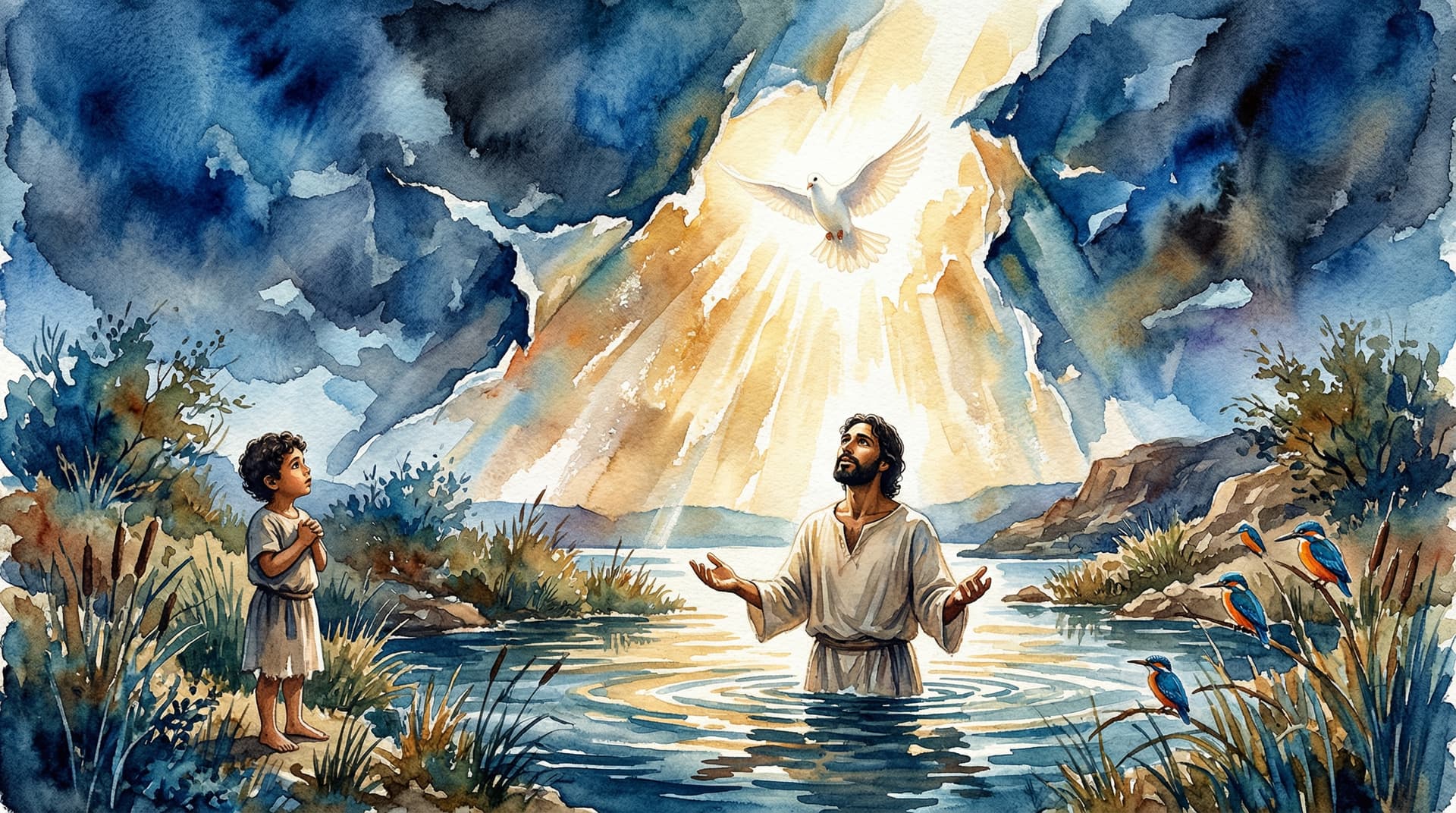
Seeing God
What does this passage reveal about who God actually is?
Movement 3: Seeing God
Passages: Matthew 3:13-17; Mark 1:9-11; Luke 3:21-22; John 1:29-34
"What does this passage show us about God's beauty, glory, or character that we wouldn't see without it?"
The Facet of Beauty: A God Who Steps Into Line With the Broken
The baptism of Jesus is the only moment in all of Scripture where the Father speaks, the Spirit descends, and the Son is visibly present -- all at the same time, in the same place. Every other revelation of God's character comes through one channel: a prophet's words, an angel's message, a burning bush. Here, all three persons of the Trinity are simultaneously active and visible. The fullness of who God is, on display at a river where sinners are confessing their failures.
That location is the revelation.
What Is Surprising About God Here
God Identifies With the Mess, Not the Clean
Jesus had no failures to confess. He had nothing to wash away. He did not need a fresh start. And he got in line anyway. Not at the front -- Luke says he came "after all the people had been submerged." He waited. He stood behind tax collectors and soldiers and ordinary people carrying the weight of their worst moments. And then he walked into the same water they had just muddied with their confessions.
This is not sympathy from a distance. This is solidarity. The clean one chose contamination. The righteous one chose the sinner's ritual. And when John protested -- "You don't belong here" -- Jesus essentially said, "This is exactly where I belong."
The surprise is not that God loves sinners. The surprise is that God's first public act -- before a single sermon, before a single miracle, before a single parable -- was to stand where sinners stand. His ministry did not begin with a demonstration of power. It began with an act of identification. He joined us before he taught us, healed us, or saved us.
God Announces Identity Before Performance
The Father's voice says, "This is my Son, the one I love -- I am completely delighted with him." Jesus has not yet done anything in public ministry. He has not healed anyone. He has not preached the Sermon on the Mount. He has not fed five thousand or walked on water or raised the dead. He has done nothing to earn the Father's delight.
And the Father is completely delighted with him.
This reveals something stunning about how God relates to his children. The delight comes first. The identity comes before the performance. The Father does not say, "Do great things, and then I'll call you my Son." He says, "You are my Son. I love you. I am delighted." And then the ministry flows from that settled identity.
This is the opposite of how the world works. The world says: perform, achieve, prove yourself, and then you will be accepted. The Father says: you are accepted, beloved, delighted in -- now go.
God Tears the Sky Open
Mark's violent word -- schizo, "torn apart" -- reveals a God who is not cautious about reaching us. The heavens had been closed. The prophetic voice had been silent. The barrier between God's realm and ours had seemed impenetrable. And God did not gently open a window. He ripped the ceiling off.
This is a God of holy impatience. Four hundred years of silence, and when the moment comes, he does not tiptoe into human experience. He tears through. The dove descending is gentle; the opening it descends through is violent. Tenderness arriving through a breach. The God who comes to us as a dove first had to rip open the thing separating us.
And here is what makes this even more striking: the sky is torn open while Jesus is standing in the dirty water. God does not tear the heavens open over the temple. Not over Jerusalem. Not over a throne room. Over a muddy river in the wilderness where confessed sinners have been washing. The most dramatic divine intervention in 400 years happens at the place of human failure, not the place of human achievement.
God Is Three Persons in Perfect Harmony
The baptism is the clearest snapshot of the Trinity in all of Scripture. The Son stands in the water. The Spirit descends like a dove. The Father speaks from heaven. Three distinct persons, three distinct actions, one unified moment of revelation.
What the crowd at the Jordan witnessed -- whether they understood it fully or not -- was the inner life of God made visible. The Father's delight in the Son. The Spirit's movement toward the Son. The Son's submission to the Father's plan. This is not a hierarchy of power. It is a dance of love. The Father loves the Son. The Spirit anoints the Son. The Son receives both and walks into the mission.
For kids, this matters because it means God is not lonely. God is not a solitary ruler issuing commands from a throne. God is a family -- Father, Son, and Spirit -- who have been loving each other for all eternity. And the baptism is the moment they invite us to see it.
What God's Emotions Look Like Here
Delight. The Father's voice does not sound reluctant, dutiful, or formal. "I am completely delighted" is the language of a parent who cannot contain their pride. Not pride in achievement -- Jesus has not accomplished anything yet. Pride in identity. Pride in who the Son is, not what the Son has done. This is a Father who looks at his Son and is overwhelmed with love.
Purposefulness. The Spirit's descent is not random. The Spirit comes down and remains -- this is anointing for a mission. The Spirit is equipping the Son for everything that is about to come. There is intention behind the tenderness. The dove is gentle, but the mission the dove empowers is a march toward a cross.
Holy impatience. The torn heavens say: I have waited long enough. I am done being distant. I am breaking through, and I am breaking through here -- at the river, in the mess, among the broken. The God who was silent for 400 years is done being silent. And his first word is not a command or a rebuke. It is "This is my Son, and I love him."
The Worship Test
After studying this passage, does it move you that God's first public act in the New Testament was to join sinners in a river? That the Father's first recorded words about Jesus are pure delight -- before any performance, any miracle, any proof? That the same God who seemed silent for centuries tore the sky open over a muddy baptism site?
The specific facet of beauty on display: God comes to where we are, not where we should be. He does not wait for us to clean up. He does not meet us in the temple after we have earned our way in. He walks into the river where the confessed failures are standing, and he says: I am with you. I have always been with you. And now I am going to show you what my love looks like when it puts on skin.
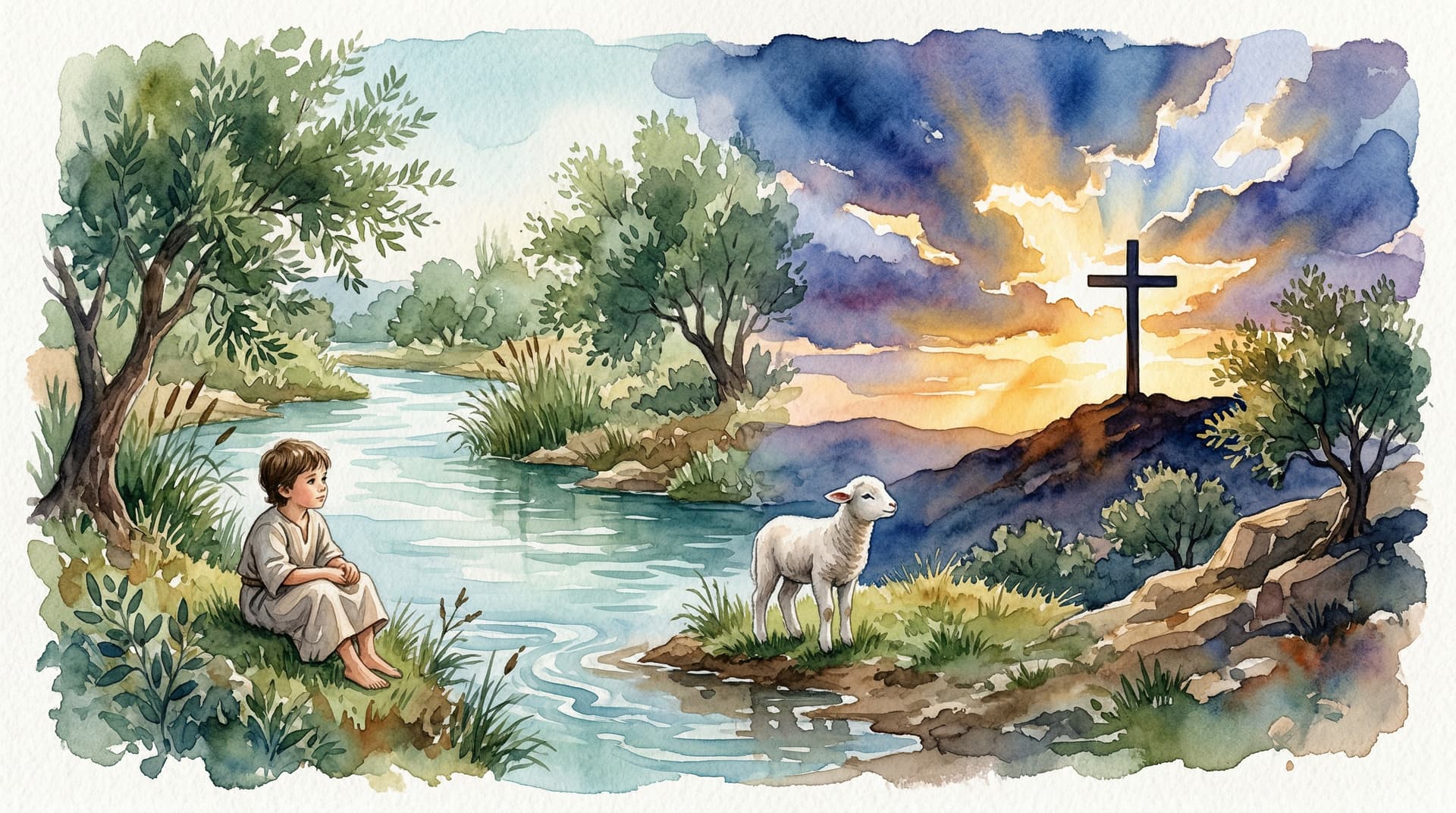
The beauty is this: the most glorious revelation of God's identity -- Father, Son, and Spirit in perfect unity -- happened at the place of human failure. God did not unveil himself in a palace or a cathedral. He unveiled himself in a sinner's river. That is who he is. That is where he goes. And that changes everything about where we are allowed to meet him.
Gospel Connection
How does this passage connect to the gospel?
Movement 4: The Specific Gospel Connection
Passages: Matthew 3:13-17; Mark 1:9-11; Luke 3:21-22; John 1:29-34
"How does Jesus fulfill, complete, or embody what this passage reveals -- SPECIFICALLY, not generically?"
The Rule
Every connection below must be specific to what the baptism reveals. If you could swap in a different passage and make the same point, it is too generic.
Jesus Enters the Water as a Preview of Entering the Grave
The baptism is a rehearsal of the cross. Going under the water and coming back up is a picture of death and resurrection -- and the New Testament explicitly makes this connection (Romans 6:3-4). But what makes the baptism unique is the substitutionary element: Jesus enters a ritual designed for sinners. He takes a sinner's place in a sinner's river.
This is not general kindness. This is specific identification. The Jordan is the first time Jesus publicly does what the cross will do permanently -- stands where the guilty stand, not because he has to, but because "this is how we fulfill everything that is right." The logic of the gospel is on display before anyone understands it: the innocent one enters the place of judgment willingly, and something happens -- the heavens open, the Spirit descends, the Father speaks. Substitution produces revelation.
At the cross, the same pattern completes itself. The innocent one enters the place of judgment willingly -- and something happens: the temple curtain tears, the centurion confesses, the buried dead rise. The baptism is the dress rehearsal. The cross is opening night.
Specific connection: Jesus going under the Jordan water foreshadows Jesus going into the grave. Both are voluntary. Both involve the sinless one entering the place of death. Both produce an eruption of God's presence -- torn heavens at the river, torn curtain at the cross. The baptism does not just point to the cross generically. It previews the specific mechanism of the cross: the righteous one taking the sinner's place.
The Torn Heavens Are the Same Tearing as the Torn Curtain
Mark's word for the heavens being "torn apart" (schizo) at the baptism is the same word he uses for the temple curtain being "torn in two" at the crucifixion (15:38). Mark only uses this word twice in his entire Gospel. That is not accidental. It is an architectural bookend.
At the baptism, the barrier between heaven and earth is torn from above -- God reaches down. At the cross, the barrier between God and humanity (the curtain separating the Holy of Holies from the rest of the temple) is torn from top to bottom -- God opens access. The first tearing says: God is coming to you. The second tearing says: you can now come to God. Together they form the complete gospel: God descends to where we are (incarnation, baptism, cross) so that we can ascend to where he is (access, relationship, new creation).
Specific connection: The tearing at the Jordan is not a separate event from the tearing at Calvary. They are one continuous ripping. God started opening the barrier at the baptism and finished it at the cross. The same violence that ripped the sky open ripped the curtain open. Both were acts of a God who will not tolerate anything standing between himself and his people.
"This Is My Son" Echoes the Binding of Isaac
The Father's declaration -- "This is my Son, the one I love" -- echoes Genesis 22, where God tells Abraham to take "your son, your only son, the one you love -- Isaac" and offer him as a sacrifice (Genesis 22:2). The verbal parallels are too precise to be coincidental. Beloved son. One of a kind. Headed toward sacrifice.
At Mount Moriah, God stopped Abraham's hand and provided a ram instead. At the Jordan, God speaks over his own Son knowing that no substitution will be offered this time. The Father is identifying Jesus as the son who will actually go through with it -- the sacrifice that Isaac only foreshadowed.
The Father's delight is not despite what is coming. It is because of it. The Father is proud of the Son who will walk the road that leads from the Jordan to the cross. "I am completely delighted with him" is the Father's response to a Son who has just voluntarily entered the sinner's place. And the Father knows: this is only the beginning. The water is a preview. The nails are coming. And the Son will not flinch.
Specific connection: "This is my Son, the one I love" is not just a statement of identity. It is the first line of a story that ends at Calvary. God is presenting his Isaac -- but this time, there will be no ram in the thicket. This time, the beloved Son goes all the way. The Father's delight at the baptism is the same Father's heart that will darken the sky at the cross. Same love. Same Son. Same plan.
The Lamb of God Takes Away What the River Cannot
John the Baptist's declaration -- "Look -- the Lamb of God, the one who takes away the world's failure!" (John 1:29, NGET) -- reframes the entire baptism. The water could symbolize washing, but it could not actually remove failure. Every person who came out of the Jordan was still carrying the weight of what they had done. The river was a symbol. The Lamb is the reality.
Jesus enters the water not to be cleansed but to begin the journey toward becoming the sacrifice that actually cleanses. The Passover lamb's blood on the doorpost caused death to pass over. The daily temple lambs pointed forward to a permanent solution. John looks at Jesus and sees: the permanent solution has arrived. The lambs can stop. The river was pointing to this person.
The genius of John's Gospel is placing this declaration right next to the baptism testimony. The water is temporary. The Lamb is permanent. Every ritual washing in Israel's history -- every sacrifice, every priest's purification, every Day of Atonement -- was a finger pointing at the man standing in the Jordan. The baptism is the last act of the old system and the first act of the new one, and both are happening in the same person at the same time.
Specific connection: The river washes symbolically. The Lamb removes actually. Jesus' baptism is the transition point between the old covenant (where symbols pointed forward) and the new covenant (where the reality has arrived). He enters the water of the old system and comes out as the Lamb of the new one. The baptism is the hinge.
The Specific Mending
The brokenness this passage reveals: We believe we must clean ourselves up before God will accept us. We think we need to be good enough, sorted enough, impressive enough before we can approach God. We stand on the riverbank thinking, "I'll come to God once I've fixed my problems." We treat God's love as something earned by performance.
The specific mending: Jesus did not wait on the shore for sinners to get clean and come to him. He got into the dirty water with them. He joined the line of the broken, the ashamed, the confessed failures -- and the Father's response was not embarrassment but explosive delight. If the Father tore the heavens open and declared his love while Jesus stood in a sinner's river, then there is no place too messy for God to meet you. You do not need to clean up first. God comes to the river, not the palace.
The new earth: The baptism points forward to Revelation 22 -- "a river of the water of life, bright as crystal, flowing from the throne of God and of the Lamb" (NGET). The Jordan was muddy, in the wilderness, and temporary. The final river flows from God's own throne, through the middle of the city, past trees whose leaves "heal the nations." The baptism river was where God met us in our mess. The Revelation river is where the mess is finally, permanently gone. No more failure to confess. No more dirt to wash. Just clear water, flowing from the Lamb who once stood in a muddier river to make this one possible.
The Anti-Moralism Checkpoint
-
"Be humble like Jesus -- serve others." Misses the point. Jesus' humility at the baptism is not a character trait to imitate. It is the mechanism of salvation -- the righteous one taking the sinner's place. The lesson is not "be humble." The lesson is "the king joined you in the water."
-
"Be obedient to God like Jesus was." Flattens the baptism into a generic obedience lesson. Jesus was not just obeying a rule. He was inaugurating a rescue mission by stepping into the sinner's position. His "obedience" here is the same obedience that leads to the cross -- it is substitution, not compliance.
-
"And this all points to Jesus who died for our sins." Too generic. This passage specifically reveals that the rescue began not with the cross but with a river -- the moment the sinless one stepped into the sinner's place. The cross finished what the baptism started. The gospel connection must trace that specific arc, not leap to a general statement.
Why Kids Care
How does this truth intersect with their actual lives?
Movement 5: Why Should a 5-10 Year Old Care?
Passages: Matthew 3:13-17; Mark 1:9-11; Luke 3:21-22; John 1:29-34
"What does this mean for their actual lives of play, fun, friendship, and family?"
This movement is a brainstorm -- a menu of angles, illustrations, and landing points for the teacher to pray through. The Spirit knows what your specific kids need. Pick what resonates, adapt freely, let the rest go.
The Transition: Connecting the Story
This lesson follows "Preparing the Way" -- the birth of John the Baptist and the breaking of 400 years of silence. Frame the transition: "Last time, we met baby John -- the one born to point. Now he's grown up. He's out in the wilderness, and everyone is coming to him. People are confessing the ways they've messed up, and John is submerging them in the river as a sign of starting over. And then one day, someone shows up in line who does not belong there."
The Lesson: The King Who Got in Line
The Arc
Three truths the four Gospel writers reveal together:
1. "Jesus stood where the mess-up people stood -- on purpose." He had no failures to confess. He had nothing to wash away. John tried to stop him. And Jesus said, "This is exactly where I need to be." The first thing the Son of God did in public was stand in line with people who had done wrong. Not to judge them. To join them.
2. "God tore the sky open and said, 'That's my Son -- I love him.'" The heavens had been closed for 400 years. And God ripped them open -- not over the temple, not over a palace, but over a muddy river in the middle of nowhere. And his first words were not a command. They were: "I love him. I am completely delighted."
3. "Everything that happened next flowed from that moment." Every healing, every parable, every miracle, every step toward the cross -- it all started here, in the river. The baptism was Jesus saying: I am with you. The Father was saying: I am sending my best. The Spirit was saying: I am empowering the rescue. The whole mission launched from a sinner's river.
The Role Play
Characters: Narrator (teacher), John the Baptist, Jesus, The Crowd (most of the kids), The Voice of God (teacher or hidden speaker).
Scene 1 -- The Line. Set up a "river" area (blue fabric, tape on the floor, or just a designated space). John the Baptist stands at the river. Teacher narrates: "People were coming from everywhere. They were telling John the things they'd done wrong -- lies they'd told, people they'd hurt, promises they'd broken. And John would dip them under the water as a sign of starting fresh." Have the crowd kids line up. Each one whispers something to John (can be silly or real -- "I was mean to my sister," "I cheated at a game"). John dips them (a gentle hand on the shoulder and they duck down and pop back up).
Scene 2 -- The Stranger in Line. After several kids have gone through, Jesus gets in line. At the back. Teacher narrates: "And then someone showed up who was different from everyone else. He hadn't done anything wrong. Not once. Not ever. But he got in line anyway. Right behind the tax collectors and the soldiers and the people who had come to confess."
Scene 3 -- John's Protest. Jesus reaches the front of the line. John stops. "Wait -- I should be coming to YOU. You don't belong here. YOU should be submerging ME." Pause. Let the kids feel the awkwardness. Then Jesus: "Let it happen. This is how things are supposed to work." John agrees. Jesus goes under the water.
Scene 4 -- The Sky Breaks Open. The moment Jesus comes up from the water, EVERYTHING CHANGES. Teacher narrates dramatically: "The sky split open. Not gently -- TORN apart, like someone ripping a piece of fabric. And the Spirit of God came down like a dove and landed on Jesus. And then a voice -- louder and more real than anything anyone had ever heard -- said:"
The Voice (from the back of the room, or the teacher in a different tone): "This is my Son, the one I love. I am completely delighted with him."
Long pause. Let it land.
Scene 5 -- The Debrief. Sit everyone down. Ask:
- "Why do you think Jesus got in line with people who had messed up?"
- "God said 'I am completely delighted' -- but Jesus hadn't done any miracles yet. He hadn't healed anyone or taught anything. Why was God already delighted?"
- "What do you think it means that God tore the sky open over a river in the middle of nowhere, not over the fancy temple?"
Why Should They Care?
Angle 1: You Don't Have to Clean Up First
The kid's world: Feeling like you need to be good before you can pray. Being embarrassed to talk to God after you did something wrong. Thinking God is mad at you when you mess up.
The God-first landing: Jesus did not stand on the shore and tell the sinners to clean up before coming to him. He got INTO the river WITH them. He stood right next to people who had lied, cheated, and hurt others. If Jesus was willing to stand in the dirty water, then there is no mess too big for God to meet you in. You do not have to fix yourself before you come to God. He comes to where you are -- even if where you are feels like the worst place.
Landing statement: "You never have to clean yourself up before coming to God. Jesus got into the river with people who had messed up. He will meet you in your mess. That's where he goes first."
Angle 2: God Is Delighted With You Before You Perform
The kid's world: Trying to earn approval. Working hard to make a parent proud. Feeling like love depends on how well you do. Getting good grades so people will say you're smart. Winning the game so the coach will notice you.
The God-first landing: The Father said "I am completely delighted with him" BEFORE Jesus did a single miracle. Before he healed anyone. Before he taught a single lesson. Before he fed five thousand people or walked on water. God's delight came first. The doing came after. Jesus did not earn the Father's love by performing. He performed FROM the Father's love.
Landing statement: "God does not love you because of what you do. He loves you because of who you are -- his child. You do not have to earn it. You already have it."
Angle 3: The Kid Who Sits With the Lonely Kid
The kid's world: The lunchroom. The playground. The kid sitting alone. The choice to either stay with the popular group or go sit with the one everyone avoids.
The God-first landing: Jesus was the most important person at that river. He could have stood apart. He could have observed from a distance. He could have set up a separate, clean-water station for himself. Instead, he walked into the same muddy water as everyone else. He chose to be WITH people, not above them. That is what God's love looks like -- not "I'll love you from over here" but "I'm coming to where you are."
Landing statement: "Jesus did not love people from far away. He walked right up to them -- the messy ones, the embarrassed ones, the ones everyone else avoided -- and stood next to them. That's what real love does. It shows up."
Angle 4: The Sky Ripped Open
The kid's world: Feeling like God is far away. Praying and wondering if anyone hears. Looking up and seeing just a ceiling.
The God-first landing: For 400 years, the sky seemed closed. No voice from God. No angels. No visions. People prayed and heard nothing. And then, at the Jordan River, God did not gently open a window. He RIPPED the sky apart. He could not wait any longer. He tore through the barrier because he wanted his Son -- and his people -- to know: I am HERE. I never left. And nothing will keep me from you.
Landing statement: "When it feels like God is far away, remember: he once tore the sky open because he could not stand being distant from you. A God who rips through the sky is not a God who forgets you."
Object Lesson Option: The Line
Setup: Have a teacher or adult volunteer stand at the front. Announce: "This line is for people who have messed up this week. If you've been unkind, if you've disobeyed, if you've said something mean, if you've made a mistake -- this line is for you."
Let a few brave kids get in line (some will, especially if you make it safe and light). Then the teacher says: "Okay, now where do I stand?" The kids will expect the teacher to stand at the front, facing them. Instead, the teacher walks to the BACK of the line and stands there.
Debrief: "That's what Jesus did. He did not stand at the front of the line judging everyone. He got in the back of the line. With the mess-up people. Because that's where he wanted to be. Not above us. With us."
Follow-Up Questions
- "Have you ever felt like you needed to be good enough before God would like you? What does this story say about that?"
- "Why do you think God was delighted with Jesus before he had done anything amazing?"
- "If Jesus got in line with mess-up people, what does that tell you about where he wants to be when YOU mess up?"
- "What do you think it felt like to hear a voice from heaven?"
- "John the Baptist called Jesus 'the Lamb of God.' What do you think that means?" (Connect to Passover if they have been taught it.)
- "If God tore the sky open once, do you think he is still that eager to be close to you?"
Age Notes
Younger (5-6)
- The role play is the lesson. Keep it physical. The line, the river, the protest, the voice from above -- that sequence carries the theology.
- The "line" object lesson is perfect for this age. Physical, immediate, surprising.
- Landing: "Jesus stood in line with the mess-up people because he loves them. And he loves you too -- even on your worst day."
Older (8-10)
- Push into the "delight before performance" angle. This age group is already feeling the pressure to earn approval -- from parents, teachers, coaches, peers. The Father's words over Jesus before any public ministry is a direct counter to their daily experience.
- Ask: "What's the difference between someone who loves you because of what you do and someone who loves you because of who you are? Which one would you rather have?" Let them think. Then: "God's love for Jesus -- and for you -- is the second kind."
- Connect the torn heavens to the torn curtain (if they are ready): "The same God who ripped the sky open at the baptism ripped the temple curtain open at the cross. He keeps tearing down everything that stands between him and us."
What to Skip
- Detailed theology of the Trinity. One sentence: "At the river, we see God in three persons -- the Father speaking, the Spirit descending, and the Son standing in the water -- all loving each other and all loving us." That is enough.
- Why Jesus "needed" to be baptized. The theological debate about impeccability and identification is for adults. For kids: "Jesus didn't need to be washed. He chose to stand with people who did. That's the point."
- The temptation in the wilderness. Mention it as a preview -- "Right after this, the Spirit leads Jesus into the desert for the hardest test of his life" -- but save it for next time.
Landing Statements
Format: God is/does ___. And because of that, you ___.
- "God meets you in your mess, not after you've cleaned it up. You never have to earn your way to him."
- "God is delighted with you before you've done anything impressive. You do not have to perform to be loved."
- "God ripped the sky open to get to you. Nothing -- not your failures, not your shame, not your worst day -- can keep him away."
- "Jesus stood in line with people who had messed up because that's where love goes. When you feel like you don't belong, remember: Jesus chose to stand right where you are."
- "The Father's first public words about Jesus were 'I love him.' That's what God sounds like. Not disappointment. Not demands. Love first."
- "Jesus did not start his mission by showing off his power. He started by showing up -- in the water, with the broken people, getting low. That is what God's power looks like."
Teacher Quick Reference
Four Gospel Perspectives -- Quick Summary for Teaching
| Gospel | Emphasis | Key Detail | One-Liner for Kids |
|---|---|---|---|
| Matthew | Righteous substitution | Jesus insists: "This is how we make things right" | "Jesus got in line with the mess-up people on purpose." |
| Mark | Torn heavens | Sky "ripped apart" -- same word as temple curtain | "God tore the sky open to get to us." |
| Luke | Prayer and relationship | Jesus was praying when the heavens opened | "God spoke because his Son was talking to him." |
| John | The Lamb revealed | "Look -- the Lamb of God who takes away the world's failure" | "John looked at Jesus and saw someone who would give everything." |
Themes Already in Kids' World
- Feeling like you have to earn love. Report cards, game performance, chores-for-approval.
- Being embarrassed about messing up. Not wanting to tell a parent what happened. Hiding a mistake.
- Someone choosing to be with you when they didn't have to. The popular kid who sits with you. The friend who stays when you're sad.
- A voice that says "I love you" when you don't feel lovable. After a bad day. After doing something wrong.
- Getting in line. Waiting for lunch. Waiting for your turn. Who stands where, and why it matters when someone important stands with you.
Framing Sentences
- The line: "Everyone at the river was there because they had messed up. And then the one person who had never messed up got in line behind them."
- John's protest: "Even John the Baptist said, 'You don't belong here.' And Jesus said, 'This is exactly where I belong.'"
- The torn sky: "For 400 years, heaven was quiet. And then God ripped it open like wrapping paper on Christmas morning. He couldn't wait any longer."
- The voice: "Before Jesus healed anyone, before he taught anything, before he did a single miracle -- his Father said, 'I love him. I am completely delighted.' The love came first."
- The dove: "The Spirit of God came down gently -- like a dove landing on your shoulder. Soft. Quiet. Personal. Right on Jesus. And it stayed."
Kid Questions
"Why did Jesus need to be baptized if he never did anything wrong?" "He didn't need it for himself. He did it for us. It was his way of saying, 'I am with you. Whatever you're going through, I'm not standing on the sideline. I'm in the water with you.'"
"Did everyone see the dove and hear the voice?" "The Gospels describe it a little differently. But what matters is: it happened. God showed up. The sky opened. The Spirit came down. The Father spoke. The most important moment at that river wasn't the water -- it was the voice."
"What does 'Lamb of God' mean?" "In the Old Testament, when people messed up, they would bring a lamb to the temple as a way of saying 'I'm sorry' to God. The lamb took the punishment instead of the person. John looked at Jesus and realized: he is the final lamb. After him, no more lambs are needed. He is going to take care of everything -- forever."
"Does God say 'I'm delighted with you' to US, too?" "Yes. When you trust Jesus, you become part of God's family. And the same love the Father has for Jesus, he has for you. Jesus actually said that -- John 17:23: 'You have loved them just as you have loved me.' The Father's delight is not just for Jesus. It's for everyone who is in Jesus."
"What happens next?" "Right after this, the Spirit leads Jesus into the wilderness -- alone, hungry, for forty days. And there, the enemy tries to make Jesus doubt the exact words the Father just said: 'You ARE God's Son, aren't you? Prove it.' That's the next part of the story."
The Bottom Line
This lesson gives children a God who comes to where they are -- not where they should be. The temptation will be moral lessons: "follow God like Jesus did" or "obey even when it's hard." Resist that. Jesus' baptism is not a model of obedience for us to copy. It is the revelation of a God who gets in line with sinners, stands in dirty water, and hears his Father say "I love you" -- all so that we would know: there is no place too messy for God to meet us, no failure too big for God to stand beside us, and no voice louder than the one that says "You are mine, and I am delighted."
The biggest gift you can give the kids today is the Father's voice. They live in a world that says "perform and then I'll love you." The baptism says the opposite: "I love you. Now watch what that love can do." Let the Father's delight be the thing that echoes in their ears when they leave.