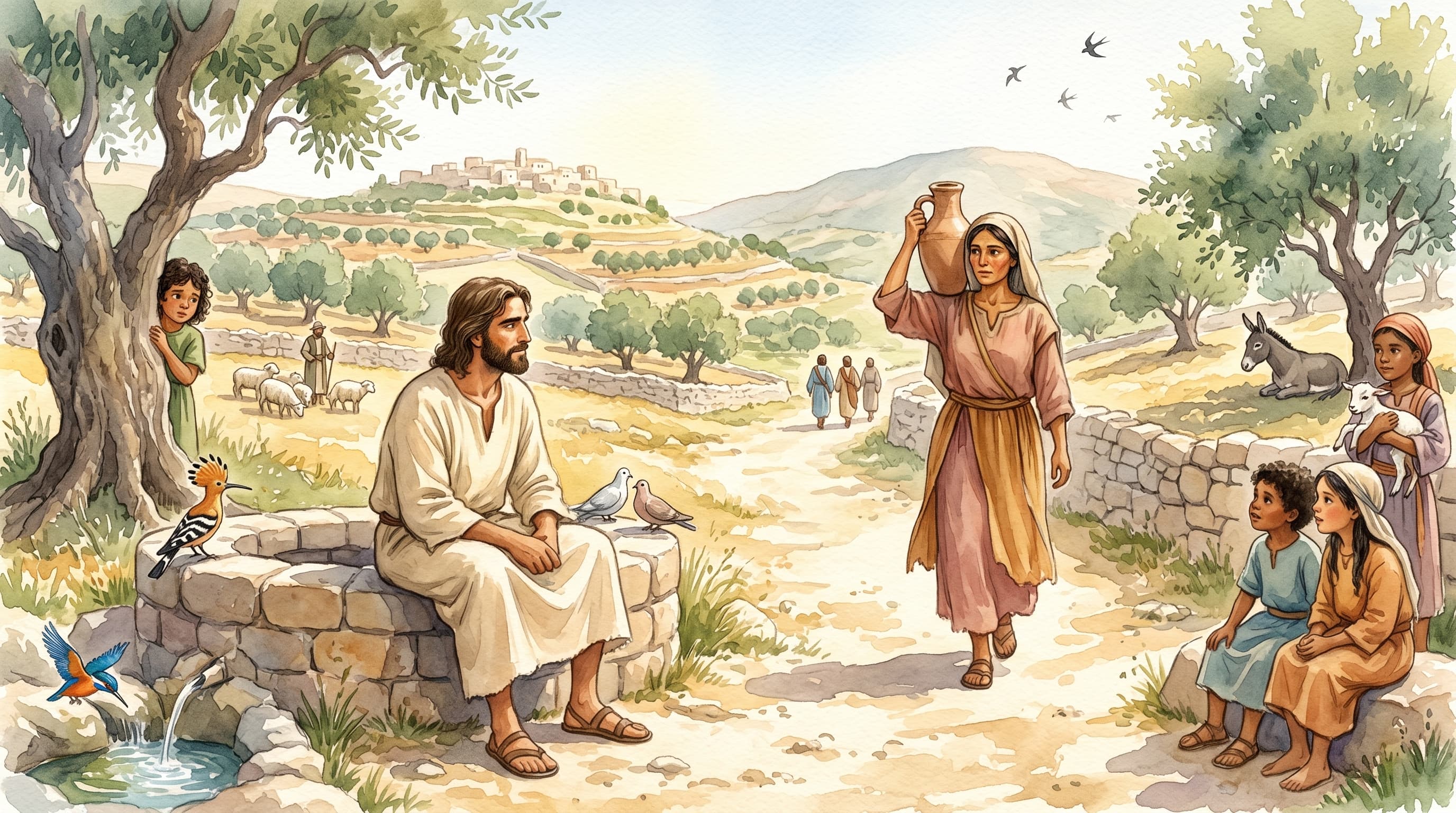
Jesus and the Samaritan Woman
A lesson preparation guide for teaching 5–10 year olds
The Original Audience
What did this mean to the people who first heard it?
Movement 1: The Original Audience
Passage: John 4:1-42
"What did this mean to the people who first heard it?"
The Detour
Most Jews traveling from Judea to Galilee crossed the Jordan twice to avoid Samaria altogether. John writes that Jesus "had to pass through" it (4:4, NGET). The Greek dei — "must, has to" — is the same word the Gospels use for the necessity of the cross. Geographically there was no necessity. Theologically there was. He took the route the religious avoided.
Why the Two Sides Hated Each Other
The split was eight centuries old. When Assyria deported Israel's northern tribes in 722 BC, foreigners were resettled in the land and intermarried with the remnant. The Samaritans were the result — close cousins, but rejected by the Judean Jews as half-breeds and heretics. The Samaritans built their own temple on Mount Gerizim. The Jews destroyed it in 128 BC. By Jesus' day, Jews and Samaritans would not share dishes, drinks, or roads. John's parenthetical at 4:9 — "Jews do not share things in common with Samaritans" — is the casual note of someone explaining a cold war.
Noon, Alone, with a Jar
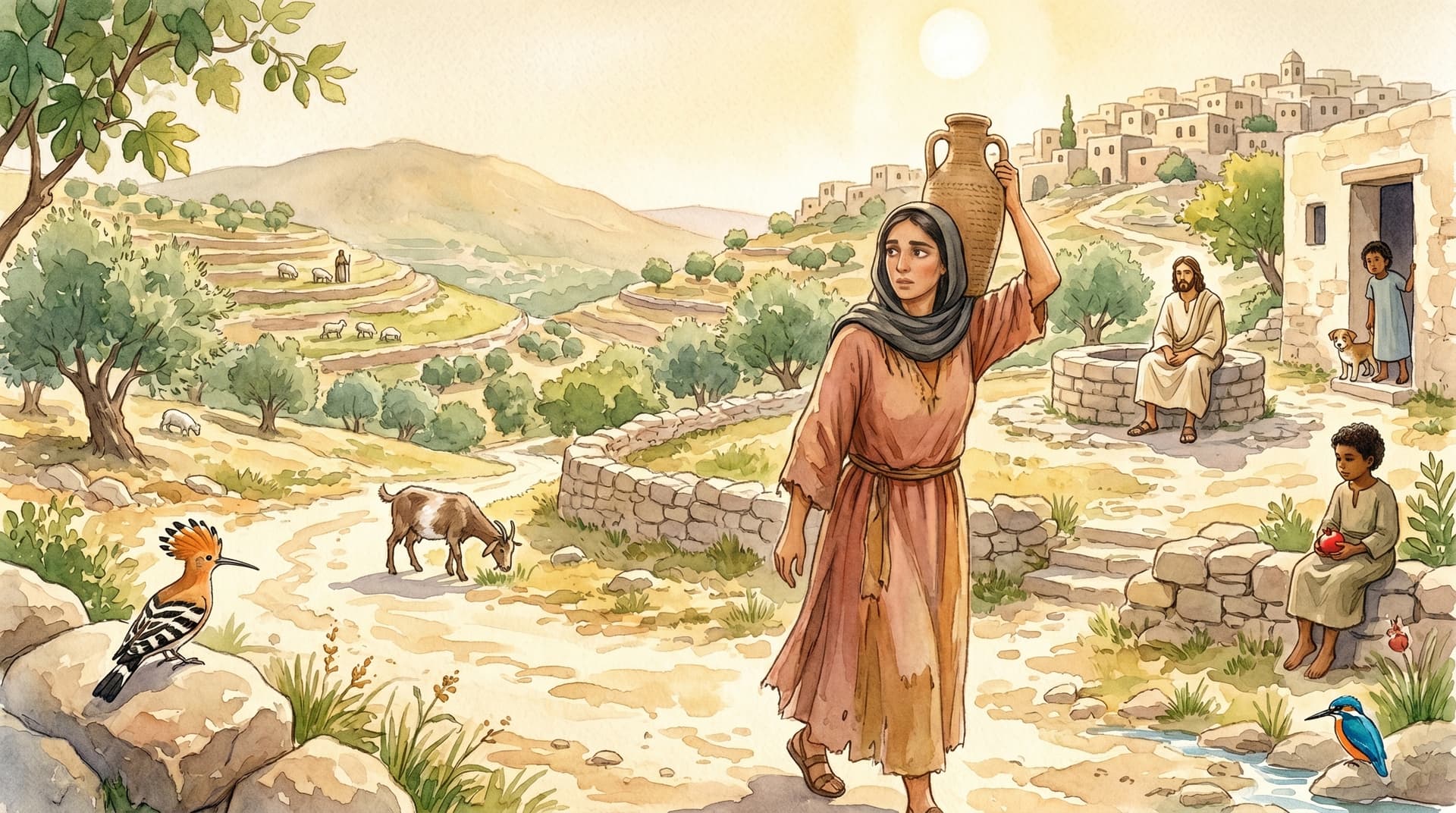
Women came to the well at dawn or dusk, in groups, when it was cool and social. This one came at noon, by herself. She was a known story in her town — five marriages behind her, a current arrangement that was not marriage. In an honor-shame culture, that meant she organized her day around when the other women were not at the well.
A Jewish man would not speak to a woman alone in public. A rabbi especially. A Jewish man would not drink from a Samaritan vessel. Jesus asks her for one. The first miracle in this scene is the request.
"Give Me a Drink"
He is also actually thirsty. John says it plainly: tired from the journey, sitting because his body needed to. He comes as the one who needs the cup before he is the one with the cup. The original audience — anyone listening to the Gospel read aloud — would have caught the strangeness immediately. Their Messiah, the Lord of glory, asking a Samaritan woman with a painful past for a sip of water from her own jar.
What the Original Audience Heard
A Jewish rabbi crossing every boundary their culture had built — ethnic, religious, gender, moral — without flinching. And the boundary-crosser turns out to be the one offering the only water that finally fills.
The Author’s Intent
What is John (the Gospel writer) doing with this scene?
Movement 2: The Author's Intent
Passage: John 4:1-42
"What is John (the Gospel writer) doing with this scene?"
The Pair with Nicodemus
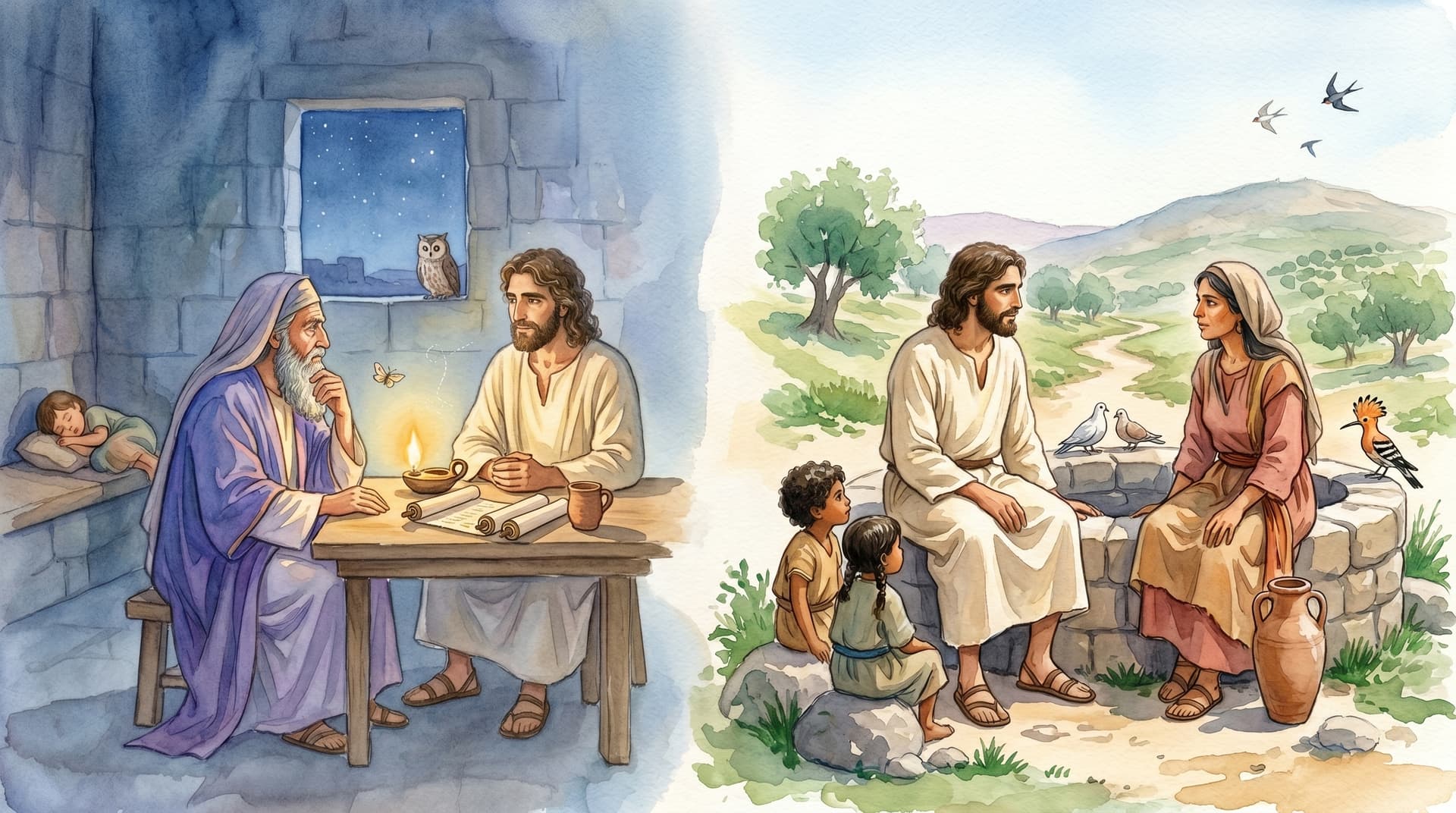
John has just told us about Nicodemus (chapter 3) — a Pharisee who comes to Jesus by night and walks away unsure. He puts the Samaritan woman immediately after. The contrasts are point for point:
- Pharisee / Samaritan
- Man / woman
- Named / unnamed
- Night / noon
- Insider / outsider
- Confident on arrival, hesitant at departure / hidden on arrival, preaching at departure
The writer is teaching his readers a pattern: the people you expect to recognize Jesus often miss him; the people you have written off often see him first.
The Well Is a Wedding Set
Three of Israel's most important marriages started at a well. Isaac's servant met Rebekah at one (Genesis 24). Jacob met Rachel at one (Genesis 29). Moses met Zipporah at one (Exodus 2). Any Jewish reader hearing "Jesus sat down by the well" felt the genre kick in before the dialogue started. A man arrives at a well, asks for water, meets a woman — this is a betrothal scene.
The Baptist had just named Jesus the bridegroom one chapter earlier (3:29). John now stages the bridegroom at a betrothal well, asking water of a Samaritan woman with a complicated past. The bride is not who anyone would have arranged.
The Titles Climb
Watch what she calls him as the conversation moves:
- "A Jew" (4:9)
- "Sir" (4:11)
- "A prophet" (4:19)
- The Messiah, implicit at 4:25-26
- By her town, "the Savior of the world" (4:42)
Each title is wider than the one before it. John is showing his reader what real seeing looks like — not a single flash of recognition but a slow climb, each layer giving more.
"I, the One Speaking to You, Am He"
Jesus' answer at 4:26 is the first direct egō eimi — "I am" — in this Gospel. He does not say it to the temple authorities or to a crowd in Jerusalem. He says it to a Samaritan woman at noon. John is making a point about where Jesus first declares himself.
"Savior of the World"
The town's confession at 4:42 — sōtēr tou kosmou — is the broadest title Jesus receives in any Gospel up to this point. Not "savior of Israel," not "savior of us," but of the world. And it is a Samaritan village that names him this. The writer is planting his global thesis early, through the mouths of people his own people had given up on.
The Useful Test
John is showing that the bridegroom announced in chapter 3 has gone to a well to ask for water from the kind of bride no one would have arranged for him. And she is the first person in this Gospel to leave her village and bring others to him.
Seeing God
What does this passage reveal about who God actually is?
Movement 3: Seeing God
Passage: John 4:1-42
"What does this passage show us about God's beauty, glory, or character that we wouldn't see without it?"
The Facet of Beauty: A God Who Knows Everything and Stays
Most relationships move in the opposite direction. The more someone learns about you, the more carefully they edit before they speak. Closeness narrows. Truth pushes people apart.
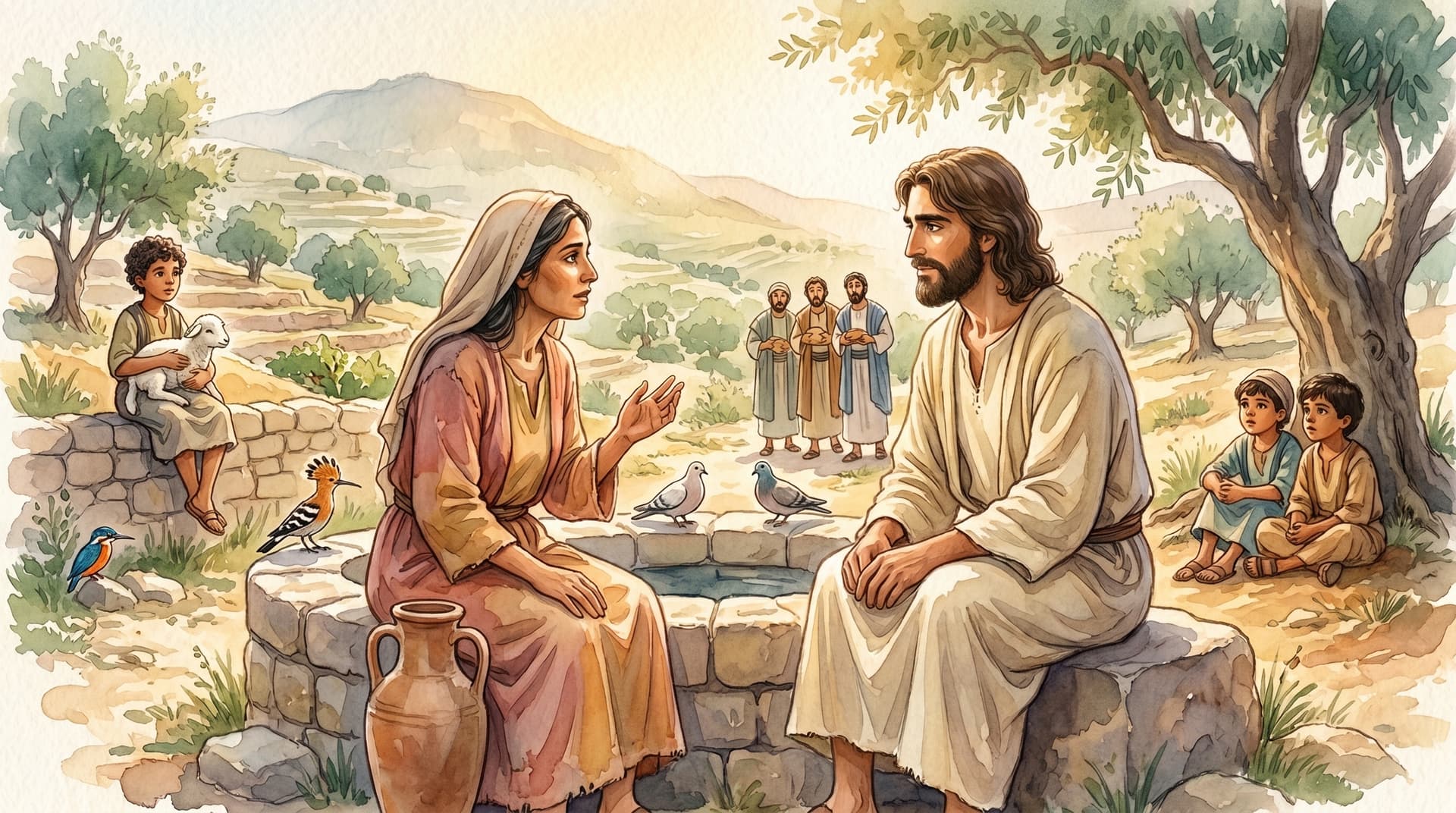
This God moves the other way. He starts by saying, "Go call your husband." When she dodges, he names the whole story — five marriages, the current arrangement, every line she has organized her day to avoid being seen for. And then he keeps talking. He does not pivot to rebuke. He does not retract his offer of living water. He hands her the most direct self-revelation in the Gospel so far. Knowing more makes him give more.
What Is Surprising About God Here
He Came Thirsty
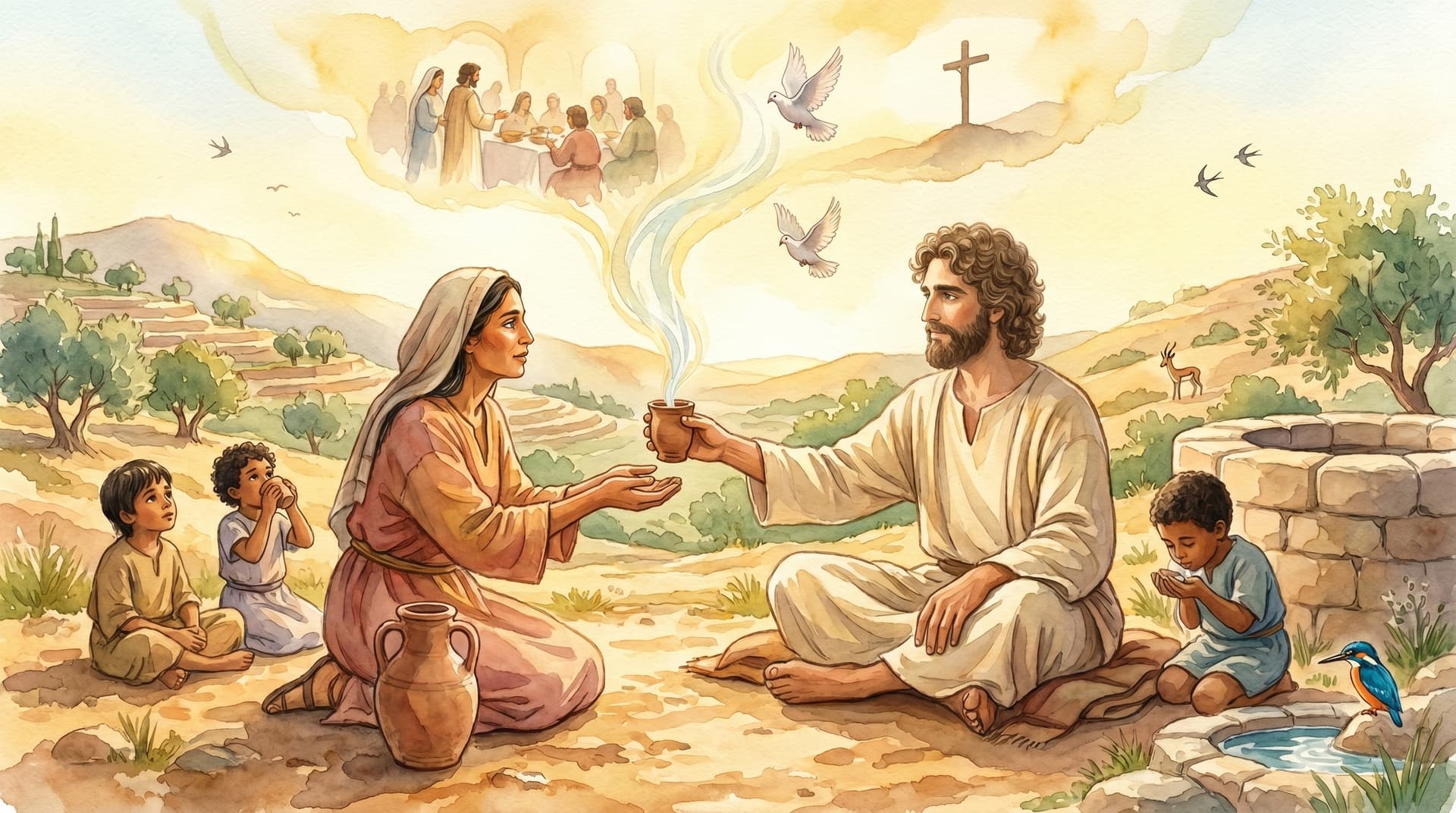
This is the only scene in John where Jesus is described as tired. He sits because his body has run out. He asks first — give me a drink — before he offers anything. The God of the universe approaches a Samaritan woman as a man with an empty cup. He receives from her hand before he fills hers.
He Takes Worship Off the Map
She tries to bait him into the old fight: which mountain, ours or yours? He refuses the question and answers a bigger one. The hour is coming when neither mountain matters, because God is spirit, and what he wants is worshipers in spirit and truth (4:23-24). He is not relocating worship from one address to another. He is taking it off the map. Access to the Father is no longer a place. It is a person standing at a well in Samaria.
He Sends the One the Town Avoided
She had been the woman the other women would not meet at the well. By sundown she is the one running back to that same town saying, come, see a man who told me everything I ever did (4:29). The first missionary in this Gospel is a Samaritan with five husbands. No training. No commissioning ceremony. She just leaves her water jar and starts talking. The writer wants the reader to notice the jar — she came for water and found something that took the water's place.
His Categories Are Wider Than His Followers'
The disciples are still working in their own people's categories. The Samaritan town breaks the categories open. Their confession — we know that this man really is the Savior of the world (4:42) — is wider than anything Jesus' own followers have said yet. God's reach is being announced through the people his own people had given up on.
What God's Emotions Look Like Here
Unhurried interest. He spends the longest recorded conversation in any Gospel on one woman whose name we never learn. Nothing in his manner is rushed.
Pleasure at the harvest. When the disciples bring him food, he says he has had something to eat they don't know about (4:32). His satisfaction is one woman walking back into town. That fed him.
Wide-angle joy. Two days in a Samaritan village (4:40-43). He stays. The disciples must have hated it. He didn't.
The Worship Test
The specific facet on display: God knows the part of you that you organize your life around hiding, and that knowledge is what draws him closer, not what pushes him away. Every other audience leaves when they find out. He arrived already knowing, and stayed.
A woman avoided the cool of the morning so no one would see her. By the time the sun was setting, she was the loudest voice in town. Not because something about her had been fixed. Because someone had known her whole story and asked her for water anyway.
Gospel Connection
How does this passage connect to the gospel?
Movement 4: The Specific Gospel Connection
Passage: John 4:1-42
"How does Jesus fulfill, complete, or embody what this passage reveals -- SPECIFICALLY, not generically?"
The Rule
The connection has to be in the passage's own grain. Three threads here only Jesus could close: the betrothal scene at the well, the living water that finally fills what wells were invented to fill, and the worship taken off the map.
Jesus Is the Bridegroom Who Came Tired to the Well
The Baptist called him the bridegroom in chapter 3. Chapter 4 stages it. He arrives at a betrothal well — Isaac's pattern, Jacob's pattern, Moses' pattern — but he comes empty-handed. No servant with gold. No flock of sheep. Just sandals dusty from a road most Jews would not walk. The bridegroom of the universe is the only one in the type-scene who arrives needing the water.
That is the gospel before the dialogue starts. He came down on purpose. He took the route the religious avoided. He sat tired because the journey toward her cost him something. The Baptist said he must increase. John 4 shows you the road he had to decrease down to get here.
Specific connection: the bridegroom Jesus announced in chapter 3 is the bridegroom who shows up at the well in chapter 4 — and the bride is the kind no Jewish father would have arranged. He is choosing her.
Living Water Is Spirit, and It Doesn't Run Out
Three chapters later, John explains himself: by this he meant the Spirit (7:39). The well at Sychar was deep, beloved, ancient — and still left people thirsty by the next afternoon. Wells like that are the shape of every fix we run to: real water, real relief, never the last word. Jesus offers something that becomes a spring of water welling up inside her (4:14). Not a refill. A source.
The cross is what made the spring possible. He could not pour out the Spirit while he was still containing it. He had to be lifted up, die, rise, ascend, and then send (John 7:39, 16:7). The living water she received in two minutes of conversation took the whole gospel to deliver.
Specific connection: she came to a well that needed her jar; she left with a spring that needed nothing. Jesus paid with his own body for the well that finally fills.
Worship Comes Off the Map at the Cross
She frames the religious world as two mountains. Jesus tells her both are about to be obsolete. The temple veil tears in Matthew, Mark, and Luke — but John has been pointing at this moment since chapter 2. The body of Jesus is the new temple (John 2:19-21). When he dies, the dividing wall comes down (Ephesians 2:14). Worshipers in spirit and truth are now everywhere, because access is a person, not a place.
Specific connection: the question "which mountain?" gets answered by a cross between two mountains, after which neither mountain mattered the way it used to.
The Specific Mending
The brokenness this passage reveals: We organize our lives around the parts of ourselves we don't want known. We chase wells that don't fill — approval, distraction, romance, achievement — and then go back to them again the next day with a bigger jar. We sort people into who's allowed near us and who isn't. The Samaritan woman is not the exception. She is the diagram.
The specific mending: Jesus does not fix this by giving us better hiding skills. He fixes it by being the one person who already knows the whole story before he asks for the cup, and stays anyway. The shame loses its job. The hiding stops being necessary. The wells stop being interesting.
The new earth: A great multitude that no one could count, from every nation, tribe, people and language (Revelation 7:9-10), crying out that salvation belongs to the Lamb. The Samaritan town saying Savior of the world is the first foretaste. The wedding from the Baptist's mouth, the bride from a well in Sychar, the global multitude singing — same story, same bridegroom, finished.
The Anti-Moralism Checkpoint
-
"Be brave like the Samaritan woman." She was not brave first. She was known first. Bravery was the overflow.
-
"Don't judge people like the Jews judged Samaritans." True but flat. The lesson is not tolerance. It is that Jesus crossed lines we would not have crossed to get to us specifically.
-
"Tell others about Jesus like the woman did." Real but too quick. She did not decide to evangelize. She left her water jar because she had been found. The witness is the symptom; the encounter is the cure.
-
"And this all points to Jesus who died for our sins." Too generic. This passage shows Jesus specifically as the bridegroom at the betrothal well, the only spring that fills, and the person who takes worship off the map.
Why Kids Care
How does this truth intersect with their actual lives?
Movement 5: Why Should a 5-10 Year Old Care?
Passage: John 4:1-42
"What does this mean for their actual lives of play, fun, friendship, and family?"
This movement is a brainstorm — a menu of angles for the teacher to pray through. Pick what fits your kids. Skip the rest.
The Lesson: The Woman Who Went to the Well Alone
The Arc
Three truths kids need to feel:
1. "She went to the well in the hottest part of the day so no one would see her." The other women went in the morning when it was cool. She went at noon. She was hiding from her own town. There was a story about her she did not want anyone to bring up, and she had spent years organizing her life around not being seen for it.
2. "Jesus took the long way to get to her." Most Jews walked around Samaria. Jesus walked through. He sat at her well. He was tired and thirsty. When she showed up, he did not avoid her — he asked her for a drink. He knew everything about her before she said a word, and he started the conversation anyway.
3. "She left her water jar." She had come for water. She left without it. She had something she did not need a jar for anymore. She ran back into the town she had been hiding from and said, come and see — he knew everything I ever did, and he didn't walk away. The town came. They believed too.
The Role Play: The Well at Noon
Characters: Narrator (teacher), Jesus (volunteer), the Woman (volunteer), the Disciples (3-4 kids), the Townspeople (the rest of the class).
Scene 1 — The Long Way. The disciples are walking with Jesus. They reach a sign that says "Samaria — KEEP OUT." Jesus walks right past it. The disciples look at each other and follow, confused.
Scene 2 — The Well. Jesus sits down, tired. He sends the disciples ahead to buy food. The woman comes with her jar, cautiously, looking around to make sure no one is there. She sees Jesus. She freezes.
Scene 3 — The Conversation. Jesus says, "Could I have some water?" She is shocked. ("You are a Jew. I am a Samaritan. We do not do this.") He says, "If you knew who I was, you'd be asking me — and I would give you living water that never runs out." She does not get it. He says, gently, "Go call your husband." She freezes again. He tells her, kindly, that he already knows her whole story. He knew. And he is still sitting there. Still talking to her. Still offering her water.
Scene 4 — The Jar. She leaves the jar on the ground. (Have the kid actually put it down.) She runs back to the townspeople. "Come! He knew everything about me! Could this be the Messiah?" The townspeople — slowly, then faster — come to the well. They meet Jesus. They believe.
Why Should They Care?
Angle 1: When There's a Part of You You Don't Want Anyone to Know
The kid's world: Lying about something and being scared someone will find out. A meltdown they are embarrassed about. A family situation they don't tell their friends. Wanting to be liked, and being sure that if anyone really knew, they wouldn't be.
The God-first landing: Jesus knew the hardest thing about the woman before he ever asked her a question. That knowledge didn't make him pull back. It made him lean in. The thing she had been hiding from the whole town was the exact thing he opened the conversation around — and he did not leave. You do not have a part of you that disqualifies you from him. He already knows. He came on purpose.
Landing statement: "There is nothing about you that Jesus does not already know. And he came anyway. That is the whole point."
Angle 2: When You're the Kid Nobody Sits With
The kid's world: Being picked last. Eating lunch alone. Walking up to a group and watching them quietly close it. The slow learning that other kids have decided you don't fit.
The God-first landing: The woman was the one nobody met at the well in the morning. Jesus went out of his way — past the "keep out" sign, in the heat of the day — to be at her well at her time. He did not bump into her. He aimed for her. There is no version of the universe where Jesus is meeting other people and forgot about you. The detour is the gospel.
Landing statement: "When it feels like no one is coming, Jesus is already on the way. He took the long road on purpose."
Angle 3: The Wells That Don't Fill
The kid's world: The third bowl of cereal after you already ate. The seventh show in a row. Wanting the new toy and then wanting another one by Tuesday. Getting what you wanted and still being a little empty.
The God-first landing: Wells are real. The water is real. It just runs out by the next afternoon, and you have to go back. Jesus offered her something different — not a better well, but a spring inside her that would not stop. That spring is the Holy Spirit. It is not a thing you carry; it is a thing that lives in you. You stop being thirsty for the things that never finished filling you.
Landing statement: "Most things stop working after a while. Jesus is the one thing that doesn't."
Object Lesson Option: The Leaky Cup
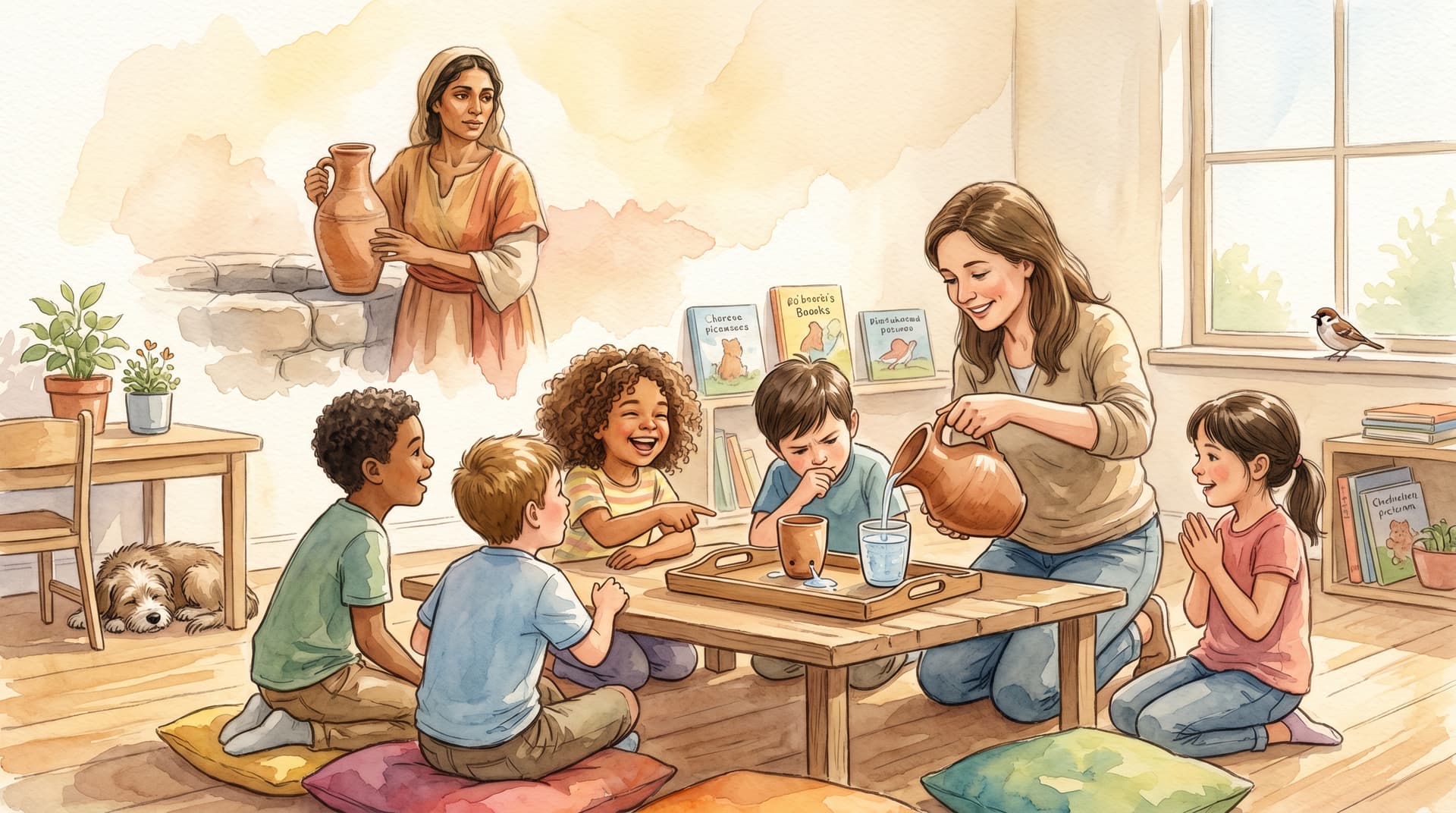
Setup: Bring two cups. One has a small hole poked in the bottom (tape over it for storage; pull the tape when ready). One is solid. Bring a pitcher of water and a tray.
Pour water into the leaky cup. The kids watch it drain. Pour again. Drain. Pour again. Drain. Ask: "Could you ever stop pouring?" No.
Pour into the solid cup. It stays full. Ask: "What if I told you there is a cup you do not even have to pour into — it just keeps being full from inside?" Let them try to picture it.
Debrief: "A lot of things in life are leaky cups. Treats, friends being nice to you, video games, getting your way. They feel full for a minute and then they're empty again, and you have to go back. The woman at the well had a leaky cup like that — five husbands, and still alone at noon. Jesus said, I have water that does not run out. I have a spring that lives inside you. That spring is the Holy Spirit. He is the one cup that just stays full, because the spring is him."
Follow-Up Questions
- "Why did the woman come to the well at noon when nobody else did?"
- "Why didn't Jesus get up and walk away when he found out about her past?"
- "What do you think she meant by leaving her water jar there?"
- "Are there things you do that are like leaky cups — they feel good for a minute, but then you need more?"
- "Has anyone ever surprised you by being kind when they knew something embarrassing about you?"
Age Notes
Younger (5-6)
- Stay on the long road and the offered drink. Jesus walked further than everybody else to find her.
- Skip the husbands. Just say: "She had a sad story, and Jesus knew it before she said a word."
- Landing: "Jesus walked all the way to her well. He did not stop till he got there."
Older (8-10)
- Push the hiding question. "Have you ever organized your day so that someone wouldn't see something? What is it like to have someone find out and not leave?"
- Connect the leaky cup to phones, treats, getting their way. They feel it. Let them name their own.
- Don't moralize the woman. Let her be a real person whose life Jesus walked into. They will project themselves onto her without help.
What to Skip
- Mount Gerizim vs. Jerusalem. Kids don't need the geography. "Different people argued about where you were supposed to worship God. Jesus said it wasn't going to be about a place anymore." Done.
- The Assyrian deportation and the history of the Samaritan split. "Their two peoples didn't get along. Hadn't for a long time."
- The Hebrew/Greek word study. Dei, egō eimi, sōtēr — useful for the teacher, invisible to the kids.
Landing Statements
Format: God is/does ___. And because of that, you ___.
- "Jesus already knows the part of you you are scared anyone will find out. And he came on purpose. You do not have to hide."
- "Most things stop working after a while. Jesus is a spring, not a well. He does not run out."
- "When you feel like no one is coming, Jesus is already on the road. He took the long way to get to you."
- "The first person to go tell a town about Jesus was a woman everyone in the town had been avoiding. He turns the kid no one sat with into the one with the news."
Kid Questions
"Did Jesus really need a drink? He's God." "He really did. That is one of the surprising parts of the story. Jesus was God and a real human with a real body that got tired and thirsty. He sat down at the well because he had to. And the first thing he said to her was a question — can I have some? He did not show up like a king. He showed up like a man with an empty cup. That is how God came near her."
"Why did Jesus bring up her husbands? Wasn't that mean?" "He was not shaming her. He was showing her he already knew. She had been spending her whole life hiding that, and he opened the door for her so she didn't have to. Once she saw he knew and was still there, she didn't have to pretend anymore. That is why she could leave the jar and go run and tell people. She wasn't hiding anymore."
"What is 'living water'?" "Jesus was using a picture. Regular water keeps you alive for a little while, and then you need more. The water Jesus was talking about was the Holy Spirit — God himself, living inside you, never running out. You stop being thirsty for the things that used to leave you empty, because you are already full."
"Why did she leave her jar?" "She came to the well to get something. She left because she had already gotten something bigger. The jar suddenly didn't matter. Sometimes the best sign that something real happened is what you stop reaching for."
The Bottom Line
This lesson gives kids a Jesus who walks past the "keep out" sign on purpose, sits down tired at a well, and starts the conversation by asking the woman everyone in town avoided for a drink. He knows the whole story before she opens her mouth. He stays anyway.
The temptation will be to land on "don't judge people" or "be brave and tell others." Resist both. The lesson is that there is a God who already knows the part of you that you spend the most energy hiding — and that knowledge is exactly what makes him lean in. The hiding is what stops being necessary. The wells are what stop being interesting.