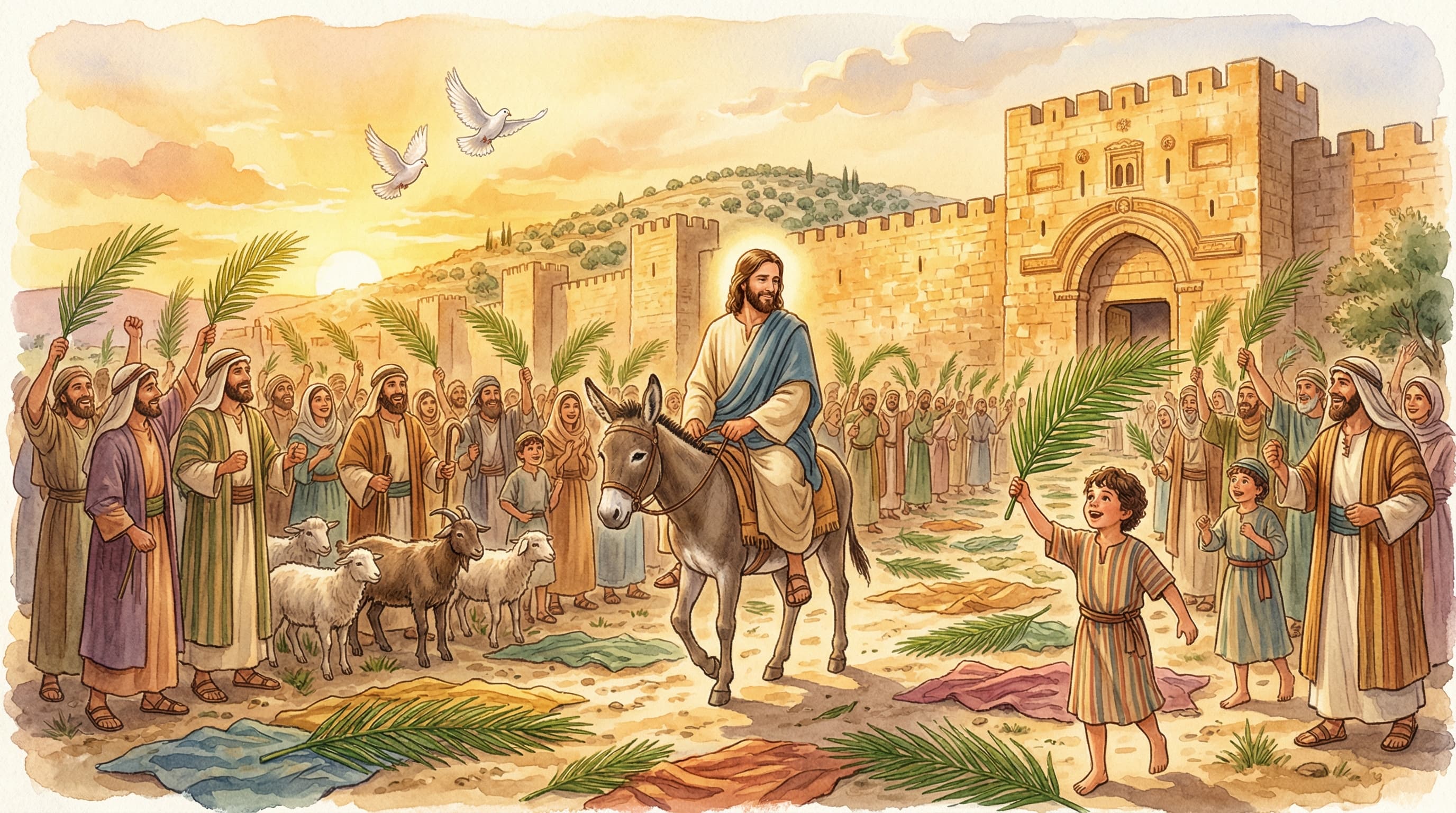
Jesus’ Triumphal Entry
A lesson preparation guide for teaching 5–10 year olds
The Original Audience
What did this mean to the people who first heard it?
Movement 1: The Original Audience
Passages: Matthew 21:1-11; Mark 11:1-11; Luke 19:28-44; John 12:12-19
"What did this mean to the people who first heard it?"
The World of Passover Week Jerusalem
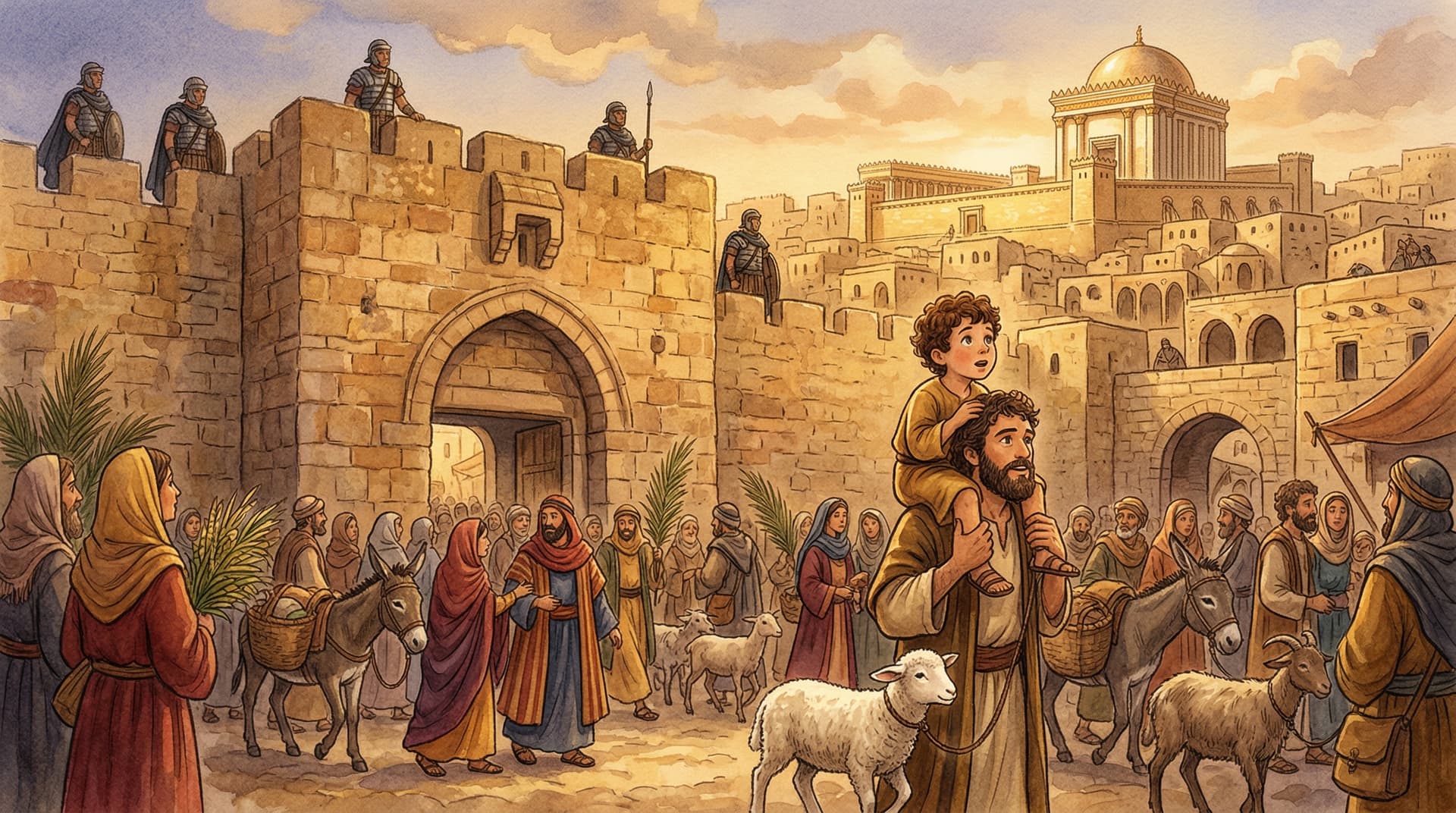
Jesus enters Jerusalem during Passover -- the single most politically and spiritually charged week in Israel's calendar. The city's population swelled from roughly 50,000 to over 250,000. Every pilgrim was there to remember the story of God liberating his people from an oppressive empire. And they were currently living under one.
Rome was everywhere. Pontius Pilate had marched his garrison from Caesarea to Jerusalem specifically because Passover was a tinderbox. Roman soldiers lined the walls. The message: we know what you're celebrating, and don't get any ideas. Every Passover carried the unspoken question: will God do it again?
Messianic fever was real. Multiple figures had recently claimed messianic authority and been crushed by Rome. Judas the Galilean led a tax revolt. Theudas promised to part the Jordan. The Egyptian led thousands to the Mount of Olives promising Jerusalem's walls would fall. All were killed or scattered. The crowd's hope was genuine but bruised -- they had been disappointed before.
The Mount of Olives was loaded. Zechariah 14:4 prophesied that "on that day his feet will stand on the Mount of Olives" -- Yahweh himself, on the day of final deliverance. Jesus begins his approach from exactly that location. Every pilgrim who knew their prophets would have felt the electricity.
The donkey was not random. Zechariah 9:9 described a coming king: "He is just and he brings rescue, yet he is humble, riding on a donkey." This was widely known messianic imagery. Kings rode warhorses into conquered cities. A donkey signaled peace -- a king coming to his own people, not against enemies. Jesus did not stumble onto a donkey. He sent disciples to get one. This was a deliberate, public, prophetic claim.
Palm branches were political. During the Maccabean revolt (164 BC), palm branches were waved when the temple was rededicated after its desecration. They became symbols of Jewish national liberation. Simon Maccabeus entered the liberated temple "with praise and palm branches" (1 Maccabees 13:51). Waving palms at Jesus was not generic celebration -- it was the crowd casting him as a liberator-king in the Maccabean tradition.
"Hosanna" was a loaded word. From Psalm 118:25-26 -- "Please, Yahweh -- rescue us! ... Life is good for the one who comes in the name of Yahweh." By Jesus' day it had become a messianic acclamation -- a cry directed at the one the crowd believed would deliver Israel. Psalm 118 was sung during Passover pilgrimages. The crowd was quoting their own liturgy and meaning it literally.
The Emotional Temperature
The crowd was desperate, hopeful, and volatile. They wanted a king who would do what the Maccabees did -- throw off the oppressors -- but permanently this time. They had heard about Lazarus being raised from the dead (John tells us this explicitly). A man who could reverse death could surely reverse Rome.
The religious leaders were terrified. Not of being wrong about Jesus, but of what Rome would do if the crowd got out of hand. "If we let him keep going like this, everyone will put their trust in him, and then the Romans will come and take away both our place of worship and our nation" (John 11:48, NGET). Their fear was political survival dressed in theological language.
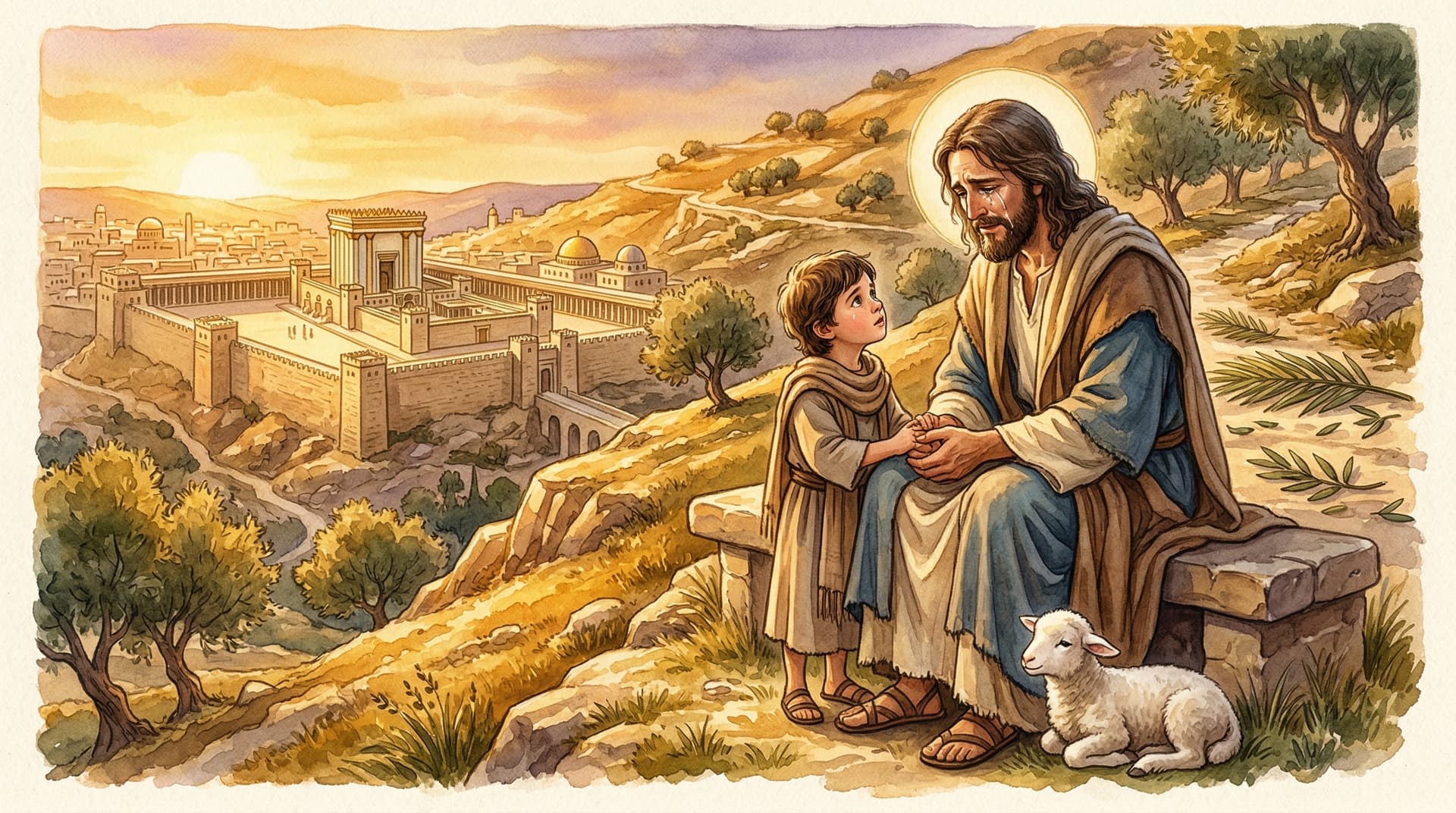
And Jesus? He was weeping.
Why This Matters for Kids
"Imagine the biggest parade you've ever seen. Everyone is cheering, waving branches, throwing their coats on the ground like a red carpet. They're shouting for their hero. But the hero isn't riding a warhorse or a tank or showing up in a helicopter. He's riding a baby donkey. And instead of smiling and waving back, he's crying. Why would a king cry at his own parade? That's what we're going to find out."
The Author’s Intent
What were the four Gospel writers each trying to show?
Movement 2: The Author's Intent
Passages: Matthew 21:1-11; Mark 11:1-11; Luke 19:28-44; John 12:12-19
"What was the author trying to do with this text?"
Four Authors, One Event, Four Angles
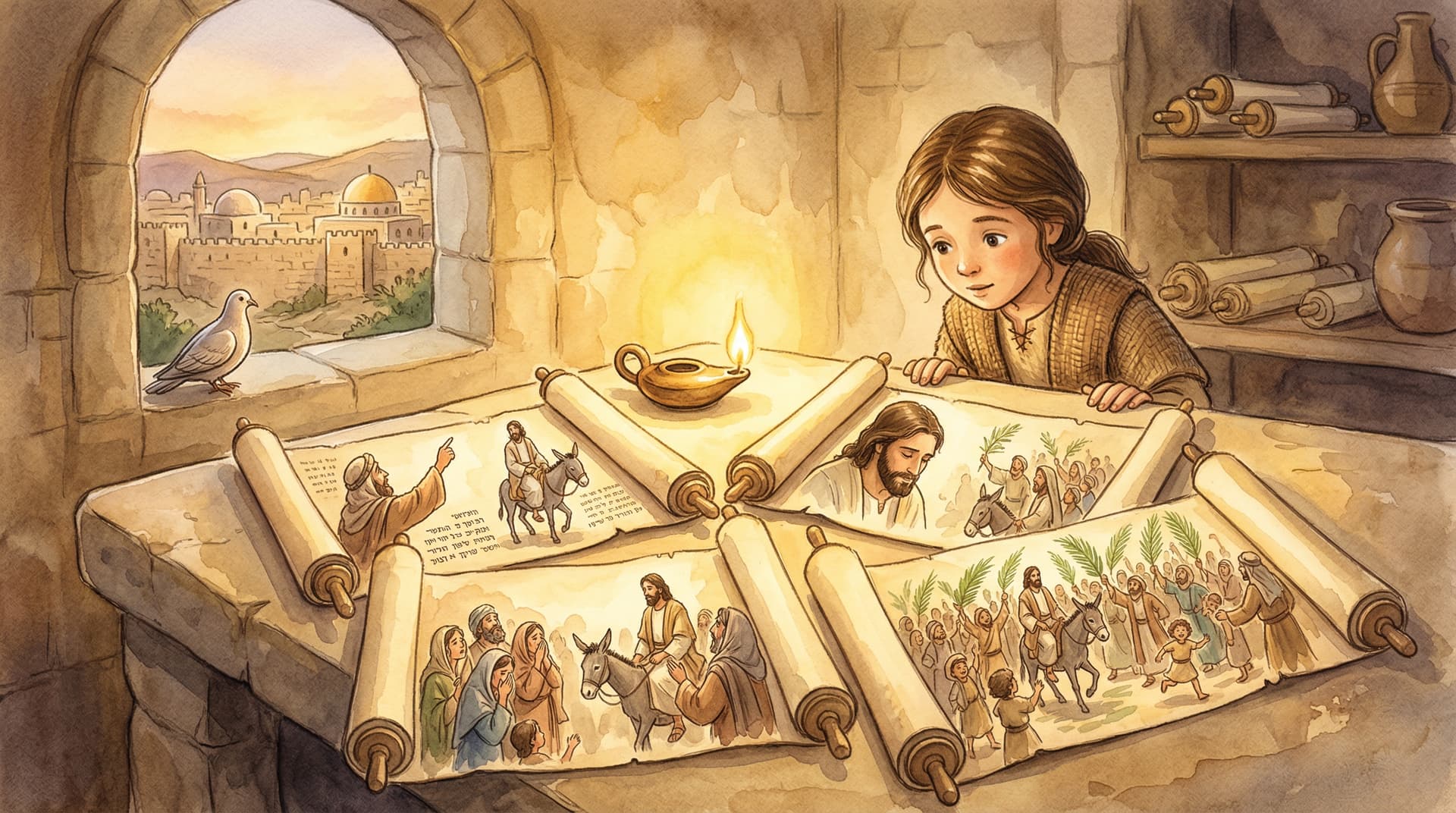
All four Gospel writers record the triumphal entry. That alone signals its importance -- this is one of a handful of events in all four accounts. But each author shapes the story to make a different argument. The differences are not contradictions. They are complementary lenses. Together they show more of the event than any single account could.
Matthew: The King Arrives as Prophesied
Matthew's fingerprint: fulfillment. Matthew writes for a Jewish audience that needs to see Jesus as the continuation and completion of their entire story. His account is saturated with Scripture.
He quotes Zechariah 9:9 explicitly -- the only Gospel writer who does. "Tell the daughter of Zion: Look -- your King is coming to you, humble, riding on a donkey, on a colt, the foal of a working animal" (21:5, NGET). Matthew wants zero ambiguity: this was planned centuries ago and is happening exactly as written.
Matthew mentions two animals -- a donkey and a colt (21:2, 7). Mark and Luke mention only the colt. Scholars debate why, but the effect is clear: Matthew is tracking the Hebrew parallelism of Zechariah 9:9 precisely, showing his Jewish readers that even the details match. He is building a legal case for messiahship through prophetic correspondence.
The crowd calls Jesus "Son of David" (21:9) -- a title with royal-messianic weight that Matthew emphasizes throughout his Gospel. When the whole city asks "Who is this?" the crowd answers: "This is the prophet Jesus, from Nazareth in Galilee" (21:11, NGET). Matthew captures the irony -- they identify him as prophet, not yet grasping he is king.
What Matthew wants you to wrestle with: Jesus' kingship is not improvised. Every detail was scripted by God centuries before it happened. If the entry was planned, the cross was planned too. The same God who arranged the donkey arranged the nails.
Mark: The Strange, Quiet King
Mark's fingerprint: the Messianic Secret meets public declaration. Throughout Mark's Gospel, Jesus tells people to keep quiet about who he is. Here, for the first time, he stages a public messianic demonstration. The contrast is deliberate.
Mark emphasizes the colt -- "a young donkey tied up that no one has ever ridden" (11:2, NGET). In the Old Testament, animals for sacred purposes had to be unused (Numbers 19:2; 1 Samuel 6:7). Mark is signaling that this is a consecrated, holy act -- not just transportation.
Mark's account is the most understated. No weeping. No extended prophecy quotes. The crowd shouts "Life is good for our father David's coming kingdom! Hosanna in the highest heaven!" (11:10, NGET). Then, remarkably: "Jesus entered Jerusalem and went into the Temple. He looked around at everything, but since it was already late in the day, he went out to Bethany with the twelve" (11:11, NGET). He just... looks around and leaves. The next day he returns and clears the temple.
That quiet survey is pure Mark. Jesus enters like a king, receives a king's welcome, walks into the temple, looks at everything -- and says nothing. It is the calm before the storm. Mark's Jesus is always doing less than expected on the surface while something enormous churns underneath. The temple cleansing the next day reveals what the quiet look meant: judgment.
What Mark wants you to wrestle with: This king does not perform on command. He surveys, he waits, he acts on his own timeline. The crowd wants a spectacle. Jesus gives them a pause. His authority does not need the crowd's energy to validate it.
Luke: The King Who Weeps Over What the City Will Miss
Luke's fingerprint: compassion and tragedy. Luke is the only Gospel writer who records Jesus weeping over Jerusalem during the entry.
"If only you had recognized today what would bring you peace! But now it's hidden from your eyes" (19:42, NGET). Luke's Jesus is not triumphant. He is heartbroken. He can see what the crowd cannot: within one generation, Rome will destroy this city, tear down the temple, and slaughter hundreds of thousands. The parade is marching toward a catastrophe that could be averted if they recognized what kind of king was in front of them.
Luke adds detail no one else includes: "The days are coming when your enemies will build siege walls around you, surround you, and close in on you from every side. They'll level you to the ground -- you and your children within your walls" (19:43-44, NGET). This happened in 70 AD with horrifying precision. Luke's readers, writing after or near this event, would have felt the weight of Jesus' foresight.
Luke also records the Pharisees demanding Jesus silence the crowd (19:39). Jesus' response is stunning: "I'm telling you -- if they kept quiet, the stones themselves would start shouting" (19:40, NGET). Creation itself would testify if humans refused to. The praise is not optional -- it is cosmically necessary.
What Luke wants you to wrestle with: The same king the crowd celebrates is grieving for the crowd. He knows they want military liberation. He is offering something deeper -- "the things that make for peace." They will reject it. And the rejection will cost them everything. Luke frames the triumphal entry as the most beautiful and most tragic scene in his Gospel simultaneously.
John: The King Whose Hour Has Come
John's fingerprint: irony and cosmic timing. John places the entry immediately after the raising of Lazarus and connects the two explicitly.
"That's actually why the crowd went out to meet him -- because they heard he had performed this miraculous sign" (12:18, NGET). The crowd's enthusiasm is directly fueled by the Lazarus miracle. They want a king who conquers death. They are right about what they want but wrong about how he will do it. He will conquer death not by avoiding it but by walking into it.
John includes the Pharisees' exasperated confession: "Look -- the whole world has gone after him!" (12:19, NGET). John loves irony. The Pharisees mean this as a complaint. John means it as prophecy. The world will go after him -- Greeks are already asking to see him (12:20-21), and John places that detail immediately after the entry. The king of Israel is also the desire of the nations.
John notes that the disciples "didn't understand any of this at the time" (12:16, NGET). Only after Jesus was glorified did they realize that everything -- the donkey, the palms, the crowd -- had been written about him. John is honest: even insiders missed it in real time. Understanding comes after the resurrection rewrites how you read the whole story.
John frames the entry as the beginning of "the hour." Throughout his Gospel, Jesus says "my hour has not yet come." Now it has. The entry is not a parade. It is a procession toward the cross. The crowd throws palms for a conquering king. Jesus is marching to a sacrifice. The triumphal entry is the start of the Passion.
What John wants you to wrestle with: Everyone is right and everyone is wrong. The crowd is right that Jesus is king. They are wrong about what his kingdom looks like. The Pharisees are right that the world is going after him. They are wrong to resist it. The disciples are right to follow him. They will not understand what they are following him into until it is over.
The Useful Test
"The authors wrote these accounts because the audience needed to understand that ___."
Matthew: Jesus is the precisely prophesied king -- his entry was scripted by God centuries ago, and if the entry was planned, everything that follows was planned too.
Mark: Jesus' authority does not depend on spectacle -- the quiet king who surveys the temple has more power than the shouting crowd realizes.
Luke: Jesus grieves over the people who celebrate him because he can see what they will miss -- and what it will cost them.
John: The triumphal entry is the beginning of the hour -- the crowd celebrates a victory they do not yet understand, a victory won not by avoiding death but by walking through it.
Seeing God
What does this passage reveal about who God actually is?
Movement 3: Seeing God
Passages: Matthew 21:1-11; Mark 11:1-11; Luke 19:28-44; John 12:12-19
"What does this passage show us about God's beauty, glory, or character that we wouldn't see without it?"
The Facet of Beauty: A King Whose Power Looks Like Weakness -- and That Is Better
The triumphal entry is the only moment in Jesus' earthly life where he publicly, deliberately, unmistakably presents himself as king. And he does it on a donkey. With borrowed coats for a saddle. Surrounded by a crowd that will abandon him within the week. Weeping.
This is not a failed coronation. This is God showing us what real kingship looks like.
What Is Surprising About God Here
God's Power Arrives Gently
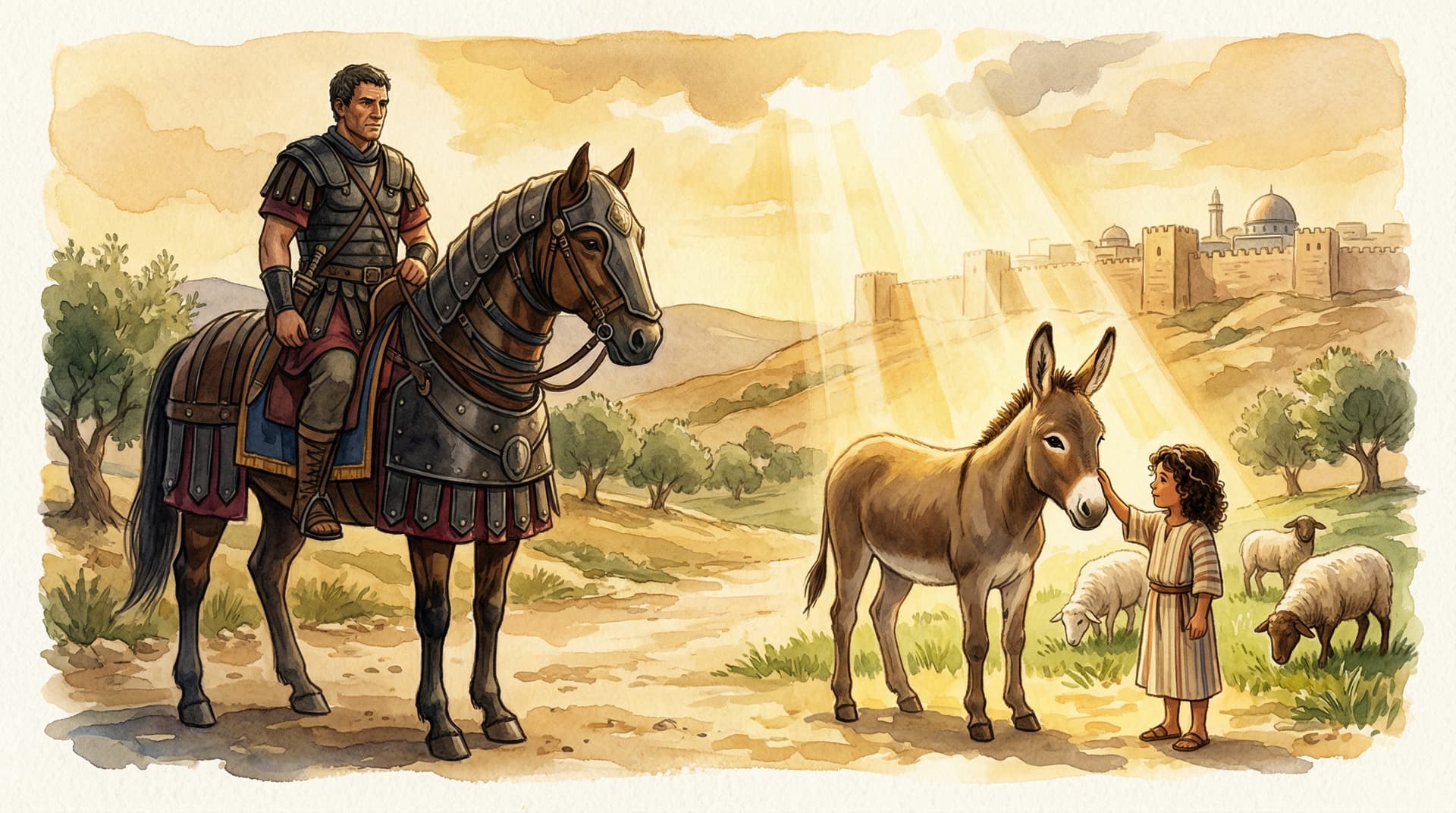
Every other king in the ancient world entered conquered cities on a warhorse with an army at his back. Zechariah's king comes "humble, and mounted on a donkey." The surprise is not just that Jesus fulfills the prophecy -- it is what the prophecy itself reveals about God's character. God had centuries to describe his king. He described someone gentle.
This is not weakness disguised as humility. It is strength that does not need to intimidate. Jesus could have ridden in on anything -- he is about to still a storm, walk out of a grave, and hold the universe together with his word. He chose a donkey because his power does not require a display. The most powerful person who ever entered Jerusalem was the one who looked least powerful doing it.
God Grieves Over the People He Is Saving
Kings do not cry at their own parades. But Luke shows us a God who sees the future his people are choosing -- rejecting the peace he offers and reaping destruction -- and weeps. Not angry tears. Grieving tears. "If only you had recognized today what would bring you peace!" (Luke 19:42, NGET).
This reveals a God whose heart breaks over what we are doing to ourselves. He is not indifferent. He is not stoic. He sees the consequences of our choices before we do, and it costs him something emotionally. The king at the parade is already carrying the weight of what the crowd will do to him by Friday.
God Orchestrates Details Across Centuries
Matthew's emphasis on prophetic fulfillment reveals a God who is not improvising. The donkey was described by Zechariah 500 years earlier. The location (Mount of Olives) was marked by Zechariah 14. The palms echo the Maccabees 160 years before. The shouts come from Psalm 118, written roughly 1,000 years before. God was scripting this scene across a millennium -- through prophets who did not know each other, for an audience that would not exist for generations.
This is not God reacting to events. This is God composing history the way a master composer writes a symphony -- themes introduced centuries apart that finally resolve in a single chord.
God's Authority Does Not Need Validation
Mark's quiet king -- who enters, surveys the temple, and leaves without a word -- reveals authority that is self-contained. The crowd screams Hosanna. Jesus does not feed on it. He does not escalate. He looks around and goes to Bethany. His authority is not dependent on popular support. It does not rise and fall with crowd energy.
This matters because the same crowd shouting "Hosanna" will shout "Crucify him" five days later. If Jesus' kingship depended on the crowd, it would die with their loyalty. It does not. His authority is unchanged on Friday. The crowd's opinion moved. His identity did not.
God Turns Irony Into Revelation
John's account drips with irony that reveals God's character. The crowd wants a king who conquers death -- because of Lazarus. They will get exactly that. But not the way they imagine. The Pharisees complain "the world has gone after him" -- and they are accidentally prophesying the global spread of the gospel. The disciples do not understand what is happening -- but after the resurrection, every detail will snap into focus.
God works through misunderstanding. He does not wait for humans to comprehend his plan before executing it. He acts, and understanding comes later. This is a God who is comfortable being misread in the short term because he knows the long term will vindicate everything.
What God's Emotions Look Like Here
Resolute grief. Jesus is not paralyzed by sorrow. He weeps and keeps riding. The grief does not stop the mission. He knows what Jerusalem will do to him and he enters anyway. This is love that walks toward pain with eyes open.
Patient authority. Mark's Jesus surveys the temple with the calm of someone who owns it. No rush. No performance. The patience of a king who will act on his own schedule, not the crowd's.
Fierce tenderness. "I'm telling you -- if they kept quiet, the stones themselves would start shouting" (Luke 19:40, NGET). Jesus insists on being praised -- not out of ego, but because the praise is true. Silencing it would be a lie. He protects the crowd's right to worship because worship is what they were made for, and this moment is what worship was made for.
The Worship Test
After studying this passage across all four Gospels, does it move you that the most powerful king in history chose to arrive gently? That he wept for the people who would kill him? That he had been planning this moment for a thousand years and it looked nothing like what anyone expected?
The specific facet of beauty on display: God's king conquers through vulnerability, not violence. His power does not look the way the world expects -- and that is not a flaw in God's plan. It is the whole point. A king on a warhorse conquers your city. A king on a donkey conquers your heart. And only one of those conquests lasts forever.
The beauty is this: the same God who orchestrated every detail -- the donkey, the palms, the shouts, the road, the century -- is the God who wept on the way in. He was in complete control and completely heartbroken at the same time. That combination exists nowhere else. That is the God of the triumphal entry.
Gospel Connection
How does this passage connect to the gospel?
Movement 4: The Specific Gospel Connection
Passages: Matthew 21:1-11; Mark 11:1-11; Luke 19:28-44; John 12:12-19
"How does Jesus fulfill, complete, or embody what this passage reveals -- SPECIFICALLY, not generically?"
The Rule
Every connection below must be specific to what the triumphal entry reveals. If you could swap in a different passage and make the same point, it is too generic.
Jesus Is the King Who Conquers by Being Conquered
The crowd expected a king who would do to Rome what the Maccabees did to the Greeks -- military overthrow, political liberation, national restoration through force. Jesus rides in on a donkey, fulfilling Zechariah 9:9, which describes a king who "is just and he brings rescue, yet he is humble" and whose dominion extends "to the ends of the earth" -- not through conquest but through character.
Five days later, the crowd's shouts flip from "Hosanna" to "Crucify him" precisely because Jesus refuses to be the king they demanded. He does not fail to be king. He refuses to be their kind of king. The cross is not where his kingship collapses. It is where his kingship is most fully expressed. The donkey was the first clue: this king's weapon is self-sacrifice, not a sword.
Specific connection: The triumphal entry is Jesus' public announcement of what kind of king he is. The donkey is not incidental. It is programmatic. Every detail of the Passion week that follows -- washing feet, breaking bread, praying in the garden, staying silent before Pilate -- flows from the same character announced by the donkey: power that serves, strength that submits, authority that dies for the ones it rules.
Jesus Grieves Over the Very People He Came to Save
Luke's weeping Jesus is not just sad. He is a surgeon who can see the disease and has the cure, watching the patient refuse treatment. "What would bring you peace" was standing in front of Jerusalem on a donkey, and Jerusalem did not recognize him (Luke 19:42, NGET).
This is the specific mending: Jesus does not save from a distance. He does not dispatch rescue from heaven. He rides into the city that will kill him, weeping for it, knowing exactly what is coming. The grief is not helpless -- he could stop it. He chooses to enter the grief rather than prevent it, because preventing it would mean abandoning the mission that saves them.
Specific connection: Jesus' tears over Jerusalem are the same heart that will pray "Father, forgive them, for they know not what they do" on the cross. The triumphal entry reveals that the cross is not just an act of obedience to the Father. It is an act of love toward the very people driving in the nails. He wept for them on Sunday. He died for them on Friday. Same love. Same people.
Jesus Is the Temple He Came to Inspect
Mark's Jesus enters the temple and "looked around at everything" (11:11, NGET). The next day he returns and clears it. What is he doing? He is the owner inspecting his house. "My house will be called a house of prayer for all nations" (Mark 11:17, NGET, quoting Isaiah 56:7).
But here is the deeper layer: within the week, Jesus will say "Tear down this temple, and I will raise it back up in three days" (John 2:19, NGET). He is not just cleansing the building. He is replacing it. The temple was where God met humanity. Jesus is where God meets humanity. He inspects the old meeting place, finds it broken, and then becomes the new one -- through his own body, torn and raised.
Specific connection: Mark's quiet temple survey is the last inspection of the old covenant's central institution by the one who will replace it. The king rides in on a donkey, walks into the temple, looks around, and what he sees is a system that has run its course. He does not renovate it. He fulfills it. His body becomes the temple. His death becomes the sacrifice. His resurrection becomes the new Holy of Holies -- open to everyone, no curtain, no lot, no priestly rotation required.
Jesus Is the Passover Lamb Entering the City
John places the entry in the context of Passover preparation. Lambs were selected on the 10th of Nisan -- inspected for blemishes, brought into the household, kept until the 14th, and sacrificed. Jesus enters Jerusalem at exactly this time. The crowd examines him (debates, questions, challenges all week). He is found "without blemish" (Pilate: "I find no fault in him"). And he is sacrificed on Passover.
The crowd thinks they are welcoming a warrior-king. They are actually processing their Passover lamb into the city. The palms, the shouts, the coats on the road -- it is an unwitting sacrificial procession. The irony is devastating and beautiful: they are right to celebrate. They just do not yet know what they are celebrating.
Specific connection: John's irony is theological architecture. The crowd waving palms for a conquering king is simultaneously fulfilling the Passover ritual of bringing the lamb into the household for inspection. Everything the crowd does "wrong" (wrong expectations, wrong understanding) God weaves into what he is doing right. Human misunderstanding does not derail God's plan. It serves it.
The Specific Mending
The brokenness this passage reveals: We want a God who operates on our terms -- who conquers the things we want conquered, on our timeline, in ways we approve of. The crowd wanted military liberation. They got a weeping king on a donkey. We want God to fix our problems the way we imagine. He offers something deeper and stranger and better.
The specific mending: Jesus does not give us what we demand. He gives us what we actually need. The crowd needed a king who would die for them, not kill for them. We need a God whose power looks like a cross, not a throne -- because a throne can only rearrange the world's power structures. A cross can remake human hearts. The triumphal entry is God saying: I know what you're asking for. I love you too much to give you that. I'm giving you something better.
The new earth: The triumphal entry is a preview of Revelation 19 -- the king returning, but this time on a white horse, with a name written: "King of kings and Lord of lords" (Revelation 19:16, NGET). The first entry was on a donkey because the mission was to save. The second entry will be on a warhorse because the mission will be to restore. The crowd at the triumphal entry got the right king at the wrong time. On the new earth, the timing and the king and the crowd and the shouts will all finally match. No more misunderstanding. No more tears. The parade the crowd wanted is coming. It is just bigger and better and later than they imagined.
The Anti-Moralism Checkpoint
-
"Be humble like Jesus." Misses that Jesus' humility is not a personality trait to copy but the revelation of how divine power actually works. His humility on the donkey is the same power that will split the sky in Revelation 19.
-
"Don't be like the crowd who turned on Jesus." Fear-based. The lesson is not "be more loyal." The lesson is that Jesus loved the disloyal crowd enough to die for them anyway.
-
"And this all points to Jesus who died for our sins." Too generic. This passage specifically reveals a king who announces his kingdom through vulnerability, grieves over the people he is saving, and walks into death as a deliberate act of the same gentle authority the donkey represents.
Why Kids Care
How does this truth intersect with their actual lives?
Movement 5: Why Should a 5-10 Year Old Care?
Passages: Matthew 21:1-11; Mark 11:1-11; Luke 19:28-44; John 12:12-19
"What does this mean for their actual lives of play, fun, friendship, and family?"
This movement is a brainstorm -- a menu of angles, illustrations, and landing points for the teacher to pray through. The Spirit knows what your specific kids need. Pick what resonates, adapt freely, let the rest go.
The Transition: Connecting the Story
This is the Easter bonus session. The kids are about to walk through the most important week in human history. Frame it: "Today's story starts like a party -- the biggest parade anyone had ever seen. But this party is different. The hero is not what anyone expected. And by the end of the week, the parade will make sense in a way nobody saw coming."
The Lesson: The Parade That Changed Everything
The Arc
Three truths the four Gospel writers reveal together:
1. "The king everyone was waiting for finally showed up -- but not the way they expected." They wanted a warrior on a warhorse. They got a gentle king on a donkey. And that confused everyone. But the donkey was the whole point. God's king does not conquer by fighting. He conquers by loving.
2. "The king could see what no one else could see." While everyone cheered, Jesus cried. He could see that the same people cheering would turn on him by Friday. And he rode in anyway. He loved them even though he knew what they would do.
3. "The king walked into the hardest week of his life on purpose." This was not an accident. Every detail -- the donkey, the road, the timing -- was planned by God for centuries. Jesus was not trapped by the crowd. He was leading a procession toward the cross. The parade was the beginning of the rescue mission.
The Role Play
Characters: Narrator (teacher), Jesus (volunteer), Crowd (most of the kids), Pharisees (2-3 kids), Disciples (2-3 kids).
Scene 1 -- The Setup. Teacher: "It's Passover week. Jerusalem is packed. Everyone is remembering how God rescued his people from Egypt. And there's a rumor: the man who brought a dead man back to life is coming to the city." Build the anticipation. Let the crowd buzz.
Scene 2 -- The Wrong King. Before Jesus enters, ask the crowd: "What do you think a king looks like when he enters a city?" Let them describe it -- armor, horse, soldiers, flags. Draw or list their answers. "That's what everyone was expecting. Watch what actually happens."
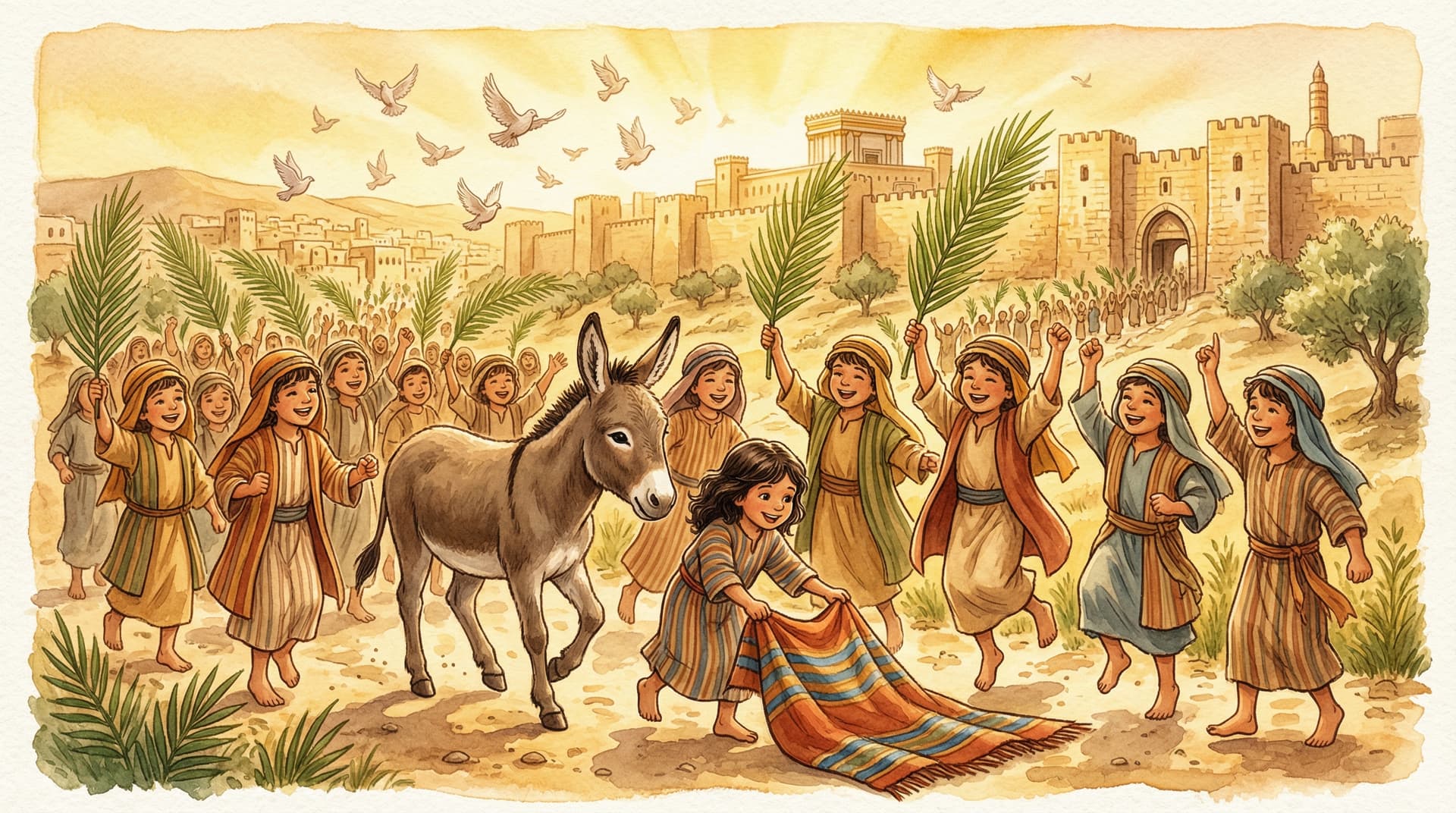
Scene 3 -- The Entry. Jesus rides in (on a chair carried by two kids, or just walking slowly while the teacher narrates). The crowd lays coats on the ground. They wave branches (paper or real). They shout "Hosanna! Blessed is the king!" Make it loud. Make it fun.
Scene 4 -- The Tears. In the middle of the celebration, the teacher narrates: "And then Jesus stopped. And he looked over the city. And he started to cry." Pause the cheering. Let it get quiet. "The king was crying at his own parade. Why?"
Ask the kids: "Why do you think Jesus cried when everyone was cheering for him?" Let them think. Then: "Jesus could see something no one else could see. He could see that these same people would turn against him in five days. He could see that the city would be destroyed because they didn't understand what kind of king he was. He cried because he loved them and he knew what was coming."
Scene 5 -- The Pharisees. The Pharisee volunteers step forward: "Make them stop! Tell your followers to be quiet!" Jesus: "If they stopped, the rocks on the ground would start shouting instead." Let the kids react. "The praise was so true and so important that even creation would do it if people wouldn't."
Scene 6 -- The Temple. Jesus walks into the "temple" area. Looks around. Says nothing. Leaves. Teacher: "He walked in, looked at everything, and walked out. What do you think he was thinking?" (This sets up the temple cleansing if you want to teach it next.)
Why Should They Care?
Angle 1: When Things Don't Look the Way You Expected
The kid's world: Getting a gift that looks boring but turns out to be amazing. A new kid at school who seems weird but becomes your best friend. A rainy day that turns into the best puddle-jumping adventure ever.
The God-first landing: God's king did not look like a king. He looked like the opposite. No armor, no army, no war horse. Just a man on a donkey. And that confused everyone. But it turns out a king who comes gently is better than a king who comes with swords. Because a gentle king changes your heart. A strong-arm king only changes your circumstances. God's way of doing things almost never looks the way we expect. And it is always better.
Landing statement: "God does things differently than we expect. His king came on a donkey, not a warhorse. His power shows up in gentleness, not force. And that is not a mistake. That is better."
Angle 2: When Someone Loves You Even Though They Know You'll Mess Up
The kid's world: When your parent helps you with something even though they know you'll probably break it. When a friend shares their toy even though you didn't share yours last time.
The God-first landing: Jesus could see that the crowd would turn on him. He knew Peter would deny him. He knew Judas would betray him. He knew the whole city would shout "Crucify him" by Friday. And he rode in anyway. He did not wait until they deserved his love. He loved them while knowing the worst thing they would ever do.
Landing statement: "Jesus does not love you because you're perfect. He loves you while knowing every way you'll mess up. And he still comes toward you, not away from you."
Angle 3: When You Want One Thing But Need Something Different
The kid's world: Wanting candy for dinner but needing real food. Wanting to skip practice but needing to build the skill. Wanting to stay up late but needing sleep.
The God-first landing: The crowd wanted a king who would crush their enemies. God gave them a king who would die for their enemies. They wanted power that would destroy. God sent power that would heal. They asked for what they wanted. God gave them what they needed. And what they needed turned out to be so much bigger than what they wanted.
Landing statement: "God loves you too much to just give you what you ask for. He gives you what you actually need. And it is always bigger and better than what you imagined."
Angle 4: The Parade Is Not Over
The kid's world: The excitement of a preview or trailer for something even bigger coming later.
The God-first landing: The triumphal entry was a preview. The crowd got the right king at the wrong time. They wanted the victory parade -- but the rescue mission had to come first. The Bible says Jesus is coming back. And the second time, he will not be on a donkey. He will be on a white horse. Every wrong thing will be made right. Every tear will be wiped away. The party the crowd wanted? It is coming. It is just bigger and later and better than anyone imagined. The triumphal entry was the trailer. The new earth is the movie.
Landing statement: "The best parade in history has not happened yet. When Jesus comes back, the party will be so big and so good that this whole world will feel like the preview."
Object Lesson Option: Two Entrances
Setup: Two kids volunteer. One enters the room loudly -- stomping, shouting, flexing, demanding attention. The other enters quietly, looks around, sits down next to someone who looks left out, and says "Hey, want to sit together?"
Debrief: "Which entrance got more attention? Which one would you actually want as your king? The loud entrance impresses you for a second. The quiet entrance changes how you feel. Jesus entered Jerusalem like the second kid. Gentle. On purpose. Looking at the people no one else was looking at. And that is what real power looks like."
Follow-Up Questions
- "If you could have any kind of king, what would you want them to be like?"
- "Why do you think a king on a donkey is actually stronger than a king on a warhorse?"
- "Have you ever wanted something and gotten something different that turned out better?"
- "Why do you think Jesus cried at his own parade?"
- "What do you think Jesus saw when he looked around the temple?"
- "If the rocks could shout, what do you think they would say?"
Age Notes
Younger (5-6)
- Focus on the contrast: warhorse vs. donkey. Have them draw both and talk about which one they'd expect a king to ride. The surprise is the lesson.
- The "two entrances" object lesson is perfect for this age -- physical, visual, immediate.
- Landing: "Jesus came gently, like the best friend you ever had, not like a scary soldier. And gentle is stronger than scary."
Older (8-10)
- Push into the weeping. "Why would a king cry at his own parade?" Let them sit with it. This age group is old enough to feel the weight of someone loving people who will hurt him.
- Explore the irony: "The crowd was right -- Jesus IS the king. But they wanted the wrong kind of king. What kind of king did they need?" Let them wrestle.
- Connect forward: "This is Sunday. What happens Friday? If Jesus knew what was coming, why did he keep going?" This sets up the crucifixion lesson powerfully.
What to Skip
- Detailed Maccabean history. One sentence: "Palm branches were a sign of victory from an old war." That is enough.
- Scholarly debates about one donkey vs. two. Not helpful for kids. The point is the same: the king chose a humble animal.
- The temple cleansing. Mention that Jesus "looked around" (Mark) and leave it as a setup for next time. The entry has more than enough for one lesson.
Landing Statements
Format: God is/does ___. And because of that, you ___.
- "God's king is gentle, not scary. You never have to be afraid of Jesus coming toward you."
- "Jesus loves you even though he knows every way you'll mess up. You do not have to be perfect for him to ride toward you."
- "God does not always give you what you want. He gives you what you need -- and it is always better."
- "The biggest, best celebration is still coming. Everything good you have ever experienced is a preview of what God is preparing."
- "Real power does not need to show off. Jesus on a donkey is stronger than every army that ever existed."
- "Jesus cried for people who would hurt him. That is what love looks like -- not waiting until someone deserves it, but giving it while knowing they won't."
Teacher Quick Reference
Four Gospel Perspectives -- Quick Summary for Teaching
| Gospel | Emphasis | Key Detail | One-Liner for Kids |
|---|---|---|---|
| Matthew | Prophetic fulfillment | Quotes Zechariah 9:9 explicitly | "God planned this parade hundreds of years ago." |
| Mark | Quiet authority | Jesus surveys the temple and leaves | "The real king doesn't need to be the loudest one." |
| Luke | Compassionate grief | Jesus weeps over Jerusalem | "Jesus cried at his own parade because he loved the people that much." |
| John | Ironic timing | Crowd comes because of Lazarus | "They wanted a king who beats death -- and that's exactly what they got, just not the way they thought." |
Themes Already in Kids' World
- Expecting one thing and getting something different (but better). Every kid has experienced this.
- Someone loving you even when you mess up. The parent who stays calm. The friend who forgives.
- The quiet kid who turns out to be the strongest. Gentle does not mean weak.
- Previews and trailers. The excitement of knowing something bigger is coming.
- Parades and celebrations. The fun of cheering for someone.
Framing Sentences
- The entry: "The biggest parade Jerusalem had ever seen -- and the king was crying."
- The donkey: "Every other king rode a warhorse. Jesus picked a baby donkey. On purpose."
- The tears: "He did not cry because he was scared. He cried because he loved them and could see what was coming."
- The stones: "If every person on earth stopped praising Jesus, the rocks would start. That's how true it is that he is king."
- The temple: "Jesus walked into the temple, looked at everything, and said nothing. But his silence was louder than the crowd."
Kid Questions
"Why didn't Jesus ride a horse?" "Because a horse is what you ride when you're coming to fight. A donkey is what you ride when you're coming in peace. Jesus came to save people, not destroy them. The donkey was his way of saying: I am your king, but I am not here to hurt anyone."
"Why did the people change their minds about Jesus?" "They wanted a king who would give them what they wanted right now -- no more Romans, no more problems. When they realized Jesus wasn't going to fight Rome, they felt disappointed and angry. They wanted a quick fix. Jesus was offering something permanent. But permanent takes longer and costs more."
"Did Jesus know he was going to die that week?" "Yes. He knew exactly what was coming. The parade, the arrest, the cross -- he knew all of it. And he still rode into the city. That is the most loving thing anyone has ever done. He walked into the worst week of his life because it was the only way to give us the best thing we'd ever receive."
"What did the rocks shouting mean?" "Jesus was saying that his kingship is so true that it's written into the ground itself. Creation knows who made it. If people refused to praise him, the physical world would do it instead. The praise is not optional -- it's what everything was made for."
"Is Jesus coming back on a horse?" "The Bible says yes. Revelation 19 describes Jesus returning on a white horse, and 'on his robe and on his thigh he has a name written: King of kings and Lord of lords' (NGET). The first time he came to save. The second time he comes to make everything right. The donkey was for the rescue mission. The horse is for the victory celebration."
The Bottom Line
This lesson gives children a God whose power is gentle, whose love is costly, and whose plans are bigger than anyone expected. The temptation will be moral lessons: "be humble like Jesus" or "don't be like the fickle crowd." Resist that. Jesus' humility on the donkey is not a character trait to emulate. It is the revelation of how God saves the world -- not through force but through self-giving love. The crowd's fickleness is not a warning to be more loyal. It is the backdrop against which Jesus' unchanging love shines brightest.
The biggest gift you can give the kids today is the image of a king who rides toward them gently, who loves them even knowing how they will fail, and who is strong enough that he does not need to prove it. That king is coming back. And the second parade will be even better.