Preparing the Way
A lesson preparation guide for teaching 5–10 year olds
The Original Audience
What did this mean to the people who first heard it?
Movement 1: The Original Audience
Passages: Luke 1:5-80 and John 1:1-8
"What did this mean to the people who first heard it?"
The World Before Luke 1 Opens: 400 Years of Silence
The last Old Testament prophet, Malachi, spoke around 430 BC. His final words were a promise and a warning: God would send "Elijah the prophet" to turn the hearts of fathers to their children and children to their fathers -- "lest I come and strike the land with a curse" (Malachi 4:5-6). Then the prophetic voice stopped. No visions. No "thus says the LORD." No angelic messengers. For roughly four hundred years.
To feel the weight: if that silence started in 2026, it would not break until the year 2426. Every generation born during that silence lived and died without hearing a fresh word from God. Grandparents told grandchildren about prophets their own grandparents had told them about. The scrolls were read, the temple sacrifices continued, but the living voice -- the voice that said "I have heard your cry" and "I am doing a new thing" -- was quiet.
What Happened During the Silence
The silence was not empty. Empires rose and fell over Israel like waves over a rock.
Persian rule (538-332 BC): The Jews had returned from exile and rebuilt the temple, but lived as subjects of Persia. They had a temple but no king, no glory cloud, no sovereignty.
Greek conquest (332 BC): Alexander the Great swept through. After his death, his generals carved up the empire. Israel was caught between the Ptolemies of Egypt and the Seleucids of Syria, pulled back and forth like a toy between older siblings.
The Maccabean revolt (167-160 BC): Antiochus IV Epiphanes desecrated the temple by sacrificing a pig on the altar and erecting a statue of Zeus in the Holy of Holies. A priestly family -- the Maccabees -- led a guerrilla revolt and won. For a brief, shining moment, Israel was independent again. The Hasmonean dynasty ruled for about a century. But these priest-kings became corrupt and power-hungry, and the people knew they were not the real thing.
Roman occupation (63 BC onward): Pompey marched into Jerusalem and even entered the Holy of Holies -- finding it empty. Rome installed client kings, culminating in Herod the Great, who was technically Jewish but universally despised. Herod massively renovated the temple into one of the most magnificent buildings in the ancient world -- but he did it for political glory, not devotion. The temple was grander than ever and more spiritually hollow than ever.
The Emotional Temperature
By the time Luke 1 opens, the people of Israel are living in a pressure cooker of longing, frustration, and fractured hope.
Longing. Luke tells us that people like Simeon were "waiting for the consolation of Israel" (Luke 2:25) and Anna spoke to "all who were looking for the redemption of Jerusalem" (Luke 2:38). There was a remnant who still expected God to act. They read Isaiah 40 -- "Comfort, comfort my people" -- and wondered when.
Fractured expectations. There was no single "messianic expectation." The Pharisees hoped for a Torah-observant king who would restore righteousness. The Zealots wanted a military liberator to overthrow Rome. The Essenes at Qumran expected two messiahs -- one priestly, one royal. The Sadducees, who ran the temple, were mostly interested in maintaining the political status quo. Everyone was waiting for something different.
Cynicism and resignation. After four centuries, some had simply stopped expecting anything. The silence had become normal. God used to speak -- but that was long ago. The temple rituals continued like clockwork, but for many, the motions were hollow. They were like people who keep setting the table for someone who never comes home.
Malachi's promise hung in the air. The last prophetic word anyone had was about Elijah returning. "Before the great and dreadful day of the LORD." That promise was either a reason to hope or a reminder of how long the wait had been.
Zechariah and Elizabeth: The Specific World of Luke 1
Into this world, Luke introduces two people: Zechariah and Elizabeth. Every detail Luke provides is loaded.
"Both righteous before God, walking blamelessly in all the commandments." This is extraordinary language. Luke is echoing the way Genesis describes Noah and the way the OT describes Abraham. These are not ordinary people. They are the kind of people you would expect God to use. And yet --
"They had no child, because Elizabeth was barren, and both were advanced in years." In first-century Judaism, barrenness was not just a medical condition. It was a social catastrophe. Children were your legacy, your security, your evidence that God had blessed you. A barren couple -- especially one as righteous as Zechariah and Elizabeth -- represented a theological puzzle. They had done everything right, and God had not given them the one thing their culture said he should.
The original audience would immediately think of Sarah, Hannah, and the Shunammite woman. Every time God opened the womb of a barren woman in the Old Testament, it meant something significant was about to happen. Luke is setting a pattern the audience knows by heart.
Zechariah was a priest of the division of Abijah. David had organized the priesthood into 24 rotating divisions (1 Chronicles 24:7-18). Abijah was the eighth division. Each division served in the temple for one week, twice a year. During their week, roughly 300 priests were on duty, with about 50 actively serving each day.
He was chosen by lot to burn incense. This is the detail the original audience would have gasped at. The incense offering was the most sacred part of the daily temple service. A priest was chosen by lot, and according to the Mishnah (Tamid 5:2), no priest who had performed this duty could ever be chosen again -- it was a once-in-a-lifetime honor. With thousands of eligible priests in the rotation, many lived their entire lives without being selected. Zechariah had waited his whole career for this moment. He was old. He might have stopped hoping for it.
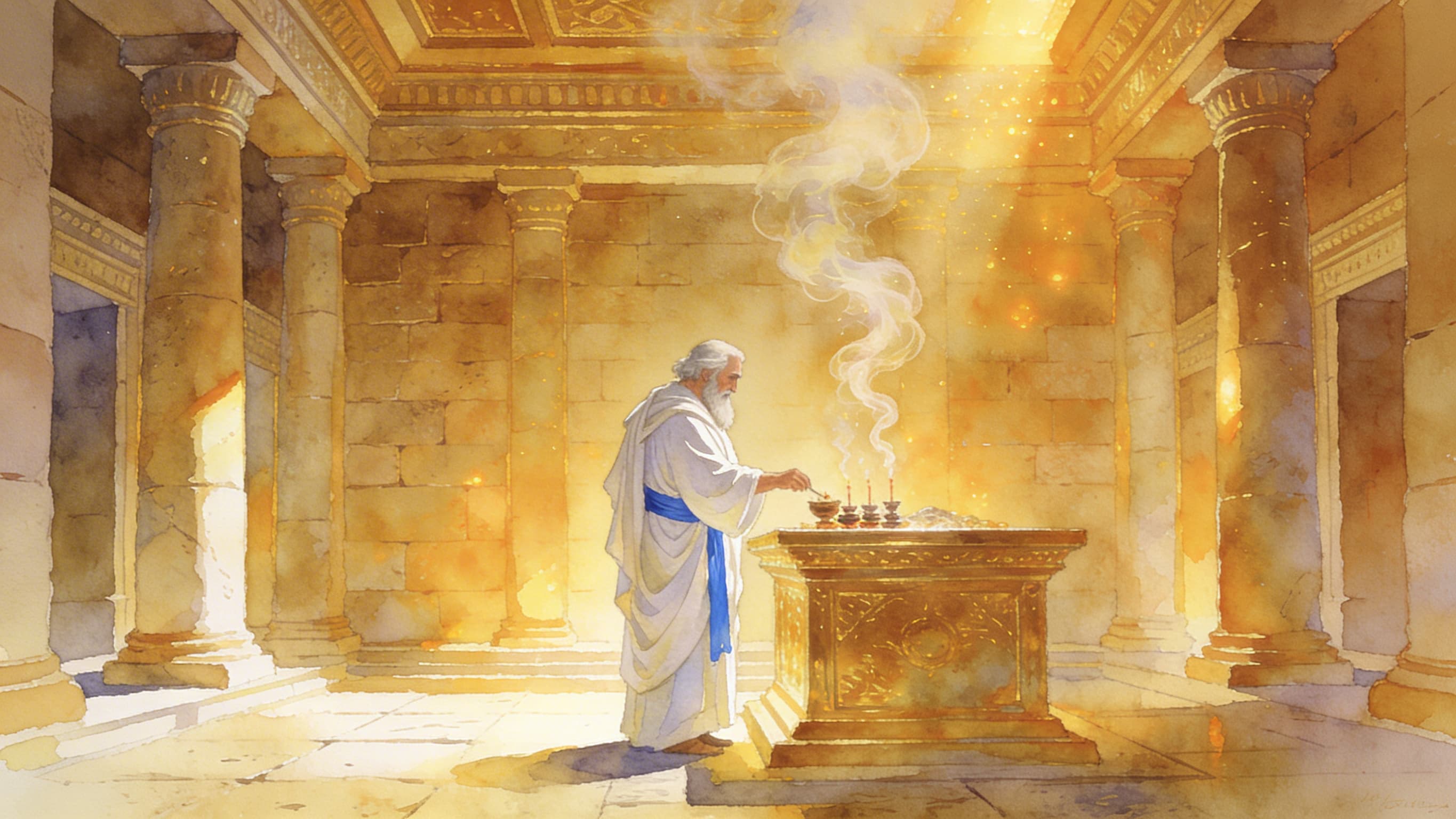
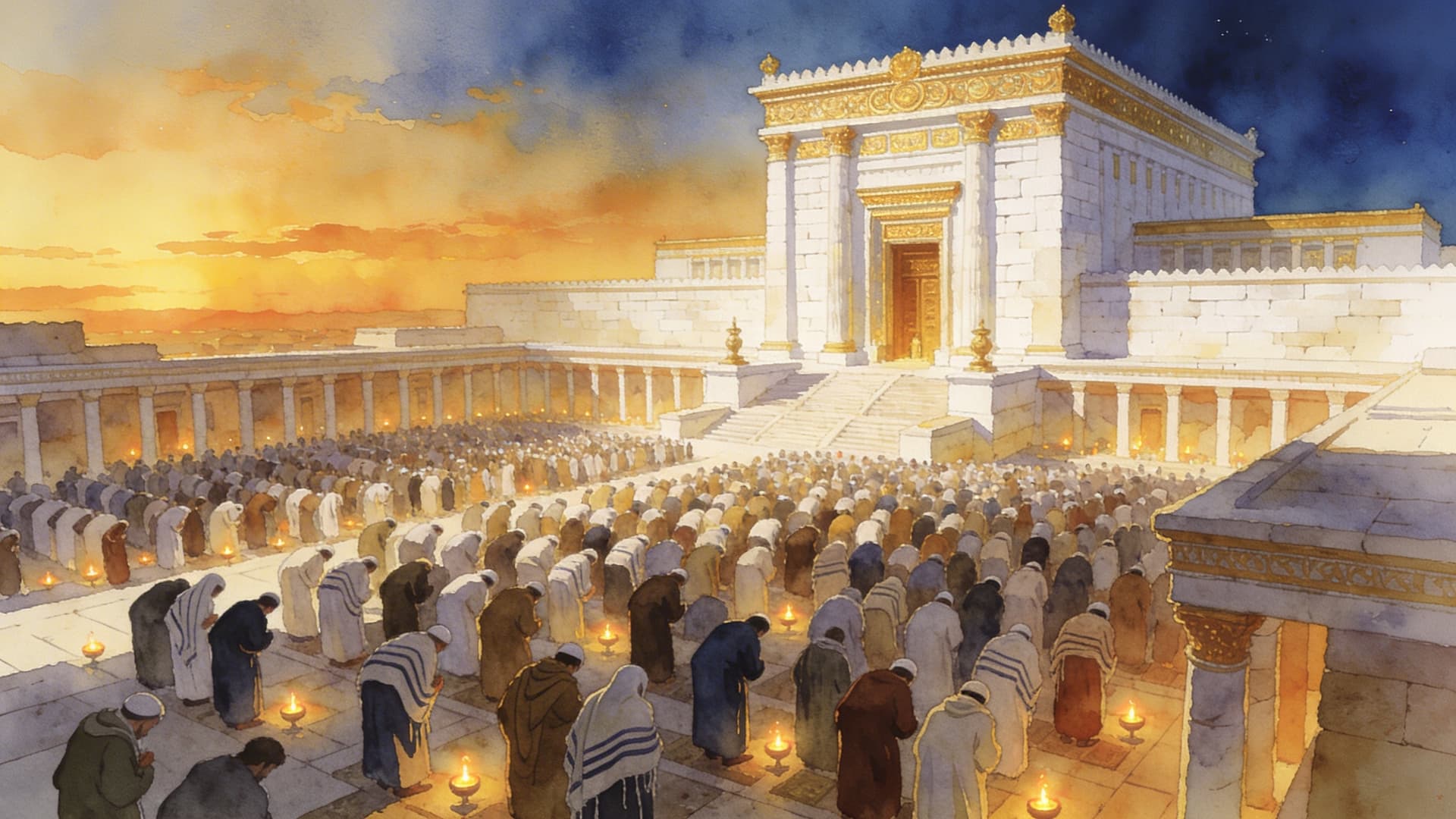
The incense altar stood in the Holy Place, just outside the Holy of Holies -- as close to God's presence as an ordinary priest could get. Psalm 141:2 says, "Let my prayer be set before you as incense." The rising smoke symbolized the people's prayers ascending to God. While Zechariah burned incense inside, the entire congregation stood outside praying. They were interceding: "May the merciful God enter the Holy Place and accept with favor the offering of his people."
This is the scene: an old, faithful, childless priest, standing alone in the holiest accessible room in the world, offering prayers on behalf of a nation that has not heard from God in four hundred years. The incense rises. The people pray outside. And then an angel appears.
What John's Audience Heard
John's Gospel opens differently -- not with a temple scene but with a cosmic declaration. "In the beginning was the Word, and the Word was with God, and the Word was God" (John 1:1). John's audience -- both Jewish and Greek -- would have been electrified by the word "Logos."
For Greek readers, logos meant the rational principle that ordered the universe -- the divine reason behind reality. For Jewish readers, it echoed Genesis 1: "God said" -- and creation happened. God's Word was not passive information. It was active power. The rabbis had developed a whole theology around God's Word as his agent of creation and revelation.
John's opening answers the 400 years of silence before anyone asks the question. "In the beginning was the Word." The Word did not begin when the silence broke. The Word was always there. The silence was real -- but it was not absence. The Word "was with God" the entire time. Every year of the silence, the Word was present, active, sustaining, holding all things together. The silence was not God leaving. It was God preparing.
And then John introduces a man: "There was a man sent from God, whose name was John" (1:6). Immediately -- he was "not the light, but came to bear witness about the light" (1:8). The first thing the audience learns about John the Baptist is what he is not. He is not the main character. He is the one who points.
Why This Matters for Kids
"Imagine your family has a tradition: every night before bed, your mom or dad tells you a story. You love it. It's your favorite part of the day. But then one night, they don't come. And the next night. And the next. Weeks go by. Months. You keep going to your room and sitting on your bed, waiting. You start to wonder: Did they forget about me? Do they still love me? Are they ever coming back?
Now imagine that goes on for your whole life. You tell your kids about the stories. Your kids tell their kids. And everyone keeps waiting. Four hundred years of waiting. That's how long God's people went without hearing from him. And they started to wonder the same things you would: Did God forget about us? Does he still care? Is he ever going to speak again?
And then one day, in a quiet room in the temple, while an old man is praying -- an angel shows up. And the angel says: God heard you. He always heard you. And he's about to do something so big that you'll understand why he was quiet for so long."
The Author’s Intent
What is the author trying to do with this passage?
Movement 2: The Author's Intent
Passages: Luke 1:5-80 and John 1:1-8
"What was the author trying to do with this text?"
Luke: The Master Storyteller Building a Bridge
Luke is the most deliberately literary of the Gospel writers. He tells Theophilus that he has "carefully investigated everything from the beginning" to write "an orderly account" (Luke 1:3). And his ordering is theological, not just chronological. Every detail in Luke 1 is placed to make an argument.
The Diptych Structure
Luke constructs chapter 1 as a diptych -- two parallel panels placed side by side so the reader sees them together and notices the differences.
Panel 1: John's announcement (1:5-25)
- Angel Gabriel appears
- To Zechariah (an old priest, in the temple)
- Announces a miraculous birth (to a barren elderly couple)
- The child will be "great before the Lord" (1:15)
- Zechariah doubts: "How shall I know this?" (1:18)
- Sign: struck mute
Panel 2: Jesus's announcement (1:26-38)
- Angel Gabriel appears
- To Mary (a young peasant girl, in Nazareth)
- Announces a miraculous birth (to a virgin)
- The child will be "great" -- without qualification (1:32)
- Mary asks: "How will this be?" (1:34)
- Sign: Elizabeth's pregnancy
The parallels are obvious. The escalation is the point. John is "great before the Lord." Jesus is simply "great." John will be "filled with the Holy Spirit even from his mother's womb" (1:15). Jesus will be conceived by the Holy Spirit -- the Spirit will be the cause of his existence (1:35). John is a prophet. Jesus is the Son of the Most High. Luke is not comparing equals. He is showing that John is the warm-up act and Jesus is the concert. And the warm-up act is already astonishing.
Why Luke Starts in the Temple
Luke could have started his Gospel anywhere. He starts in the Holy Place of the temple, with incense rising and a congregation praying. This is deliberate. The temple is where heaven and earth were supposed to meet. It is the place of God's presence. But for four hundred years, no prophetic word had come from that place.
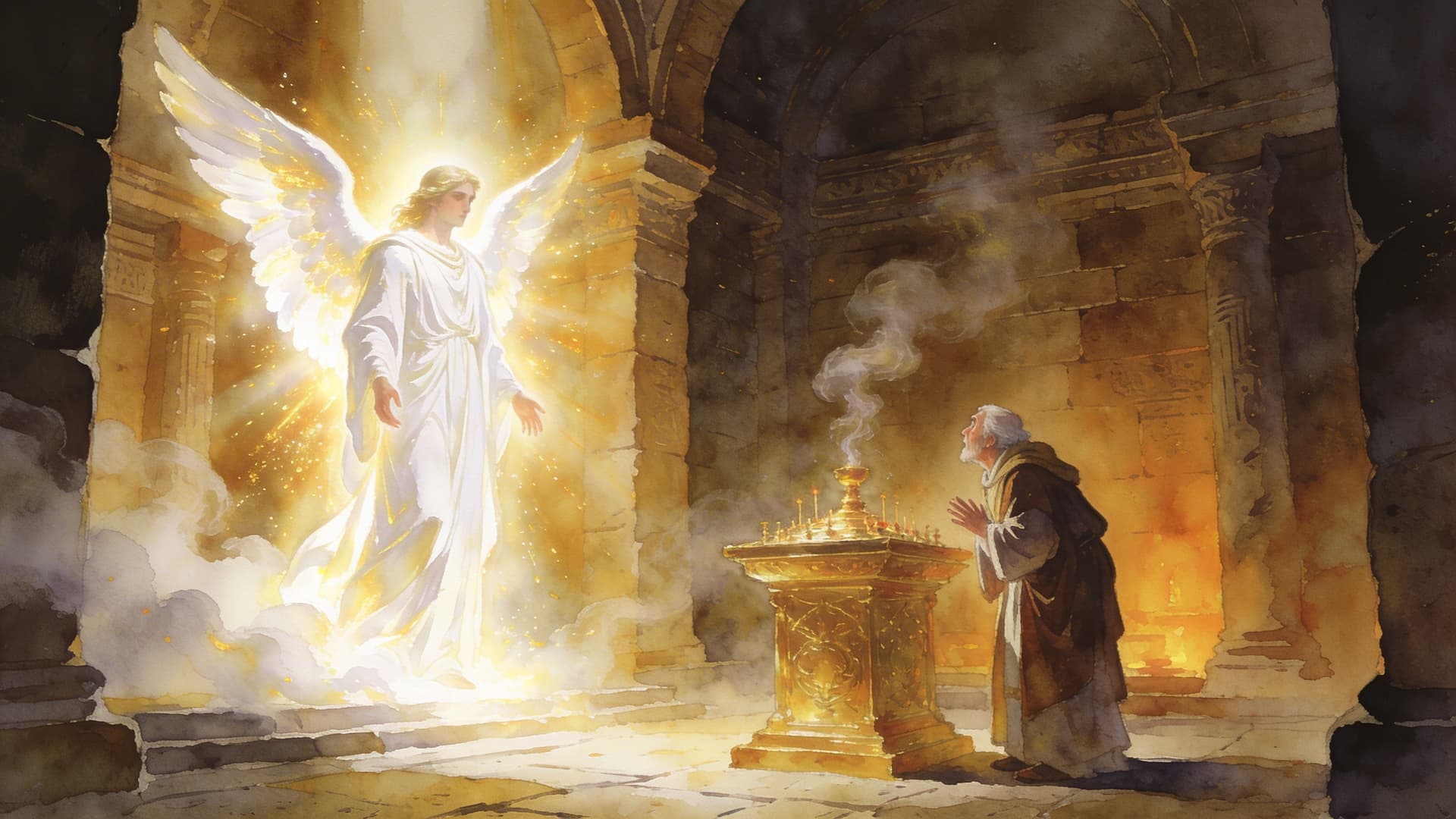
Luke's opening scene reclaims the temple as a place where God speaks. The angel appears at the incense altar -- the place of prayer. The message is: God has heard the prayers. Not just Zechariah's prayer for a child, but the accumulated prayers of four centuries of silence. The incense that symbolized the people's prayers rising to God? God is answering.
The Old Testament Echoes Are Not Accidents
Luke packs his narrative with echoes of previous births-to-barren-women:
-
Sarah and Abraham (Genesis 18:11-14): Too old. Laughed at the promise. But God did it. Gabriel's words to Zechariah -- "your wife Elizabeth will bear you a son" -- echo the angel's words to Abraham at Mamre.
-
Hannah (1 Samuel 1-2): Barren, ridiculed, but she prayed desperately, and God gave her Samuel -- the prophet who would anoint kings. Mary's Magnificat (Luke 1:46-55) is almost a rewrite of Hannah's song. Luke wants you to hear Hannah when Mary speaks.
-
The Shunammite woman (2 Kings 4:14-17): Elisha promises a son to a woman who had given up hope. The pattern: God opens wombs that should stay closed, and the children born become instruments of his purposes.
Luke's audience knows this pattern. Every time God does this -- barren woman, miraculous birth -- it means a new chapter in the story of salvation is beginning. Luke is saying: this is that. But this time, the chapter is the final one.
Gabriel: The Connection to Daniel
The angel identifies himself: "I am Gabriel, who stands in the presence of God" (Luke 1:19). Gabriel appears by name only twice in the Old Testament -- both times in Daniel (8:16, 9:21). In Daniel 9, Gabriel gave Daniel the prophecy of the "seventy weeks" -- a timeline for when the Messiah would come. That timeline pointed to this very era.
Luke's audience would catch this: the angel who told Daniel when is now telling Zechariah who and how. The countdown that Daniel started is ending. The same messenger is back.
What Luke Wants the Reader to Wrestle With
Silence Is Not Absence
The single most important argument Luke makes in chapter 1 is this: God's silence was not God's absence. Zechariah and Elizabeth were "righteous before God" during the silence. They served faithfully when nothing was happening. And God was watching the whole time. The moment God chose to break the silence, he chose a couple who had been faithful in it.
The author wants the reader to understand that the 400 years were not wasted time. They were preparation. God was not distant -- he was building something. The silence was a pregnancy.
Doubt Is Not Disqualifying, But It Has Consequences
Zechariah doubts: "How shall I know this? For I am an old man, and my wife is advanced in years" (1:18). Gabriel's response is sharp: "You will be silent and unable to speak until the day that these things take place, because you did not believe my words" (1:20).
This seems harsh -- especially because Mary asks a similar question ("How will this be?") and is not punished. The difference is subtle but real. Zechariah's question is about evidence: "How shall I know?" -- give me proof. Mary's question is about mechanism: "How will this be?" -- I believe you, but I don't understand the physics. Zechariah is a priest standing in the temple, the place of faith, who has just seen an angel, and he asks for more proof. The issue is not his confusion but his demand for a sign when he is literally looking at one.
But -- and this is crucial -- the punishment is also a mercy. Zechariah is silenced, not rejected. He is not cast aside like Saul. He is made to be quiet. And in the quiet, something changes. Nine months of enforced silence. Nine months of not being able to voice his doubt, his fear, his theological confusion. Nine months of listening instead of speaking. When his mouth finally opens (1:64), what comes out is not a timid prayer or a cautious hope. It is one of the most explosive prophecies in the Bible -- the Benedictus.
Luke wants us to see: God's discipline is preparation, not punishment. Zechariah went into the silence doubting. He came out prophesying. The silence remade him.
Zechariah's Silence Mirrors Israel's Silence
This is the layer most modern readers miss. Zechariah -- a priest, representing the people before God -- is struck silent for doubting God's word. Israel -- the people of God -- had been living in silence for four hundred years. The parallel is intentional. A doubting priest is silenced. A doubting nation was silenced. And both silences end with prophetic speech about the coming Messiah.
When Zechariah's mouth opens, he does not talk about his son first. He talks about what God is doing for Israel: "Blessed be the Lord God of Israel, for he has visited and redeemed his people" (1:68). The nation's silence and the priest's silence break at the same moment, for the same reason: God is keeping his promise.
John's Intent: Reframing Everything Cosmically
John the Evangelist writes his prologue with a different purpose. Luke tells the story from earth upward -- a priest, a temple, an angel. John tells it from heaven downward -- the eternal Word, creation, light, darkness.
The Word Was Always Speaking
"In the beginning was the Word" (1:1). John's first move is to demolish the idea that the silence was real -- cosmically speaking. The Word -- the Logos -- was never silent. He was "in the beginning." He was "with God." He "was God." Through him "all things were made" (1:3). "In him was life, and the life was the light of men" (1:4).
The silence between Malachi and Matthew was a human experience, not a divine reality. God was not quiet. He was sustaining every atom of the universe through his Word. The light was shining in the darkness the entire time -- "and the darkness has not overcome it" (1:5).
John the Baptist: The Arrow, Not the Target
John the Evangelist interrupts his cosmic poetry to make a clarification: "There was a man sent from God, whose name was John. He came as a witness, to bear witness about the light, that all might believe through him. He was not the light, but came to bear witness about the light" (1:6-8).
This is emphatic -- almost anxious. "He was NOT the light." Why the insistence? Because John the Baptist was so extraordinary that people genuinely wondered if he was the Messiah (Luke 3:15). The Evangelist wants no confusion. John's entire identity -- his entire purpose for existing -- was to point at someone else. The Greek word for "witness" is martys, from which we get "martyr." A witness who gives testimony. John's life was testimony. His birth, his preaching, his baptizing -- all of it was one long pointed finger.
The Useful Test: Can you complete this sentence: "The authors wrote these passages because the audience needed to understand that ___." Answer: God's silence was not abandonment, it was preparation -- and the preparation is over. Everything the Old Testament pointed to, everything Israel waited for through four centuries of silence, is about to arrive. And the first sign is an old priest, a barren woman, and a baby whose entire life will be spent saying: "Not me. Him."
Seeing God
What does this passage reveal about who God actually is?
Movement 3: Seeing God
Passages: Luke 1:5-80 and John 1:1-8
"What does this passage show us about God's beauty, glory, or character that we wouldn't see without it?"
The Facet of Beauty: God Speaks After Silence, and the Silence Was Not Wasted
Every passage in the Bible shows us something specific about God that we would not see as clearly anywhere else. What Luke 1 and John 1 reveal is this: God is a God who is faithful during silence, and whose silence is always pregnancy -- never emptiness.
This is not a passage about God's power (though he is powerful here). It is not primarily about God's justice or holiness. It is about God's faithfulness in the dark -- his relentless, patient, behind-the-scenes purposefulness during the long seasons when nothing seems to be happening.
What Is Surprising About God Here
God Rewards Quiet Faithfulness That Nobody Noticed
Zechariah and Elizabeth were righteous. They walked blamelessly. They did everything right. And they had nothing to show for it -- no child, no public recognition, no dramatic story. They were old, faithful, and invisible.
God's response? He chose them. Not a young power couple. Not a priest with political connections. Not someone who had done something spectacular. He chose the two people who had been faithful when it cost them something and gained them nothing. Their faithfulness during the silent years was not unnoticed. It was a qualification.
This reveals something stunning about God's character: he sees quiet faithfulness. He does not just reward the dramatic -- the Elijahs who call fire from heaven and the Davids who kill giants. He sees the couple who showed up to temple, served their rotation, prayed their prayers, and went home childless for decades. And he says: you are exactly the people I want for the most important mission in four hundred years.
God Breaks the Silence Where Prayer Is Happening
The angel does not appear in the palace. Does not appear to the high priest or a political leader. He appears at the incense altar -- the place where prayers rise. The people are outside praying. Zechariah is inside, offering the symbol of their prayers. And at that exact intersection -- where human longing meets divine presence -- God speaks.
The surprise: God's silence did not mean he was not listening. The prayers were accumulating. Four hundred years of prayers, rising like incense, and God was receiving every one. The silence was not a closed door. It was a room filling with incense that had not yet been answered -- not because God was ignoring it, but because he was preparing an answer so enormous that anything earlier would have been premature.
God's Timing Is Ruthlessly Precise and Incomprehensibly Patient
Why four hundred years? Why not three hundred? Why not fifty? Why did Zechariah and Elizabeth have to wait until they were old?
Luke does not explain God's timing. He just shows us that when God finally moves, every piece is exactly where it needs to be. The right priest. The right division (Abijah, the eighth -- service falling at exactly the right moment). The right lot drawn for the incense offering -- a once-in-a-lifetime chance that falls on the exact day God has planned to break four centuries of silence. The convergence is not coincidence. It is choreography on a scale that spans centuries.
This reveals a God whose patience is not passive. He is not waiting for the right moment in the way we wait for a bus. He is building the right moment -- arranging priests and lots and empires and wombs across generations so that everything converges at a single point.
God's Silence Is Preparatory, Not Punitive
The 400 years of silence feel like abandonment from the human side. But from God's side, they were the final trimester. Luke 1 reframes the silence entirely. God was not absent during those centuries. He was:
- Allowing empires to build roads that the gospel would travel on
- Scattering the Jewish diaspora so that synagogues existed in every major city
- Developing the Greek language into a universal tongue so the New Testament could be written in it
- Positioning a righteous elderly couple in the exact priestly rotation at the exact historical moment
- Fulfilling Daniel's timeline down to the generation
The silence was the most active preparation period in the history of redemption. God was not sleeping. He was working at a scale so large that no one standing inside it could see it.
God Turns Doubt Into Prophecy
Zechariah doubts. God silences him. But he does not discard him. Nine months later, when Zechariah's mouth opens, what comes out is not a timid whisper. It is the Benedictus -- one of the most theologically rich, prophetically charged, scripturally saturated hymns in the Bible.
God took a doubter and made him a prophet. He took nine months of silence and turned them into nine months of preparation. Zechariah went into the silence full of doubt. He came out full of the Holy Spirit (1:67).
This reveals a God who is not threatened by doubt. He does not reject doubters -- he remakes them. Zechariah's silence was not just discipline. It was an incubation chamber. God was growing something in Zechariah during those nine months that could not have grown any other way: a faith so deep and a vision so clear that it could produce the Benedictus.
What God's Emotions Look Like Here
Tender Patience
"Do not be afraid, Zechariah, for your prayer has been heard" (1:13). Which prayer? His prayer for a child? His prayer for Israel's redemption? Yes. Both. God has been listening to both prayers for decades. And the tenderness in "do not be afraid" is the tenderness of someone who has been watching you struggle and is finally able to say: it's here. What you've been asking for -- it's here.
Joyful Anticipation
Gabriel says John will bring Zechariah "joy and gladness, and many will rejoice at his birth" (1:14). God is not solemn about this announcement. He is joyful. The angel is delivering good news and he knows it. After four hundred years, God is about to do the thing he has been planning since Genesis 3:15. He is excited. This is not a reluctant rescue. It is a father who has been preparing a surprise for his children and can barely contain himself.
Fierce Purposefulness
Elizabeth says, "Thus the Lord has done for me in the days when he looked on me, to take away my reproach among people" (1:25). God is not indifferent to Elizabeth's suffering. Her barrenness was real pain. Her social shame was real shame. And God did not just tolerate it -- he actively worked to remove it. But the timing was precise. He did not remove it earlier because the removal itself was part of a larger purpose. Her personal vindication and the cosmic announcement were the same event.
The "Worship Test"
After studying this passage, do you feel the weight of a God who is faithful during silence? Does it move you to realize that the same God who tracked Zechariah through decades of quiet service is tracking your own quiet faithfulness? That the prayers you pray into what feels like a void are accumulating like incense before a throne?
If the teacher encounters this text and does not worship, something is missing. The beauty here is a God whose patience is not neglect, whose silence is not absence, and whose timing -- while agonizingly slow from our side -- is breathtakingly precise from his. A God who turns doubters into prophets and barren women into mothers of world-changers. A God who has been working for four hundred years and is finally ready to show what he has been building.
The specific facet of beauty on display: God is relentlessly faithful in the dark. He sees quiet faithfulness. He hears unanswered prayers. He works on timescales we cannot perceive. And when he finally speaks, it is worth everything it cost to wait. The silence was not the story. The silence was the inhale before the greatest sentence ever spoken: "The Word became flesh and dwelt among us."

Gospel Connection
How does this passage connect to the gospel?
Movement 4: The Specific Gospel Connection
Passages: Luke 1:5-80 and John 1:1-8
"How does Jesus fulfill, complete, or embody what this passage reveals -- SPECIFICALLY, not generically?"
The Rule
Every connection below must pass one test: could you swap in a different passage and make the same point? If yes, it is too generic. Movement 4 asks what is true of Jesus because of Luke 1 and John 1 specifically.
Jesus Is the Word That Breaks the Silence
John 1:1 does not say "In the beginning, God spoke." It says "In the beginning was the Word." The Word is not something God does. The Word is someone God is. Jesus is not God's message. Jesus is God's speech itself -- the living, breathing, walking act of communication.
For four hundred years, God did not send a prophet, a vision, or a sign. When he finally broke the silence, he did not send another message. He sent himself. "The Word became flesh and dwelt among us" (John 1:14). Every previous prophet carried God's words. Jesus is God's Word. The silence did not end with information. It ended with incarnation.
Specific connection: The 400 years of silence are answered not by more words about God but by the Word who is God. Jesus is the speech act that makes all previous speech acts feel like whispers. The silence was so long because the Word coming to break it was so big.
Jesus Is the True Temple Where God Meets Humanity
Zechariah stood in the Holy Place -- as close to God's presence as an ordinary priest could get. The incense altar was just outside the curtain that separated the Holy Place from the Holy of Holies. Zechariah could get close, but he could not enter. And even in that sacred space, God had to send an angel to communicate. The meeting was mediated. Indirect. A messenger about a messenger about the Messiah.
"The Word became flesh and tabernacled among us" (John 1:14 -- the Greek eskenosen literally means "pitched his tent"). Jesus is what the temple was trying to be. Zechariah needed a special room, a once-in-a-lifetime lot, and a supernatural angelic appearance to receive a message from God. In Jesus, God walks into the village square. No curtain. No lot. No qualification required. The gap between the Holy Place and the Holy of Holies -- the gap Zechariah could not cross -- Jesus eliminates by being both sides of the curtain at once.
Specific connection: The temple scene in Luke 1 is the last time God communicates through the old system -- priest, temple, angel, incense. From here forward, God communicates through a person. The incense altar was a placeholder for the one in whom all prayers would be answered directly.
Jesus Is What John Points To
John the Baptist's entire identity is defined by who he is not. "He was not the light, but came to bear witness about the light" (John 1:8). Gabriel told Zechariah that John would "go before him in the spirit and power of Elijah, to turn the hearts of the fathers to the children" (Luke 1:17). John is the arrow. Jesus is what the arrow points at.
This is the most unique feature of John's role in all of Scripture: he is the last and greatest of the Old Testament prophets (Jesus himself says this in Matthew 11:11), and his greatness consists entirely in pointing at someone greater. His job is not to be impressive. His job is to make sure everyone is looking in the right direction when Jesus arrives.
John's role in the womb is the same as his role in the wilderness. When pregnant Mary visits pregnant Elizabeth, John leaps in Elizabeth's womb (Luke 1:41). Before he can speak, before he can point, before he can preach -- he responds to Jesus's presence with his whole body. His first act of witness happens before birth. His whole life, from womb to wilderness to beheading, is one continuous act of pointing.
Specific connection: John the Baptist is the living fulfillment of Malachi 4:5-6. The last words of the Old Testament promised that Elijah would return to "turn the hearts of fathers to their children." Luke 1:17 says John will do exactly this -- "in the spirit and power of Elijah." The Old Testament's final promise is the New Testament's opening scene. Jesus does not begin his public ministry until John has prepared the way. God does not just show up. He prepares hearts first. That is his character.
The Benedictus: Past Tense for a Future Event
Zechariah's prophecy (1:68-79) is extraordinary for a specific reason: he speaks about the coming salvation in past tense. "He has visited and redeemed his people" (1:68). "He has raised up a horn of salvation" (1:69). Jesus has not been born yet. The redemption has not happened yet. But Zechariah speaks as though it already has.
This is not sloppy grammar. This is prophetic certainty. God's promises are so reliable that Zechariah treats the future as accomplished fact. He has seen enough -- the angel, the pregnancy, the nine months of silence-turned-clarity -- to know that what God starts, God finishes. The Benedictus is an old man betting his prophetic credibility on the certainty of God's word.
And what does Zechariah prophesy about Jesus specifically?
-
"A horn of salvation in the house of David" (1:69) -- Jesus is the strong Savior from David's line. Not a philosopher-king. A horn -- the symbol of an animal's fighting strength. Jesus saves by force, by power, by an act of strength. But the strength is the cross, not the sword.
-
"To remember his holy covenant, the oath that he swore to Abraham" (1:72-73) -- Jesus is the fulfillment of the oldest promise in the Bible. Not just David's covenant. Abraham's. The one that said "in you all the families of the earth shall be blessed" (Genesis 12:3). Every prayer prayed during the 400 years of silence was a prayer for this. Jesus is the answer to all of them at once.
-
"The sunrise from on high shall visit us, to give light to those who sit in darkness and in the shadow of death" (1:78-79) -- The Greek word anatole means both "sunrise" and "the rising of a branch" -- echoing the messianic "Branch" of Isaiah 11:1 and Zechariah 3:8. Jesus is the dawn after the longest night. Four hundred years of darkness, and then: sunrise. Not a candle. Not a flashlight. The sun.
The Specific Mending
Every passage reveals not just who God is but what is broken in us. This passage reveals a specific brokenness and a specific mending:
The brokenness: We are people who interpret God's silence as abandonment. When we pray and nothing happens, when life is hard and God seems quiet, we conclude he has forgotten us. We stop expecting him to show up. We go through the motions -- we keep setting the table, but we stop believing anyone is coming to dinner. We turn faithfulness into a habit rather than an expectation.
The mending: Jesus is the proof that God's silence is never abandonment. He is the Word who was there the entire time -- "in the beginning," before the silence, during the silence, through the silence. When he arrives, he does not apologize for the delay. He reveals that the delay was the preparation. And the preparation was for something so much bigger than what we were asking for that, had it come earlier, we would not have been ready to receive it.
The new earth: The Benedictus ends with a vision: "to guide our feet into the way of peace" (1:79). The ultimate fulfillment is a world where God's silence is impossible -- because "the dwelling place of God is with man" (Revelation 21:3). No more waiting. No more wondering. No more incense rising to an unseen God. Face to face, with the Word who spoke creation into existence, in a world where every sunrise is a reminder that the longest night is over forever.
The Anti-Moralism Checkpoint
Test every lesson against these traps:
-
"Be faithful like Zechariah and Elizabeth." Misses that their faithfulness was sustained by "the hand of the Lord" and that Zechariah himself doubted at the critical moment. The lesson is not about their moral achievement but about God's faithfulness to people who are faithful imperfectly.
-
"Be humble like John the Baptist." Flattens John into a role model. John's humility was not a personality trait he cultivated. It was a response to seeing Jesus. He pointed away from himself because he had seen someone so much more beautiful that self-promotion became absurd.
-
"And this all points to Jesus who died for our sins." If your gospel connection could be pasted onto any other passage, you have not reached this passage's specific thread. Jesus is not generically the answer. He is specifically the Word who breaks the silence, the sunrise after the longest night, the fulfillment of the last promise the Old Testament made.
The Bottom Line
Luke 1 and John 1 are the hinge of the Bible. Everything before this pointed forward. Everything after this points back. John the Baptist stands at the pivot -- the last prophet of the old era and the first witness of the new. His entire existence says one thing: the wait is over. The silence has broken. The Word has come. And his name is Jesus.
For kids, the landing is: God never forgot. Every year of waiting, every prayer that felt unanswered, every quiet night when it seemed like God was far away -- he was building something. And what he built was not a new rule or a new prophet or a new temple. What he built was a way to be with you forever. The Word became a person so that God would never be silent again.
Why Kids Care
How does this truth intersect with their actual lives?
Movement 5: Why Should a 5-10 Year Old Care?
Passages: Luke 1:5-80 and John 1:1-8
"What does this mean for their actual lives of play, fun, friendship, and family?"
This movement is a brainstorm -- a menu of angles, illustrations, and landing points for the teacher to pray through. The Spirit knows what your specific kids need. Pick what resonates, adapt freely, let the rest go.
The Transition Lesson: Connecting the Story
This is the bridge lesson between the Old Testament and New Testament. The kids have been learning about God's work through Ezra, Nehemiah, and the prophets. Now they need to feel the shift: everything that was promised is about to arrive. The 400 years of silence is the pause between the final chapter of Act 1 and the opening scene of Act 2.
Before the lesson content, take a moment to frame it: "We've been learning about what God did for his people in the Old Testament. He rescued them, rebuilt their temple, gave them his Word. But then something happened: God went quiet. For a really, really long time. Today's story is about the moment God finally spoke again -- and what he said changed everything."
The Lesson: The Long Silence and the First Sound
Use a dramatic enactment to let kids experience the silence and its breaking. This lesson is built around contrast -- the long wait and the sudden, overwhelming answer.
The Arc
Two things that are true at the same time, and the surprising third thing that connects them:
1. "God was quiet for a very long time." Four hundred years. No prophets. No visions. No angels. The people kept praying, kept reading the scrolls, kept showing up to the temple. But God did not send anyone to speak for him. And the people started to wonder: has God forgotten us?
2. "Two people never stopped trusting." Zechariah and Elizabeth were old. They had no children. In their world, that meant people thought God had not blessed them. But they kept serving God anyway. Zechariah was a priest. Elizabeth was faithful. Nobody famous. Nobody important. Just two people who kept showing up when nothing was happening.
3. "And then, in the quietest room in the world, God broke the silence." Zechariah was chosen -- once in his whole life -- to go into the most special room in the temple and burn incense. While everyone outside was praying, an angel appeared. And the angel said: God heard you. He always heard you. And he is about to do the biggest thing he has ever done.
The Role Play
Characters: Narrator (teacher), Zechariah, Elizabeth, Angel Gabriel, the Praying Crowd (as many kids as want to participate), Baby John (optional -- a doll or a volunteer).
Scene 1 -- The Long Silence. Have all the kids sit in total silence. The teacher narrates: "God's people waited. And waited. One hundred years. Two hundred years." Count off centuries slowly. Let the silence feel uncomfortable. After about 30-45 seconds (which will feel like forever to kids), ask: "How did that feel? Imagine that for four hundred years. That's how long God's people waited to hear from him."
Scene 2 -- Zechariah and Elizabeth. Two volunteers play Zechariah and Elizabeth. Teacher narrates: "There was an old priest named Zechariah and his wife Elizabeth. They loved God. They did everything right. But they had no children. And in their world, people thought that meant something was wrong. But they kept serving God. Every single day." Have them mime praying, serving, going through daily life.
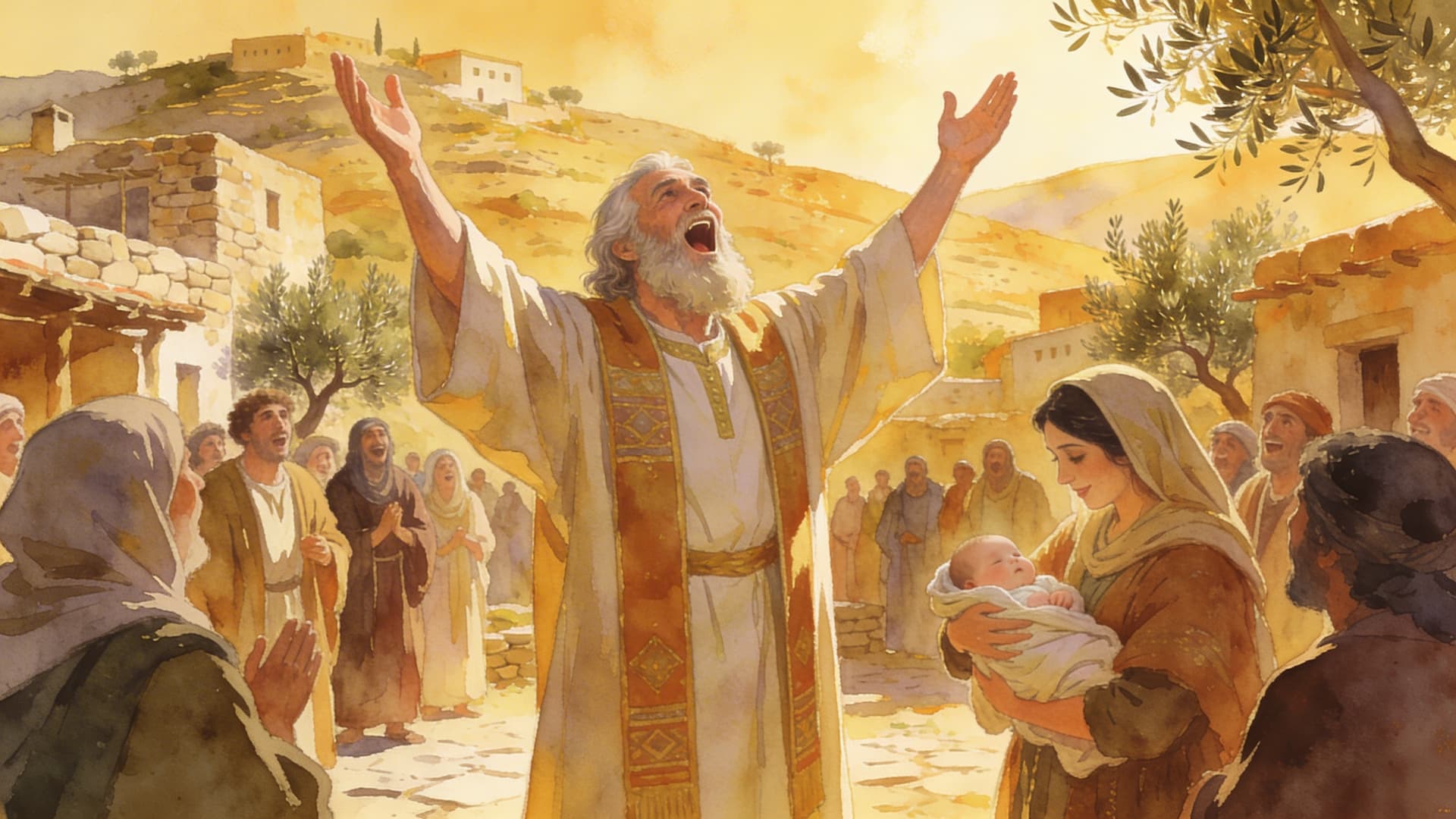
Scene 3 -- The Incense Lot. Narrator: "One day, Zechariah's name was drawn from a bowl. Out of thousands of priests, HE got chosen to go into the holiest room he would ever enter and burn incense. This would only happen once in his entire life." Have Zechariah walk slowly toward a designated "Holy Place" area. Meanwhile, all the other kids become the praying crowd outside. They fold their hands and whisper prayers: "Please, God, hear us. Please don't forget us."
Scene 4 -- The Angel. Zechariah is alone in the "Holy Place." Long pause. Then -- Gabriel appears (another volunteer steps out from behind something, or the teacher dramatically shifts roles). "Do not be afraid, Zechariah. Your prayer has been heard. Your wife will have a son, and you will call his name John. He will prepare the way for someone greater -- someone you have been waiting for your whole life."
Pause and ask: "Zechariah had been waiting his whole life. The whole nation had been waiting for four hundred years. How do you think he felt?"
Scene 5 -- The Doubt and the Silence. Zechariah: "But... I'm old. My wife is old. How can this be?" Gabriel: "I am Gabriel. I stand in the presence of God. Because you did not believe, you will not be able to speak until this happens." Zechariah tries to talk -- no sound comes out. He walks out to the crowd. They see something has happened. He waves his hands but cannot speak.
Scene 6 -- The Baby and the Breakthrough. Fast-forward nine months (narrator: "Nine months of silence for Zechariah -- on top of four hundred years of silence for the nation"). Elizabeth has a baby. People ask: "What's his name?" Everyone expects a family name. Zechariah writes on a tablet: "His name is John." And immediately -- his mouth opens. And what comes out is not "hello" or "finally!" What comes out is a prophecy: "Blessed be the Lord God of Israel, for he has visited and redeemed his people!"
The Reveal: "Zechariah's first words after nine months of silence were not about himself. They were about what God was doing. And what God was doing was keeping the biggest promise he ever made. The silence was over. And baby John was going to grow up to point everyone to someone even greater. We'll meet that someone next week."
Why Should They Care?
Angle 1: When It Feels Like God Is Not Listening
The kid's world: Praying and feeling like nothing happens. Asking God for something and not getting an answer. Wondering if God is even real because they can't hear or see him.
The God-first landing: God heard Zechariah's prayer. He heard it for years and years and years. The answer was not "no." The answer was "not yet -- because I'm preparing something bigger than what you asked for." Zechariah asked for a baby. God gave him a baby who would prepare the entire world for Jesus. The prayer was heard. The answer was bigger than the request.
Landing statement: "God hears every prayer you pray, even the ones that feel like they bounce off the ceiling. He is not ignoring you. He might be preparing an answer so big that it takes time to build."
Angle 2: Feeling Invisible
The kid's world: Being the quiet kid who does the right thing but never gets noticed. Watching the loud kids get attention. Doing your chores, being kind, trying hard -- and nobody says anything.
The God-first landing: Zechariah and Elizabeth spent their whole lives being faithful and invisible. Nobody wrote about them. Nobody told their story. They were just an old, childless couple serving God in obscurity. And then God chose THEM. Not the high priest. Not the famous rabbi. The quiet, faithful ones. God sees the people nobody notices. And sometimes, he saves his biggest assignments for them.
Landing statement: "God does not pick the loudest or the most popular. He picks the faithful. If you are doing the right thing and nobody seems to notice -- God notices. And he might be saving something incredible for you."
Angle 3: When Something Takes Forever
The kid's world: Waiting for Christmas morning. Waiting for a parent to come home from a trip. Waiting for the school year to end. Waiting for something they were promised.
The God-first landing: Four hundred years is a long time. But God was not doing nothing during the waiting. He was building roads. He was moving kings. He was preparing a family. Every day of the wait was a day of God's preparation. The wait was not empty time -- it was building time. And when the answer finally came, it was so much bigger than anyone imagined that they understood: the wait was worth it.
Object lesson: Bring a wrapped gift and set it visibly in the room at the very start of class. Do not mention it. Let the kids glance at it, wonder about it, maybe ask about it. Keep saying "not yet." At the end of the lesson, open it together. Inside: something good (treats, a small prize). "You've been looking at this gift the whole time. The waiting made you more curious, didn't it? More excited? God's people waited four hundred years. And the gift was worth every second."
Angle 4: The Person Who Points
The kid's world: Having a friend who introduces you to something amazing -- a book, a game, a song. The friend is great, but what they showed you is what you really love now.
The God-first landing: John the Baptist was not the main character. He knew it. His whole life was about pointing at Jesus and saying, "Look at HIM, not me." And that was not a failure -- it was his purpose. God made John specifically to be a pointer. Some of the most important people in God's story are not the ones in the spotlight. They are the ones who help other people see Jesus.
Landing statement: "You might not be the main character in every story. But God might be making you the person who points others to Jesus. And that is one of the most important jobs there is."
Follow-Up Questions
- "What's the longest you've ever had to wait for something? How did it feel when it finally happened?"
- "If you couldn't talk for nine months, what would be the first thing you'd say?"
- "What do you think Zechariah learned during his nine months of silence?"
- "Why do you think God chose an old couple and not a young, powerful one?"
- "What does it feel like when you do the right thing and nobody notices?"
- "Who is someone in your life who has helped you see God better -- like John pointed people to Jesus?"
Age Notes
Younger (5-6)
- Keep the role play physical and simple. The silence exercise in Scene 1 is powerful even for this age -- 30 seconds of silence will feel enormous.
- The wrapped gift object lesson works perfectly for this group. The anticipation is built in.
- Landing: "God heard every prayer, even when it was quiet for a long, long time. And when he finally answered, it was the best answer ever."
Older (8-10)
- Push into the Zechariah-doubt angle. "Why do you think God made Zechariah unable to speak? Was it punishment? Or was God doing something else?" Let them debate.
- The "feeling invisible" angle resonates strongly with this age group. They are old enough to feel overlooked and to value fairness.
- Ask: "John the Baptist's whole job was to point at Jesus. What does it look like for us to point people to Jesus?" Let them brainstorm concrete examples.
What to Skip
- The Magnificat (Mary's song, 1:46-55). Beautiful but belongs in the next lesson (the birth of Jesus). Mention Mary's visit to Elizabeth briefly if needed, but the focus stays on Zechariah, Elizabeth, and John.
- Political details of the intertestamental period. One sentence: "After the last prophet, God's people were taken over by one empire after another -- Greek, then Roman. They kept waiting for God to rescue them." That is enough.
- Theological complexity of the Logos. For kids, "the Word" means "God speaking." That is sufficient. "In the beginning was the Word" = "God was always there, always ready to speak."
Landing Statements
Format: God is/does ___. And because of that, you ___.
- "God hears every prayer, even the ones that seem to disappear. You never have to wonder if God is listening. He is."
- "God sees the quiet, faithful people that nobody else notices. You do not have to be loud or famous for God to choose you for something amazing."
- "God's silence is not God leaving. It is God building. When things feel quiet, God might be preparing something bigger than you can imagine."
- "God keeps every promise, even if it takes longer than you expected. You can trust him with the things that feel like they are taking forever."
- "God does not waste anything -- not your waiting, not your doubts, not even your silence. He uses all of it."
- "The whole Old Testament was building to this moment: God was about to show up in person. And he sent someone ahead to make sure everyone was looking in the right direction."
Teacher Quick Reference
Themes Already in Kids' World
- Waiting for something that takes forever. Christmas. A birthday. A vacation. A parent coming home.
- Praying and feeling like nothing happens. Every kid who has prayed knows this experience.
- Feeling invisible. Doing the right thing and nobody notices or cares.
- Someone who introduces you to something amazing. The friend who says "you HAVE to read this book" or "listen to this song."
- Being quiet and noticing new things. When you stop talking, you start hearing things you missed.
Framing Sentences
- The 400 years: "Imagine not hearing from your best friend for your entire life. Your parents' entire lives. Your grandparents' entire lives. That's how long God's people waited."
- Zechariah's lot: "Thousands of priests, and only one name got picked. It could only happen once in your whole life. And Zechariah's name came up on the exact day God chose to break four hundred years of silence."
- The angel: "While everyone outside was praying 'please, God, hear us,' inside the temple, God was already answering."
- Zechariah's silence: "God didn't take away Zechariah's voice to be mean. He gave Zechariah nine months to listen. And when Zechariah finally spoke, he had something incredible to say."
- John's purpose: "John the Baptist was like a flashlight in a dark room. The flashlight is useful -- but it is not the sun. John pointed at the sun."
Kid Questions
"Why did God wait so long?" "We don't fully know. But we know this: when God finally acted, everything was perfectly ready. Sometimes the longest waits produce the biggest gifts."
"Was God mad at Zechariah?" "Not mad -- but serious. Zechariah was standing in the holiest room he would ever enter, looking at an angel, and he still said 'prove it.' God silenced him -- but he didn't reject him. And Zechariah came out of the silence a completely different person."
"Why couldn't John just BE the Messiah?" "Because nobody can be their own pointing finger. John's job was to make sure everyone was looking in the right direction. If people looked at John and stopped there, they would miss the whole point. John knew that. And he was okay with it -- because he had seen who he was pointing at."
"Does God still go quiet?" "Sometimes it feels that way. But the Bible says God will never leave you or forsake you. And now that Jesus has come -- the Word became a person -- God's silence is broken forever. You have his words in the Bible. You have his Spirit inside you. You are never in a silence like the 400 years, because Jesus already came."
"What's the next lesson about?" "If today was the introduction, next week is the main event. Everything Zechariah sang about, everything John was born to point to -- next week, we meet him."
The Bottom Line
This lesson gives children a God who is faithful in the dark. The temptation will be moral lessons: be patient, be faithful, be humble like John. Resist that. Zechariah and Elizabeth's patience came from God's hand on their lives. John's humility came from seeing Jesus. The patience, the faithfulness, the humility -- it all flows from one source: a God who keeps his promises even when it takes four hundred years, and whose silence is never the final word.
The biggest gift you can give the kids today is anticipation. They should leave this lesson leaning forward, the way you lean forward at the end of a chapter that says "to be continued." Because the next chapter is the one the whole Bible has been building toward. And it starts with a baby in a manger.