He Must Become Greater
A lesson preparation guide for teaching 5–10 year olds
The Original Audience
What did this mean to the people who first heard it?
Movement 1: The Original Audience
Passage: John 3:22-30
"What did this mean to the people who first heard it?"
The Setting
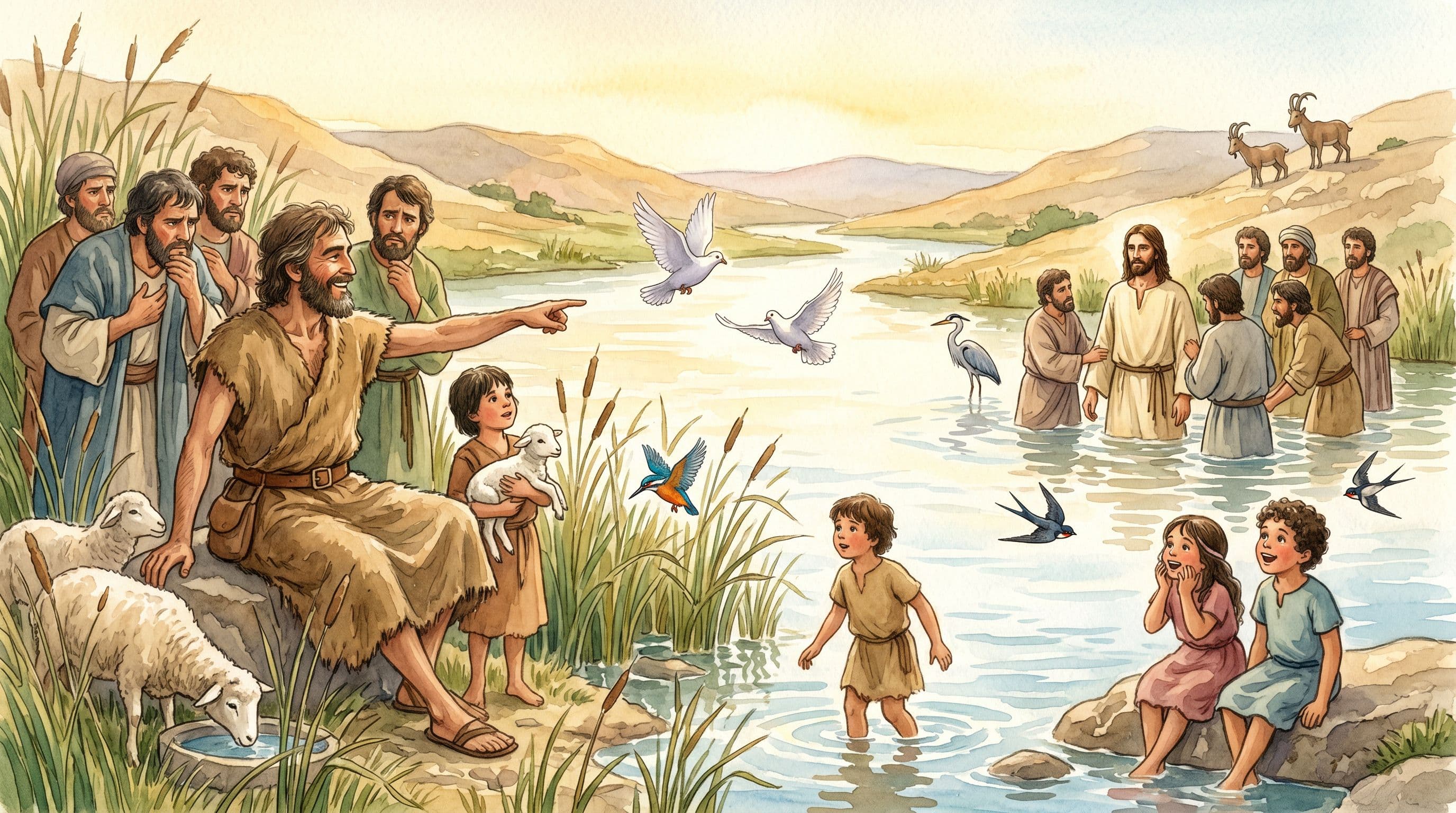
After his night-time conversation with Nicodemus, Jesus leaves Jerusalem with his disciples and moves into the Judean countryside. They begin baptizing too (John 4:2 clarifies it was the disciples, not Jesus personally). At the same time, John the Baptist is still working, a short distance away at Aenon near Salim -- a spot John names because "there was plenty of water." This is the only time in the Gospels Jesus and John overlap in active ministry. It does not last long: verse 24 quietly tells us this happened "before John had been put in prison."
The Argument
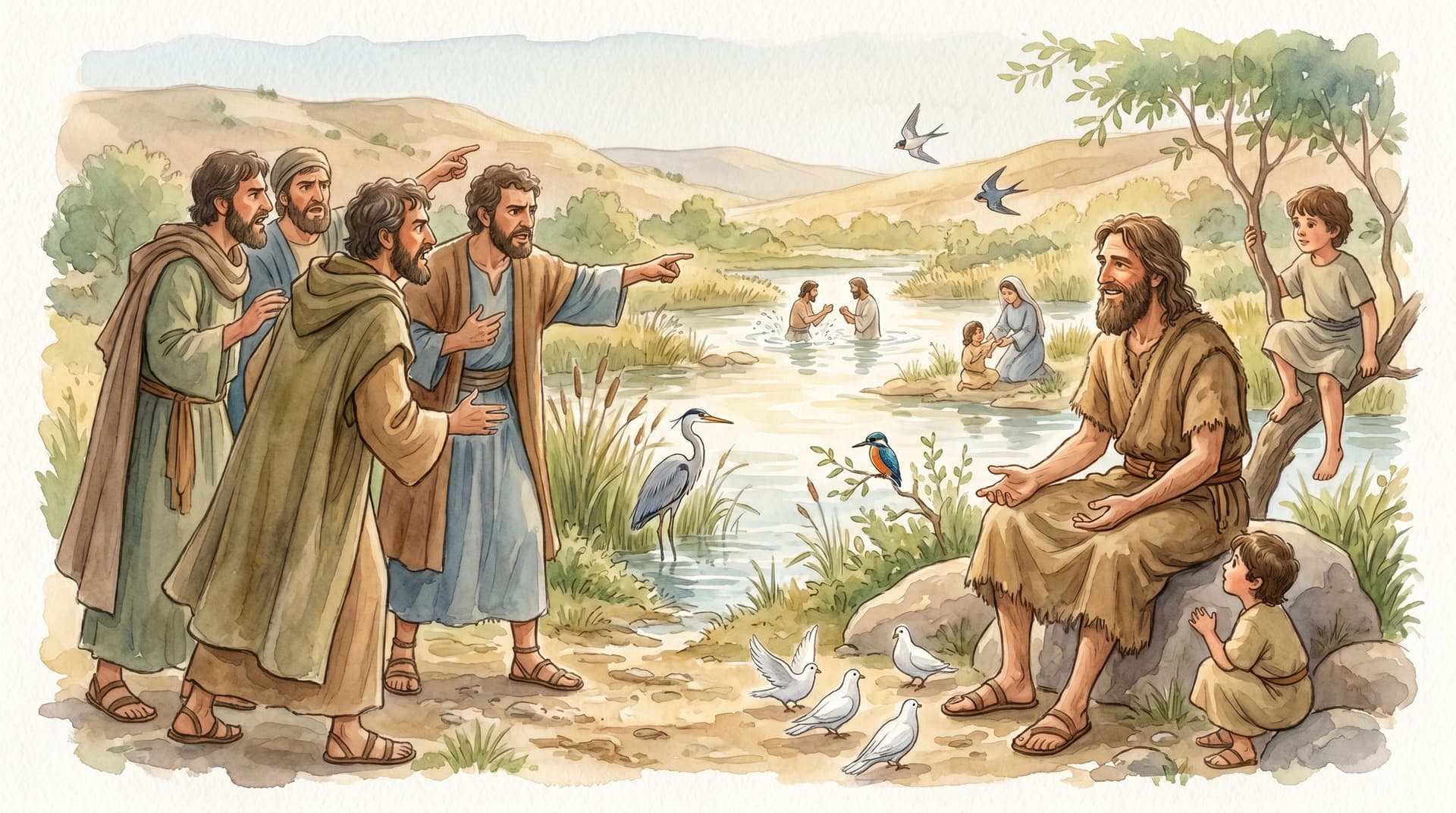
A dispute breaks out between John's disciples and "a Jew" about ceremonial washing. The text does not tell us what was said -- only what the disciples take from it. They come to John upset: "Rabbi, that man who was with you on the other side of the Jordan -- the one you testified about -- look, he is baptizing, and everyone is going to him" (3:26, NGET).
Underneath the words: jealousy. In rabbinical culture, a disciple's identity was tied to his teacher's reputation. If John's crowds were thinning, John was diminished -- and so were they. They are not asking John for theology. They are asking him to do something about it.
The Friend of the Bridegroom
John answers with a wedding picture his audience would have known immediately. The bridegroom had a shoshbin -- a trusted friend who arranged the marriage, brought the bride to the groom, and then stood outside the wedding chamber. When the friend heard the bridegroom's voice, his job was done. He was not the groom. He never expected to be. His joy was being trusted with the bridegroom's joy.
John reframes everything: he is the friend. Jesus is the groom. The bride was never his. Of course people are going to Jesus -- that is the whole point. The decrease is not a loss. It is the goal.
"From Heaven"
His first line is the foundation: "A person can receive only what is given them from heaven" (3:27, NGET). Crowds are not currency you earn. Influence is not yours to keep. Whatever John has, God gave -- and God can move it whenever he wants. That single sentence dissolves the whole jealous frame.
What the Original Audience Heard
The most famous prophet of the generation -- the one Jesus called the greatest born of women (Matthew 11:11) -- calmly telling his own disciples that being eclipsed by Jesus is not failure. It is success. And his joy is more complete the smaller he gets, not less.
The Author’s Intent
What is John (the Gospel writer) doing with this scene?
Movement 2: The Author's Intent
Passage: John 3:22-30
"What is John (the Gospel writer) doing with this scene?"
John's Last Word on Himself
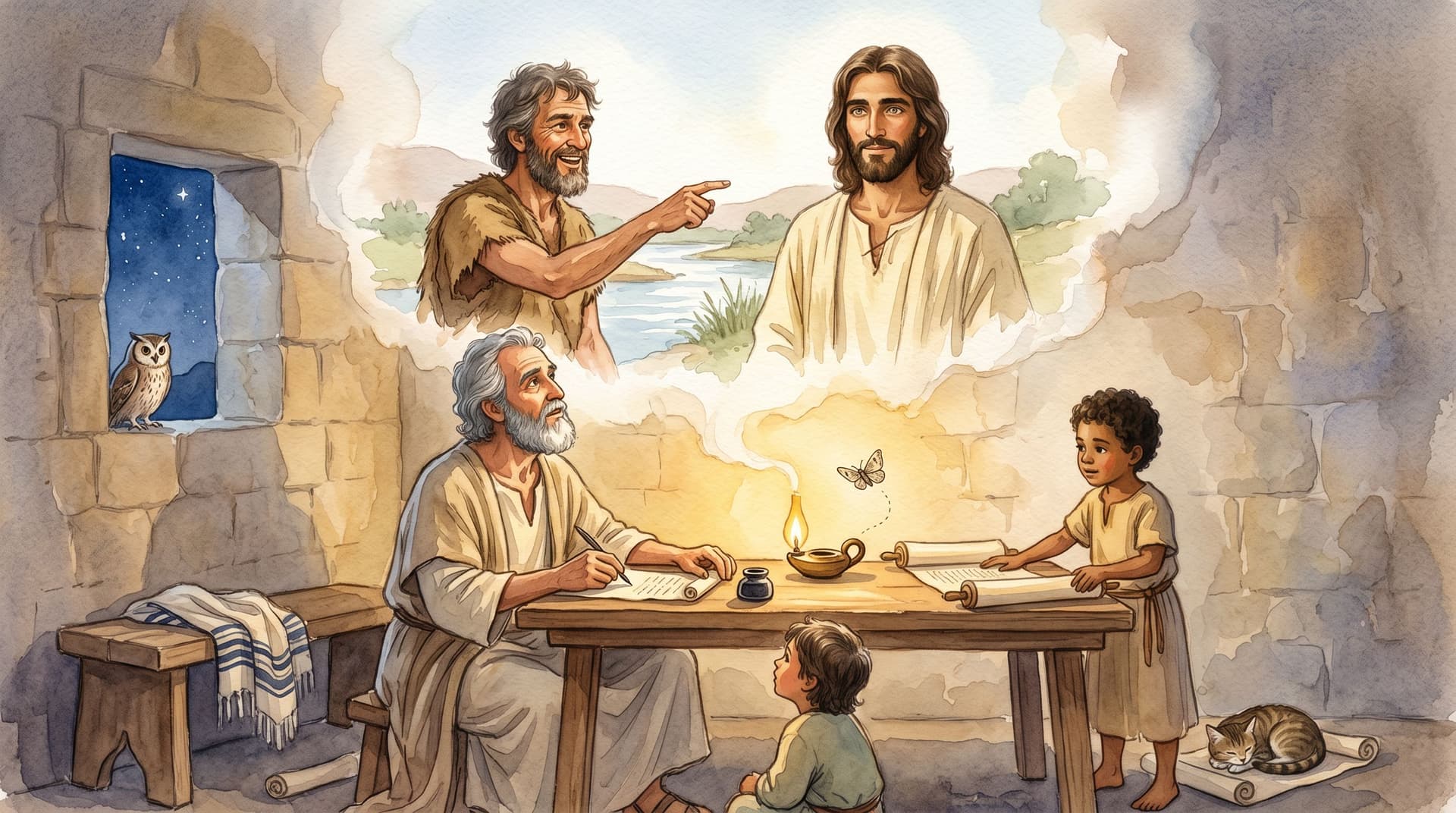
This is John the Baptist's final extended speech in the Gospel. After this, he is arrested and beheaded off-stage. The Gospel writer puts the Baptist's most clarifying line at the very end of his testimony, not the beginning. Everything earlier -- the wilderness preaching, the "voice crying out," the "behold the Lamb of God" -- gets summarized here in five words: He must become greater.
The Gospel writer wants the reader to hear the Baptist finish his own job correctly. Many in the early church still followed John the Baptist as a Messiah figure (see Acts 19:1-7). The author is closing that door from the Baptist's own mouth: I am not him. I never was. Stop looking at me.
The Bridegroom Theme Is Starting
John (the writer) uses wedding imagery as a thread through his whole Gospel. The first sign is at a wedding (Cana, John 2). Here the Baptist names Jesus as the bridegroom. The promise will end with the marriage supper of the Lamb in Revelation 19. By putting "bridegroom" in the Baptist's mouth this early, the writer is planting a seed: the story you are reading is a wedding story. Jesus is not just a teacher or a king. He is coming to take a bride.
Joy Is the Test
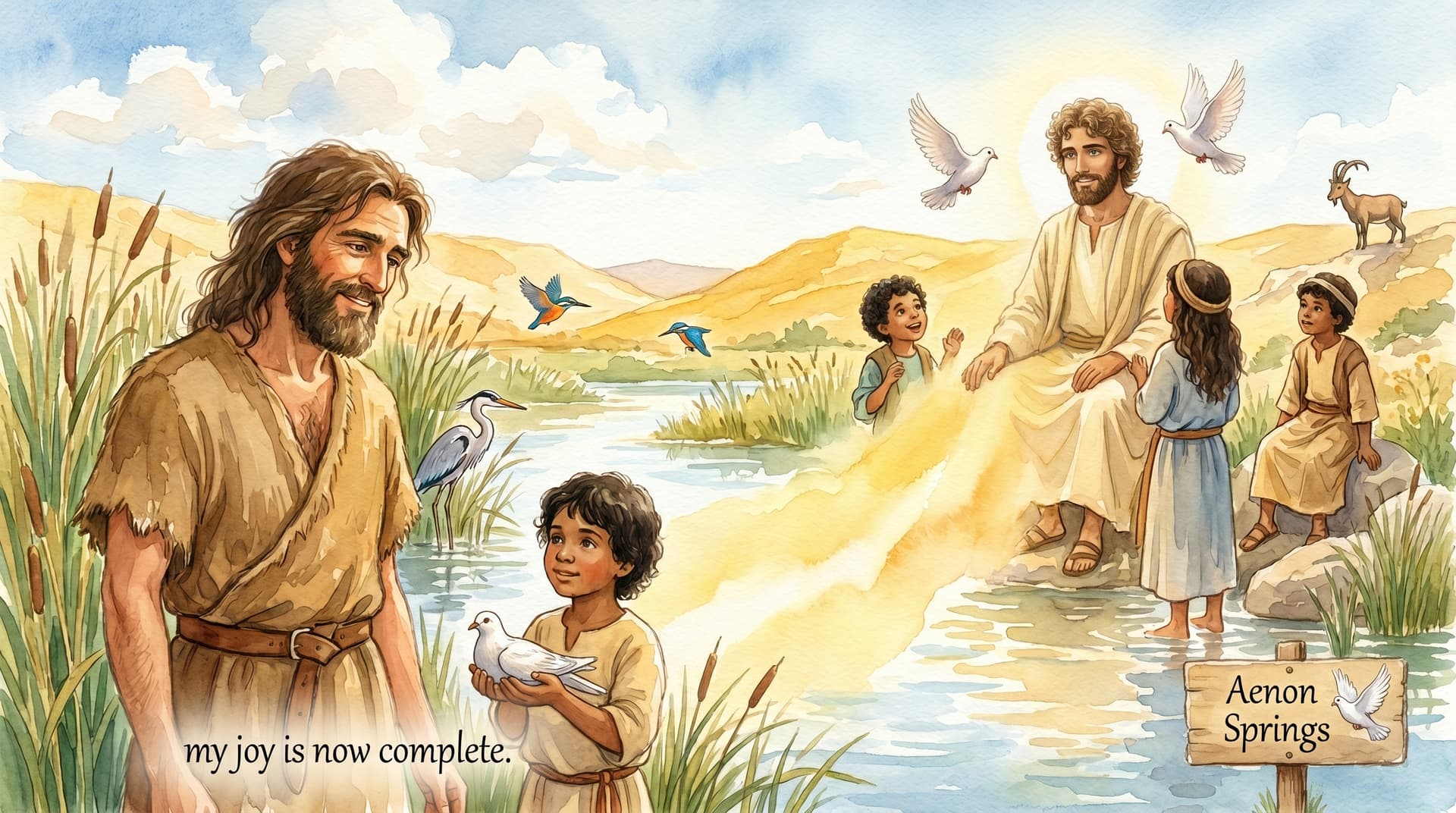
The Baptist's measure of faithfulness is not crowd size. It is joy. "That joy is mine, and it is now complete" (3:29, NGET). Complete -- peplērōtai -- the same word Jesus will use at the cross: "It is finished" (19:30). The writer is showing what mature faith sounds like: it does not feel emptied when Jesus gets the attention. It feels finally full.
The Three Moves the Writer Is Making
1. Identity comes from heaven, not from crowds. "A person can receive only what is given them from heaven" (3:27). The Baptist is not falsely modest. He is simply naming the source. Nothing he had was ever his to defend.
2. Joy comes from the bridegroom's voice, not from being the bridegroom. The friend's job is to bring the bride and then step out of the room. Faithfulness is being trusted with the joy -- not being the center of it.
3. The increase of Jesus is not a threat. It is the point. The disciples treat Jesus as competition. The Baptist treats Jesus as completion. The writer wants the reader to feel the difference.
The Useful Test
John (the Gospel writer) is using the Baptist's last big speech to settle the question: who is Jesus, and what does a faithful witness look like? Jesus is the bridegroom. The Baptist is the friend. And the friend's joy is full -- not in spite of becoming smaller, but because of it.
Seeing God
What does this passage reveal about who God actually is?
Movement 3: Seeing God
Passage: John 3:22-30
"What does this passage show us about God's beauty, glory, or character that we wouldn't see without it?"
The Facet of Beauty: A God Whose Presence Makes Smaller People Happier
Most heroes get bigger to be happy. The Baptist gets smaller to be happy -- and it works. The reason it works is the person he is decreasing in front of. Jesus is the kind of glory you can lose yourself in without losing anything. The closer you get, the less you need to be the center, and the more joy you actually have. That is not true of any other person, any other crowd, any other audience. Only Jesus.
What Is Surprising About God Here
He Is a Bridegroom, Not Just a King
The Baptist could have called Jesus a teacher, a prophet, the Messiah, the Lamb -- he has used all those titles already. Here he picks the one no one expected: the bridegroom. This is not the language of a ruler. It is the language of a husband. The God of Israel had called himself this in the prophets (Isaiah 62:5, Hosea 2:16), and now the Baptist is pointing at Jesus and saying: that one. The God of the universe came to take a bride, and you are looking at him.
His Voice Is the Joy
The Baptist does not say his joy is in seeing Jesus succeed, or in finishing his work, or in being faithful. He says his joy is in hearing the bridegroom's voice. That is striking. The joy is not in the outcome. The joy is in the person -- specifically, in being close enough to hear him. God is the kind of God who is his own reward. The reward for following him is more of him.
He Lets His Friends Be Friends
The Baptist is not a tool God used and discarded. He is called friend. Jesus will later say it explicitly to his disciples: "I no longer call you servants... I have called you friends" (John 15:15). The God revealed here does not want assistants who serve from a distance. He wants friends who stand outside the door, listening for his voice, glad just to be the ones who got to bring the bride.
Decrease Is the Shape of Glory
This is the strangest part. The God of this story makes joy expand as the witness shrinks. No human relationship works this way. Every other audience demands that you get bigger to matter more. With this God, the opposite is true. The closer you are to him, the smaller you can be and the happier you become. That is not religious humility. That is reality bending around a God who is actually that glorious.
What God's Emotions Look Like Here
Quiet sovereignty. The Baptist's whole answer assumes God gives, God moves, God decides who gets what. None of it is anxious. None of it is asking permission.
Marriage joy. Jesus is not on a mission. He is on his way to a wedding. The mood underneath this scene is celebration, not crisis.
Pleasure in his friends. The Baptist's joy is complete. That is not a sentence about the Baptist's psychology. That is a sentence about a God who fills people up by drawing close, not by handing out roles.
The Worship Test
The specific facet of beauty on display: God is the only person you can decrease in front of and be more, not less. Every other crowd you shrink in front of leaves you smaller. Jesus leaves you fuller. The Baptist is happier at his vanishing point than he was at his peak.
The beauty is this: the bridegroom showed up, and the friend who had spent his whole life pointing at him got to hear his voice. That was the whole payment. Not a title, not a crowd, not a promotion -- just the voice of the one he had been waiting for. And it was enough.
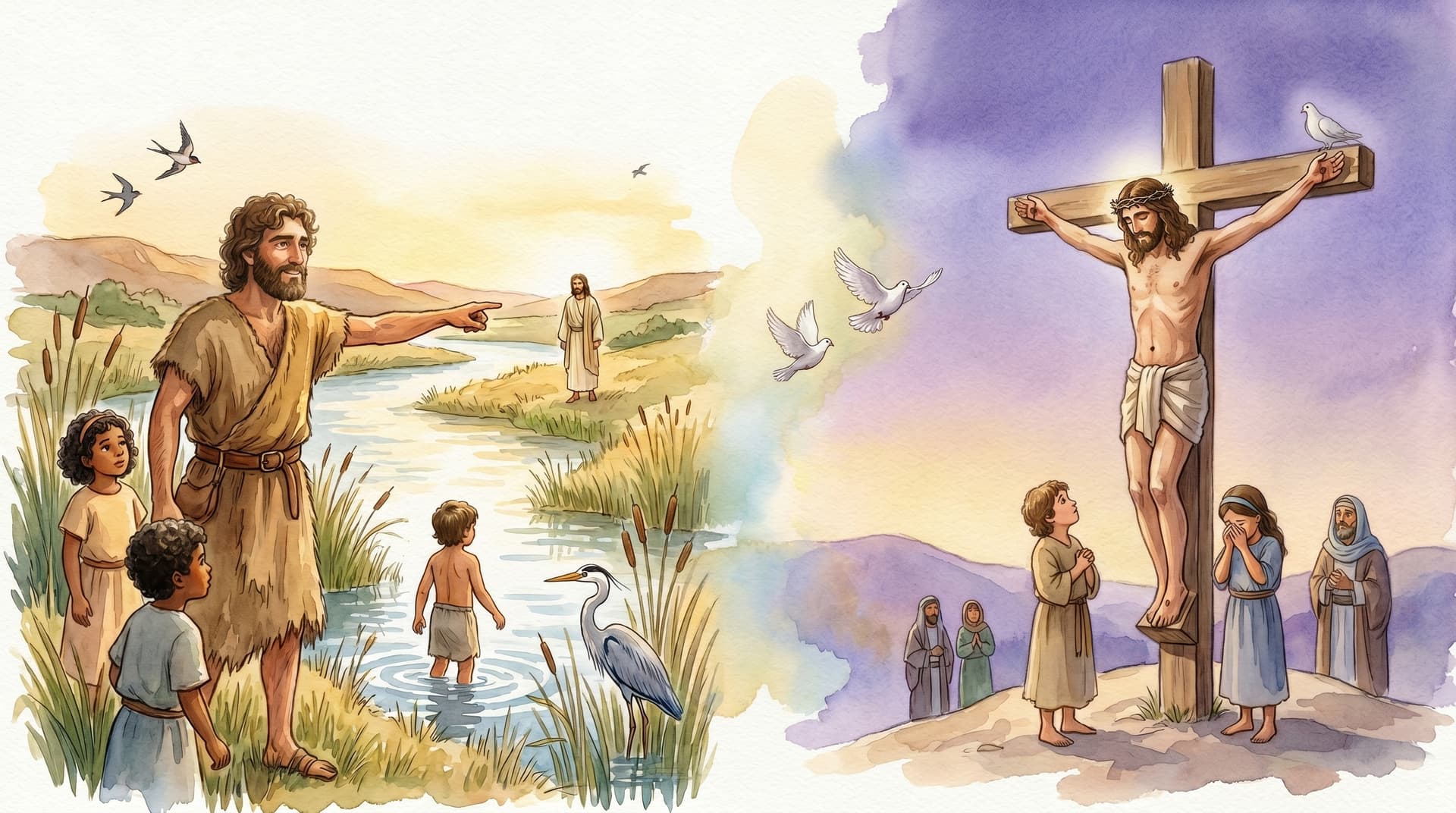
Gospel Connection
How does this passage connect to the gospel?
Movement 4: The Specific Gospel Connection
Passage: John 3:22-30
"How does Jesus fulfill, complete, or embody what this passage reveals -- SPECIFICALLY, not generically?"
The Rule
If the same point could be made from any other passage, it is not specific enough. Here, the gospel connection runs through the bridegroom image and the math of decrease.
Jesus Is the Bridegroom Who Decreases for the Bride
The Baptist says, "He must increase." But the Gospel does something stunning -- before Jesus increases, he decreases. He goes lower than the Baptist ever did. The Baptist loses his crowd. Jesus loses his life. The Baptist's decrease is the model. Jesus' decrease is the redemption.
This is the part the Baptist could not have seen yet: the bridegroom does not just take a bride. He buys her. The wedding requires a death. Jesus decreases all the way to the cross so that the bride -- the church -- can be his. And then he increases forever.
Specific connection: The Baptist's joy is hearing the bridegroom's voice. The bride's joy is being bought by the bridegroom's blood. The same person who taught John to be glad about decreasing is the one who decreased the furthest, so we could be his.
"He Must" Was the Cross, Not Just the Crowds
"He must become greater" is not a sentence about popularity. The Greek "must" -- dei -- is the same word the Gospels use for the necessity of the cross (Luke 24:26, Mark 8:31). Jesus must increase because of what he came to do. And the way he increases is by being lifted up -- on a cross first (John 3:14, just nine verses earlier), and then to the right hand of the Father. The Baptist may not have known how thick those two words were. The Gospel writer did.
Specific connection: The "must" in "He must become greater" is the same "must" that puts Jesus on the cross. His increase is not an upgrade. It is a resurrection.
The Friend's Joy Is the Christian's Joy
The Baptist gives us the template for what it feels like to follow Jesus correctly. The joy is not in being central. The joy is in being near. Hearing his voice is the payment. Every Christian who has loved Jesus more than their own platform knows the line is true -- and it does not work in reverse. People who try to be central next to Jesus end up bitter. People who shrink next to him end up full.
Specific connection: The Baptist is not just a model of humility. He is the first person in the Gospel of John who got the math right -- joy expands when Jesus expands, even at our own expense. This is the joy Jesus is offering every disciple who comes after him.
The Specific Mending
The brokenness this passage reveals: We are always trying to be the bridegroom. We want to be the favorite, the best, the one everyone is going to. The disciples' jealousy ("everyone is going to him") is the human default. We measure ourselves by comparison. We get smaller in our own eyes when someone else gets larger. We mistake being looked at for being loved.
The specific mending: Jesus does not fix our comparison problem by giving us better self-esteem. He fixes it by becoming the bridegroom himself -- the one person it is finally safe to lose to. Being decreased in front of Jesus is not loss. It is exactly what we were built for. Every other audience makes us hungry. He makes us full.
The new earth: "Let us rejoice and be glad and give him glory! For the wedding of the Lamb has come, and his bride has made herself ready" (Revelation 19:7, NGET). The Baptist heard the bridegroom's voice and called his joy complete. On the new earth, that voice is everywhere, and that joy is everyone's. The friend's joy becomes the bride's joy. The wedding the Baptist pointed to actually happens.
The Anti-Moralism Checkpoint
-
"Be humble like John the Baptist." Too thin. The Baptist's humility was not a personality trait he worked on. It was the natural shape of standing next to Jesus. Telling kids to be humble without showing them who they are humble in front of just produces a different version of self-focus.
-
"Don't be jealous." Misses the engine. The disciples were jealous because they thought identity was a zero-sum game. The cure is not less jealousy. The cure is a bigger Jesus.
-
"Point others to Jesus instead of yourself." True but generic. The passage is more than evangelism advice. It is teaching that the soul itself gets bigger as it points smaller. That is theology, not technique.
-
"And this all points to Jesus who died for our sins." Too generic. This passage specifically reveals Jesus as the bridegroom who comes to take a bride, the "must" that drives him to the cross, and the joy that fills a faithful witness as they shrink in front of him.

Why Kids Care
How does this truth intersect with their actual lives?
Movement 5: Why Should a 5-10 Year Old Care?
Passage: John 3:22-30
"What does this mean for their actual lives of play, fun, friendship, and family?"
This movement is a brainstorm -- a menu of angles for the teacher to pray through. Pick what fits your kids. Skip the rest.
A translation note: The Bible's picture is a wedding -- John as the "friend of the bridegroom." For 5-10 year olds who haven't lived a wedding yet, the joy of that role is hard to feel. Below uses a parallel that maps onto something they actually do: showing up at your best friend's birthday party with a gift you picked out for her. Same theological move -- you are thrilled when the person you love opens the thing you brought, because giving it to her was the whole point. (Strictly, John is also part of the bride Jesus came to take. "Friend of the bridegroom" is the role he plays in this specific moment of handing off. The kids don't need to carry that distinction.)
The Lesson: The Gift Was Always Going to Her
The Arc
Three truths kids need to feel:
1. "John's disciples were upset that everyone was going to Jesus. They expected John to be upset too." Everyone was leaving John for Jesus. His followers thought that was bad news for them. They wanted John to fix it.
2. "John said: imagine you walked into your best friend's birthday party with a present you picked out yourself. When she opens it and everyone is around her -- are you sad?" You're not sad. You're thrilled. The whole reason you brought it was to give it to her. Watching her love it is the joy. You were never going to keep it.
3. "He must become greater; I must become less." Not sad. Not defeated. Glad. The smaller John got next to Jesus, the more full his joy got -- because Jesus is who the gift was always for. John had spent his whole life getting people ready to turn to Jesus. Now they were turning. The present was being opened. The party was working.
The Role Play: The Birthday Present
Characters: Narrator (teacher), John the Baptist (volunteer), John's disciples (3-4 kids), Jesus (volunteer), the rest of the class as the "townspeople" / party guests.
Scene 1 -- The Complaint. John's disciples come running, agitated. "Rabbi! Everyone is going to that other guy! Nobody is even mentioning your name anymore! We have to do something!" John just smiles.
Scene 2 -- The Picture. John pulls them in. "Imagine you walk into your best friend's birthday party with a present in your hands. You picked it out. You wrapped it yourself. You have been thinking about her face when she opens it for weeks. You hand it to her. She unwraps it. She gasps. Everyone gathers around her to see what it is. Nobody is hugging you. Are you sad?"
Let the kids answer. (They will say no.) "Why not?"
(Let them work it out.) "Right. Because the present was always going to her. You weren't trying to keep it. You came to give it. Watching her love it is the whole reason you came."
Scene 3 -- The Joy. John turns toward the river. "That is what is happening right now. I have spent my whole life getting this gift ready -- telling people, somebody amazing is coming. Now he is here. And the people are going to him. That is the present being opened. That is the party working exactly right."
Scene 4 -- The Math. John turns slowly to his disciples. "He has to get bigger. I have to get smaller. And -- this is the part you keep missing -- that is what I want. I am happier right now than I have ever been."
Why Should They Care?
Angle 1: When the Joy Is in the Giving, Not in Being Thanked
The kid's world: Handing your best friend the birthday present you picked out. Showing your dad the drawing you made for him. Bringing your mom flowers from the yard. Helping your little sister tie her shoe. The little spark of joy when the thing you brought lands the way you hoped.
The God-first landing: John spent his whole life getting people ready to turn toward Jesus. The "gift" was every person who walked toward the river to be baptized. When those people started walking past John to Jesus instead, John wasn't losing -- he was finishing the giving. The whole point was to hand them over. When you love Jesus, the things you do for him are gifts too. Your kindness to your sister, your prayer for your friend, the way you tell somebody about him -- those are presents. The joy isn't being told you did a good job. The joy is handing them to him and watching him have them.
Landing statement: "When you love somebody enough, giving feels better than being thanked. Jesus is that somebody."
Angle 2: When You Don't Have to Defend Your Name
The kid's world: Somebody told the story wrong and you didn't get credit. Your sibling used your idea and acted like it was theirs. The teacher praised somebody else for the thing you did. The little voice inside that says they need to know it was me.
The God-first landing: John was the most famous prophet of his generation. When Jesus showed up, all that attention started moving away from him -- and he did not chase it. He did not remind everyone of his miracles. He did not defend his reputation. He didn't need to. Jesus knew exactly who John was. That was enough. The same is true for you. The most important Person in the universe knows your name, your story, every quiet good thing you did that nobody noticed. You can let go of the smaller spotlight because the bigger Eye is already on you. Defending your name is a job you do not have to take.
Landing statement: "You don't have to fight to be remembered. Jesus already knows. That is enough."
Object Lesson Option: The Wrapped Present
Setup: Bring a real wrapped gift -- anything, a candy bar, a small toy, doesn't matter what's inside. Pick two volunteers. Volunteer A is the "gift giver." Volunteer B is the "birthday kid."
Hand the present to Volunteer A. Tell them: "It's your best friend's birthday. You picked this out for her. Walk over and give it to her."
Volunteer A hands it over. Volunteer B unwraps it. As soon as B starts opening it, tell the rest of the class: swarm her. "Wow! What is it? That is so cool! Happy birthday!" Everyone crowds Volunteer B. Nobody looks at Volunteer A.
Turn to Volunteer A and ask, loud enough for the room: "Are you sad nobody is looking at you?"
Wait for the answer. The kid will probably say no, with a smile. Ask why. Let the answer come from them.
Debrief: "Right. You weren't trying to keep the gift. You came to give it. Watching her love it is the whole reason you came. If everyone had run to you instead, the party would have broken. The present was always going to her.
That is exactly what John the Baptist felt when Jesus showed up. John had spent his whole life getting a gift ready -- telling people, get ready, somebody amazing is coming. When that somebody finally showed up and the people went to him, John wasn't losing. He was finishing the giving. He was the happiest person on the riverbank.
Here is why this matters for you. You will spend a lot of years watching other people get attention you wanted. A sibling, a classmate, a friend. The world tells you that means you lost. Jesus tells you something different. The things you do for Jesus are gifts -- and gifts don't belong to you. Once you hand them over, the joy is in him having them, not in everyone noticing you gave them. The smaller you get next to Jesus, the fuller the giving feels."
Follow-Up Questions
- "Have you ever given someone a present you were really excited about? How did it feel when they opened it?"
- "Why wasn't John sad that people were going to Jesus?"
- "Is there a time you wanted everyone to know it was you who did something? What did that feel like?"
- "What does it feel like to know Jesus already knows everything good about you, even when nobody else does?"
- "What is something you could 'give' to Jesus this week -- not a thing, but a small action -- where the joy would just be in giving it?"
Age Notes
Younger (5-6)
- Stay on the wrapped present. They have given gifts. They know the feeling. The picture is the whole lesson.
- Skip the wedding/bridegroom mention entirely.
- Landing: "John was bringing a gift to Jesus. The gift was the people. And John was happy when they went to him."
Older (8-10)
- The Bible actually uses a wedding picture, not a birthday gift. Mention it briefly: "John says he's like the 'best man' at a wedding -- the friend who helps get everything ready, then steps back when the groom shows up. We're using a birthday present because it's the same idea and easier to feel."
- Push the reputation question hard. "When have you wanted credit and didn't get it? What did that feel like? What would change if you really believed Jesus already knew?"
- Name the trap: most of life is a fight to defend your name. Jesus is the One whose attention you don't have to fight for -- and he is the only audience that finally counts. That changes the size of every other spotlight.
What to Skip
- The exact location of Aenon near Salim. "John was still baptizing nearby." Done.
- The dispute about ceremonial washing. "His followers got into an argument, and they came back upset."
- A long explanation of "shoshbin" / Jewish wedding customs. Mention "best man" only in passing if at all. Don't camp there.
- Peer-vs-peer comparison framing. The story is not "be gracious when your friend wins." It is "Jesus is the One worth loving more than your own spotlight." Keep Jesus as the One getting bigger, not a peer.
Landing Statements
Format: God is/does ___. And because of that, you ___.
- "Jesus is who the gift was always for. You don't have to keep it. Giving it to him is the joy."
- "John's joy was full when Jesus got bigger. The trick isn't being humble. The trick is loving Jesus enough that his bigness feels like a present being opened."
- "Jesus already knows your name and every good thing you did. You don't have to spend so much energy making sure other people know."
- "What you have was given from heaven. You don't have to defend it, and you don't have to compare."
Kid Questions
"Was John sad that people were leaving him?" "No. That is the surprising part. He said his joy was complete -- more full than ever. He had spent his whole life telling people, 'Someone amazing is coming.' When that someone finally showed up and the people went to him, John wasn't losing. He was finished, in the best way. Like the kid who walks into a party with a present and is the happiest person in the room when their friend opens it."
"What does 'he must become greater; I must become less' mean?" "It means Jesus is supposed to be the big one, and John is supposed to be the small one -- and that is exactly how it should be. John wasn't trying to be a hero. He was bringing a gift to the hero. When the hero shows up and starts opening the gift, the gift-giver steps back. That is a good thing, not a sad thing."
"Is it bad to want to be good at things?" "No -- God made you to do things and do them well. The question is who you're doing it for. If you're doing it so people will look at you, you'll never have enough. If you're doing it because Jesus is good and you want him to have it, you can keep getting better and stay happy at the same time. The Baptist did real things and worked hard. He just always knew who the gift was for."
"Why a present? Was John actually bringing Jesus a gift?" "Not a wrapped one. We're using a picture to feel the same thing. The 'gift' John was bringing was every person he was getting ready -- helping them turn their heart toward Jesus. When those people went to Jesus, John was handing the gift over. That was the whole reason he was there. The Bible uses a different picture -- a best man at a wedding -- but the feeling is the same: the friend's joy is full when the main Person finally has what was always meant for him."
The Bottom Line
This lesson gives kids a Jesus worth giving everything to. John's joy got bigger the smaller he became, because the Person he was decreasing for was Jesus -- the Friend the gift was always meant for.
The temptation will be to land on "be humble" or "don't be jealous of your friends." Resist both. The story is not about peer competition. It is about Jesus. Jesus is the One worth loving more than your own spotlight. The smaller John got next to Jesus, the fuller he became -- because his whole life was a present he had been waiting to hand over, and now it was being received. When kids see that the joy is in the giving, not in being thanked, they have the heart of this passage.