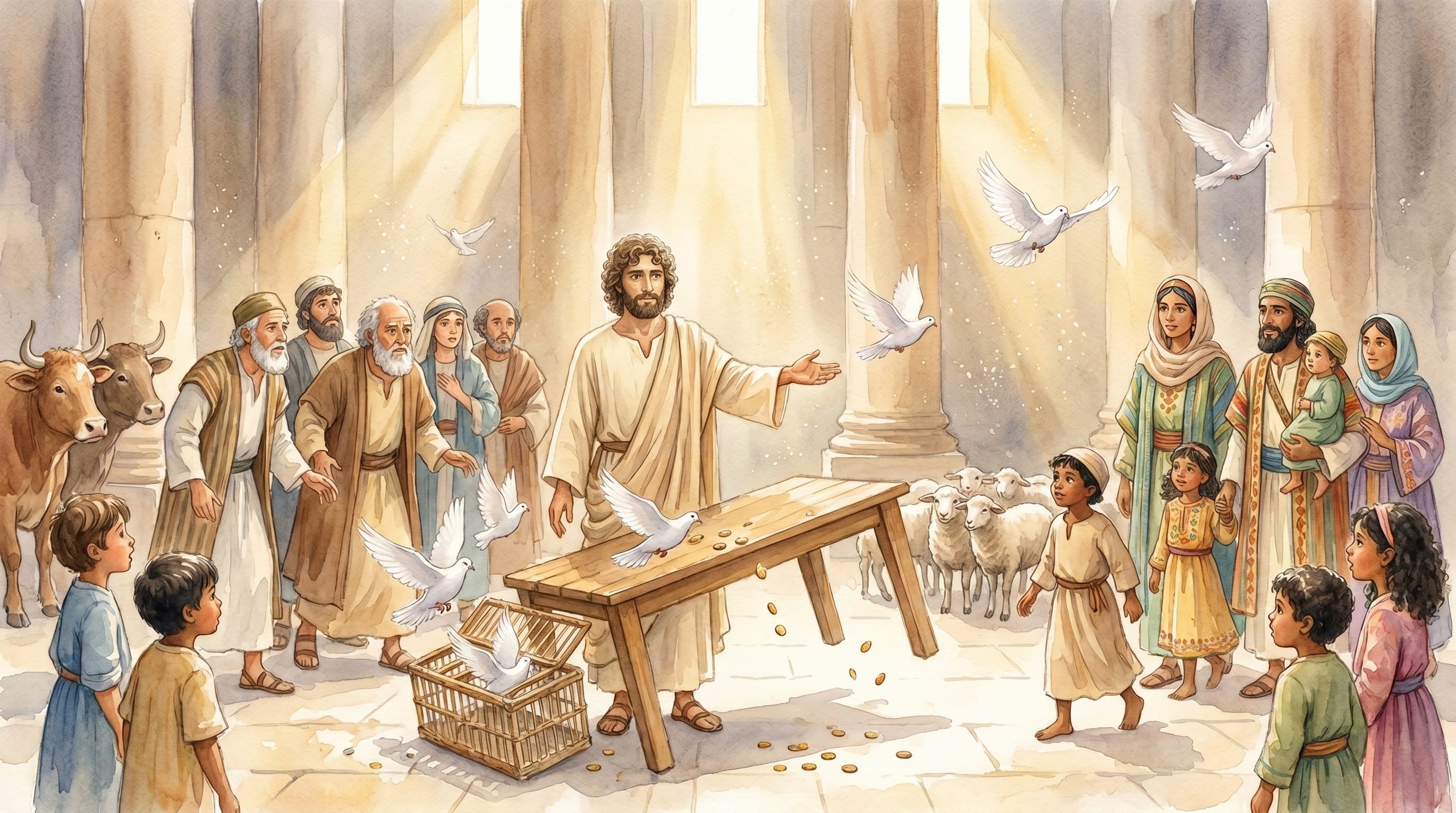
Jesus Cleanses the Temple
A lesson preparation guide for teaching 5–10 year olds
The Original Audience
What did this mean to the people who first heard it?
Movement 1: The Original Audience
Passage: John 2:13-22
"What did this mean to the people who first heard it?"
The World of the First Passover of Jesus' Ministry
John places this scene at the very beginning of Jesus' public ministry -- his first Passover as a teacher with disciples. The other Gospels record a similar temple cleansing at the end of Jesus' life. John deliberately puts his account up front. Whether he is recording a separate earlier event or relocating the scene for theological effect, the point is the same: from the first day, Jesus' ministry is on a collision course with the temple.
The temple was the center of everything. It was not just a building. It was the place God had promised to dwell. It was where sins were forgiven through sacrifice, where pilgrims came from across the empire, where heaven and earth touched. To stand in the temple courts was to stand at the most important address on the planet.
Herod's temple was massive and unfinished. "It has taken forty-six years to build this temple" (John 2:20, NGET). Construction had begun under Herod the Great around 20 BC and would not be fully finished until 64 AD -- six years before Rome demolished it. The complex covered roughly 36 acres. Walking into it would have felt like walking into the world's most impressive cathedral while it was still under scaffolding.
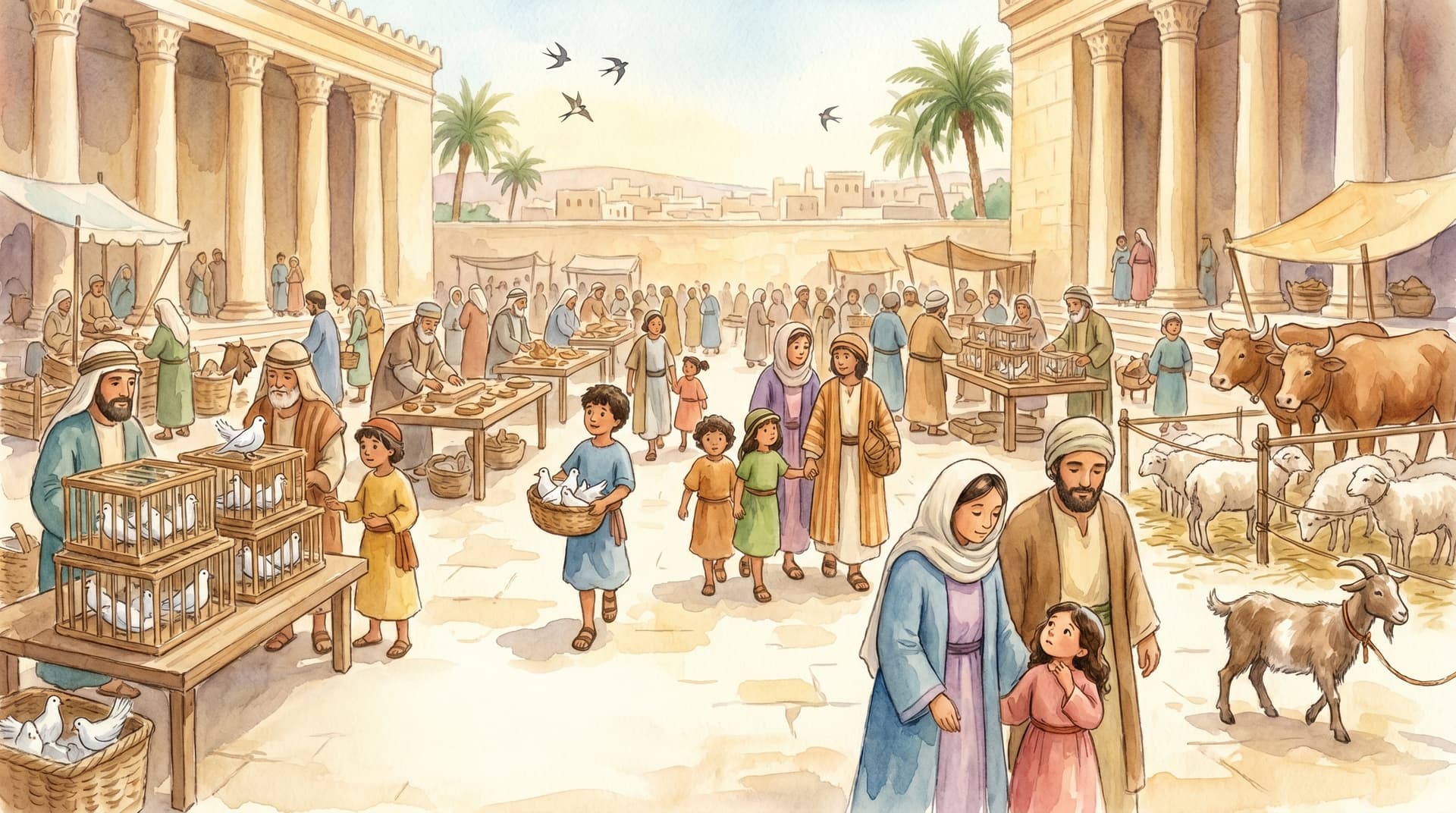
The Court of the Gentiles was the outermost area -- the only space non-Jews were permitted to enter. It was meant to be a place of prayer for the nations (Isaiah 56:7). It had become a livestock market.
The merchants had a logical reason to be there. Pilgrims traveled long distances and could not bring their own animals -- they needed to buy approved sacrifices on site. Roman coins bore Caesar's image, which counted as idolatry, so they had to be exchanged for Tyrian shekels to pay the temple tax. The system was practical. It was also exploitative -- exchange rates were brutal, and animal prices were marked up because pilgrims had no alternative.
But the deeper problem was location. The market was set up in the Court of the Gentiles -- the one place outsiders could pray. The system that "served" Israelite pilgrims actively shut out the people Israel was supposed to bless. Worship for some required excluding the rest.
"My Father's house" was a stunning claim. Jewish tradition called the temple God's house. By calling it his Father's house, Jesus was saying something his audience could not miss: he is the Son of the one this whole place exists for.
The Emotional Temperature
The merchants would have been indignant -- this was their livelihood, sanctioned by the temple authorities. The pilgrims would have been split: some grateful that someone finally said it, others angry their Passover preparations had just been disrupted. The disciples were watching their teacher do something dangerous in his first public act in Jerusalem.
The religious leaders did not ask, "Were we wrong?" They asked, "What sign do you show us for doing this?" (2:18). Translation: who gave you authority over our temple?
Jesus' answer was a riddle they would not understand for three years.
Why This Matters for Kids
"Imagine your school has a chapel where everyone is supposed to pray, and one day you walk in and find people selling stuff in there -- and the only people who can't fit in anymore are the visitors. Then a kid your age walks in, flips the tables, and says, 'This is my Dad's place. You don't get to use it like this.' Everyone freezes. Who is this kid? That is what happened the first time Jesus walked into the temple as a teacher."
The Author’s Intent
What was John trying to show by placing this scene at the start?
Movement 2: The Author's Intent
Passage: John 2:13-22
"What was John trying to do with this text?"
Why John Puts This Scene at the Start
John structures his Gospel around signs and around Jesus' "hour." He places the temple cleansing at the very beginning, right after the wedding at Cana. The Synoptic Gospels (Matthew, Mark, Luke) place a temple confrontation at the end. John is making a deliberate choice: from chapter two, the reader should know that Jesus did not come to renovate the temple system. He came to replace it.
The first miracle was wine at a wedding (John 2:1-11). The first public act in Jerusalem is overturned tables. John pairs them on purpose: Jesus replaces ceremonial water with celebratory wine, and Jesus replaces the temple with himself. Both scenes say the old containers cannot hold what Jesus is bringing.
The Three Things John Wants You to See
1. Jesus' Zeal Is Not a Loss of Control
"Zeal for your house will consume me" (John 2:17, NGET, quoting Psalm 69:9). John is the only Gospel writer who quotes this verse, and he chooses the future tense -- "will consume me." Psalm 69 is a Suffering Servant psalm. The same zeal that drives Jesus to clear the temple will eventually be the zeal that drives him to the cross. His anger here is not a tantrum. It is the same love that will lay his life down. The whip in his hand on Tuesday will be replaced by nails in his hands on Friday -- and both come from the exact same heart.
2. The Riddle Is the Point
"Tear down this temple, and I will raise it back up in three days" (John 2:19, NGET). The leaders take it literally. They miss it. John steps in to translate: "But he was speaking about the temple of his body" (2:21, NGET).
This is John's signature move. Characters hear Jesus literally and miss the deeper meaning -- Nicodemus on being born again, the Samaritan woman on living water, the crowd on bread from heaven. The misunderstanding is not a side effect. It is the structure. John wants the reader, with hindsight, to see what the original audience could not: Jesus is the temple.
3. The Disciples Only Got It Later
"After he was raised from the dead, his disciples remembered that he had said this, and they trusted in the Bible and the words Jesus had said" (John 2:22, NGET). John is honest: even insiders did not understand in real time. The cross and resurrection rewired how they read everything that came before. Faith here is not "figuring it out as it happens." Faith is going back, after the resurrection, and seeing that everything had pointed to it.
The Useful Test
"John wrote this passage because the audience needed to understand that Jesus did not come to fix the temple system but to replace it -- with himself. His zeal for God's house and his willingness to be torn down come from the same love. And the disciples only saw the whole picture after the resurrection, which is also how the readers see it now."
Seeing God
What does this passage reveal about who God actually is?
Movement 3: Seeing God
Passage: John 2:13-22
"What does this passage show us about God's beauty, glory, or character that we wouldn't see without it?"
The Facet of Beauty: A God Whose Anger Is Love Protecting Access
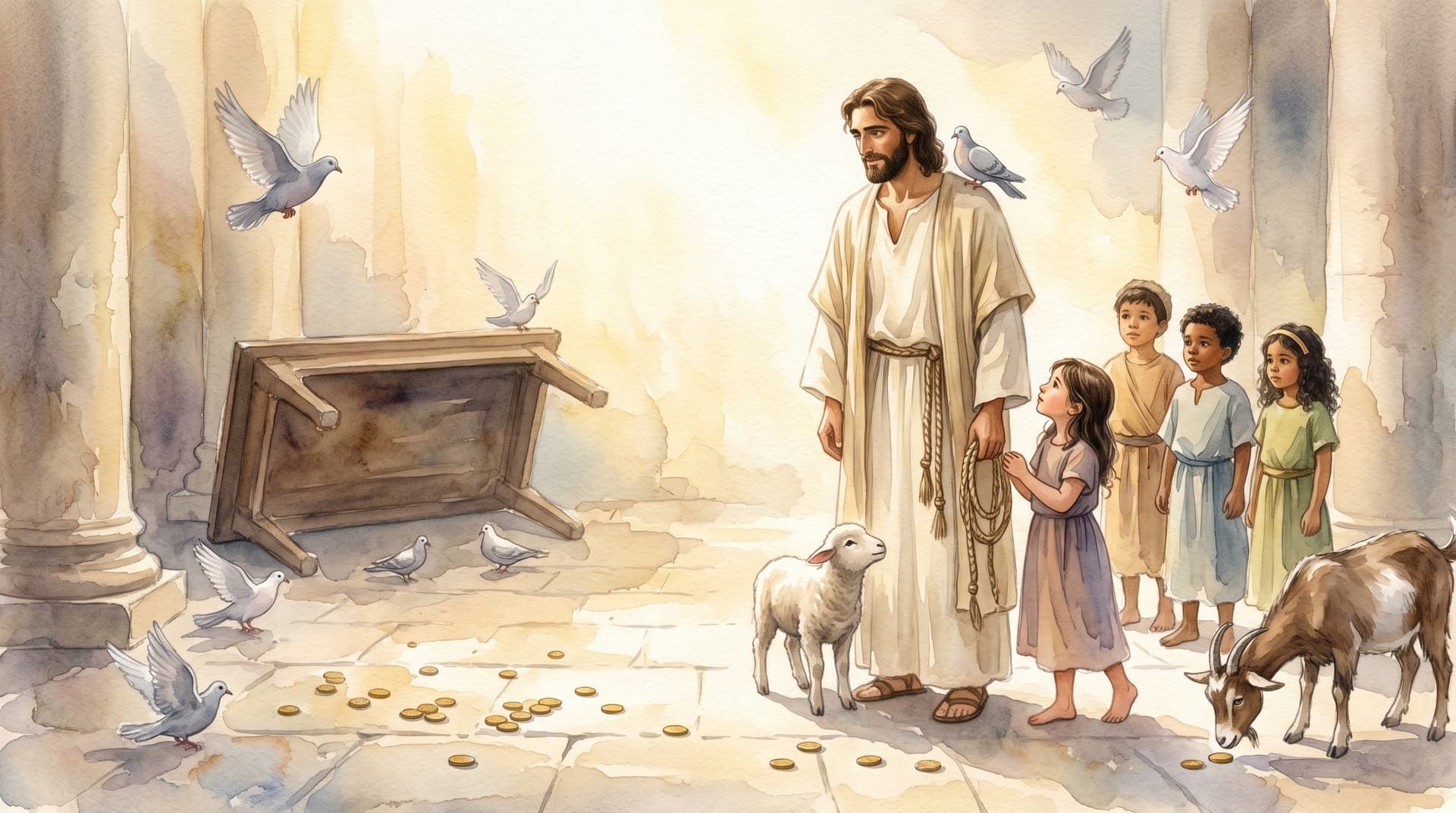
Most kids are taught a Jesus who is gentle, patient, and kind. He is. But in this passage he braids cords into a whip and drives livestock and people out of a courtyard. If the only Jesus a kid knows is the smiling one in the picture book, this scene short-circuits. That is the point. The God of the Bible is more than nice. His love is fierce, and his fierceness has a target -- not people who wandered in confused, but a system that was keeping people out.
What Is Surprising About God Here
His Anger Has an Address
Jesus does not lash out at the merchants for being merchants. He drives them out because of where they are. The Court of the Gentiles was the one place outsiders could pray, and it had been turned into a barnyard. God's anger here is not against sin in the abstract -- it is against what was making it harder for outsiders to come near him. His fury is hospitality with teeth.
He Calls It "My Father's House"
This is the first time in John's Gospel Jesus speaks publicly about his identity, and he does it in the temple. The temple was God's house. By calling it his Father's house, Jesus is claiming sonship in a way no one in Israel had ever claimed it. The God of the temple has a Son, and the Son has shown up to take inventory.
He Is Already the Replacement
"Tear down this temple, and I will raise it back up in three days" (John 2:19, NGET). Standing in the most sacred building on earth, Jesus says: this place is about to become unnecessary. Not because God stopped wanting to dwell with people, but because he found a better way. The whole point of the temple was that God would meet humanity somewhere. From now on, the somewhere is a someone.
He Walks Toward His Own Demolition
The verb Jesus uses is striking: "tear down" (lyō) -- the same word used for releasing prisoners or dissolving structures. He invites it. The temple system would not be reformed. It would be torn down -- in his body. He sees it coming. He walks in anyway.
What God's Emotions Look Like Here
Protective fury. Not random anger. Anger aimed at what blocks people from God.
Quiet ownership. He moves through the courts like the owner of the place, because he is. No permission asked. No vote taken.
Patient riddle. He does not explain himself to the leaders. He hands them a saying they will only understand after Easter morning. He is content to be misunderstood now if it means being seen rightly later.
The Worship Test
The specific facet of beauty on display: God's love is fierce enough to flip tables for the people who can't get in. His anger in the temple is not the opposite of his love at the cross. It is the same love showing up differently. The Jesus who weaves the whip is the same Jesus who will be torn down himself so that no one ever has to be kept out again.
The beauty is this: the Son of God walks into his Father's house, finds it being used to lock people out, and does something about it. Then he walks toward his own death so that the new house -- his body, his church, his people -- can be wide open forever. The whip and the cross are the same heart.
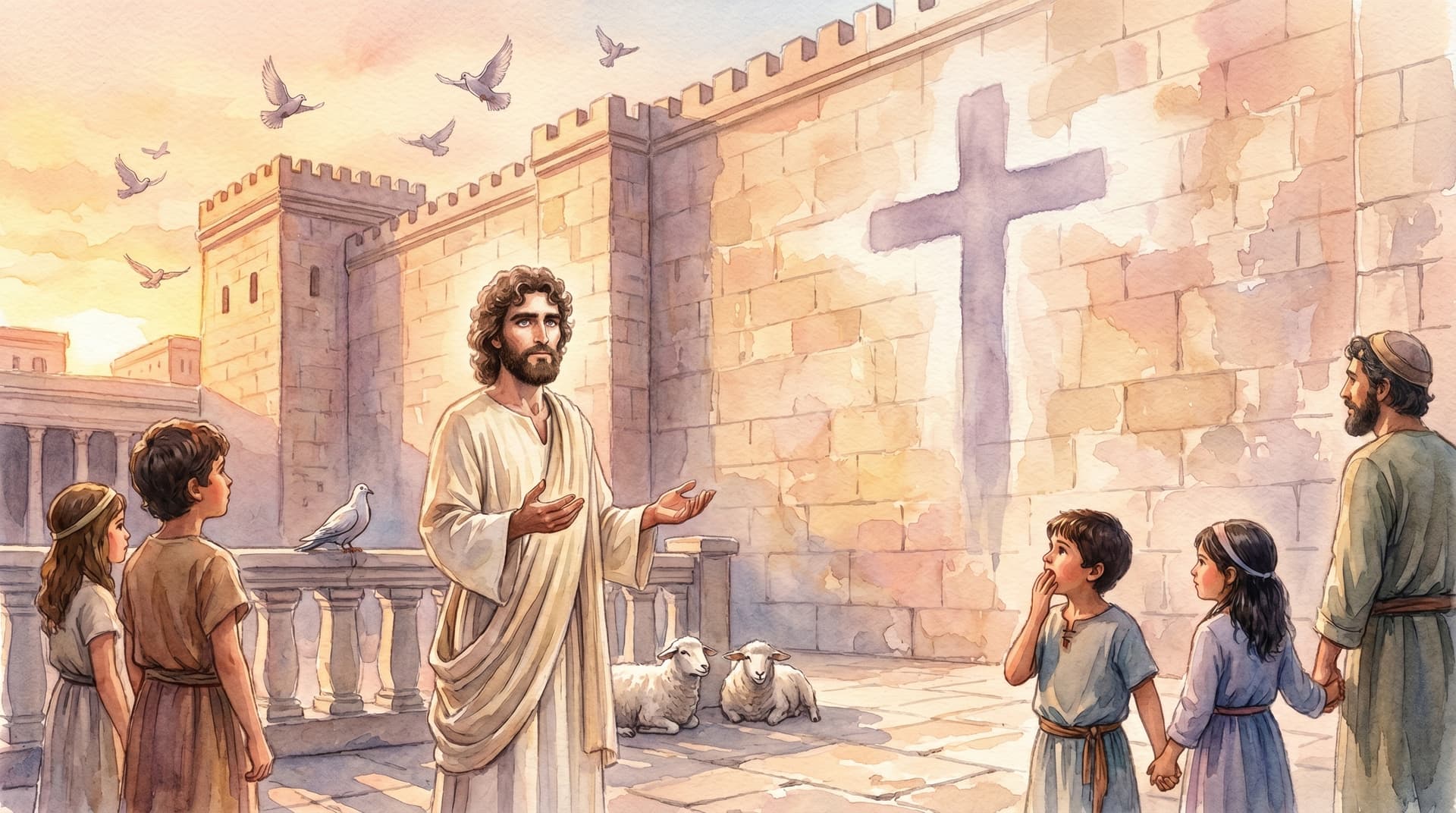
Gospel Connection
How does this passage connect to the gospel?
Movement 4: The Specific Gospel Connection
Passage: John 2:13-22
"How does Jesus fulfill, complete, or embody what this passage reveals -- SPECIFICALLY, not generically?"
The Rule
The connection has to be specific to what the temple cleansing reveals. If the same point fits any other passage, it is not specific enough.
Jesus Is the Temple
This is the heart of the passage and John says it outright: "He was speaking about the temple of his body" (2:21, NGET). The temple was the place God promised to meet people, where sacrifices were made, where heaven and earth touched. Jesus declares that all of that is now him. His body is the meeting place. His death is the sacrifice. His resurrection is the new Holy of Holies thrown open.
Specific connection: Every function the temple performed, Jesus performs in his own body. You do not need a building, a priest, or a particular city to come near God anymore. You need Jesus -- and he is offering himself. The temple cleansing is not just judgment on a corrupt system. It is the announcement that the system was always pointing to him.
The Whip and the Cross Come from the Same Love
Psalm 69:9 -- "Zeal for your house will consume me" -- is a Suffering Servant text. John quotes it precisely because the same intensity that drives Jesus to clear the courts will drive him to lay down his life. Anger and atonement are not opposites in him. Both protect access. The whip clears the way for outsiders to pray today. The cross clears the way for outsiders to come home forever.
Specific connection: When Jesus loves you, he is not soft. He is fierce about anything that gets between you and his Father. The same love that flips tables on Tuesday is the love that gets nailed to a cross on Friday. Both moves remove obstacles. Neither is more "him" than the other.
He Walks Toward His Own Demolition
"Tear down this temple, and I will raise it back up in three days" (2:19, NGET). The leaders thought he was crazy. The disciples thought he meant the building. He meant his body. From his very first Passover in Jerusalem, Jesus is announcing that he came to be torn down. He is not surprised by the cross. He is not cornered by it. He aimed at it.
Specific connection: Jesus is the only person in history who walked into his own death willingly, scheduled it from the start, and promised the resurrection before the death. The temple cleansing is the trailer for the cross -- and Jesus wrote, directed, and starred in it on purpose.
The Specific Mending
The brokenness this passage reveals: We turn relationship with God into transaction. The merchants were not pure villains -- they were running a system where worship had become a marketplace, where access required payment, where some people were always on the outside. Every kid (and every adult) does some version of this. We try to earn God's nearness by being good enough, performing well enough, looking right enough. And we shut other people out in the process.
The specific mending: Jesus does not renovate the marketplace. He shuts it down. You cannot pay your way to God because Jesus already paid. You cannot earn your way in because the doors were knocked off the hinges when the curtain tore. The temple cleansing exposes the false economy. The cross ends it forever.
The new earth: "I did not see a temple in the city, because the Lord God Almighty and the Lamb are its temple" (Revelation 21:22, NGET). On the new earth there is no temple at all -- not because God is absent but because he is everywhere. The cleansing was the beginning of the end of buildings as access points. The new earth is the ending. God's whole creation becomes the meeting place.
The Anti-Moralism Checkpoint
-
"Don't be greedy like the merchants." Misses the point. The issue is not their profession, it is what they were displacing. The lesson is not "be more honest." The lesson is "Jesus came to clear the way for everyone to come close to God."
-
"Be zealous like Jesus." Dangerous without context. Jesus' zeal flows from love and authority that we do not have in the same measure. Telling kids to be angry on God's behalf usually produces something that is not love.
-
"Jesus shows that anger is okay sometimes." True but shallow. The point is not a permission slip for anger. It is that God's love has muscle, and that muscle is what protects access for the people who cannot fight for themselves.
-
"And this all points to Jesus who died for our sins." Too generic. This passage specifically reveals Jesus replacing the temple with his own body, claiming sonship publicly for the first time, and walking deliberately toward his own demolition so the meeting place could be opened to everyone.
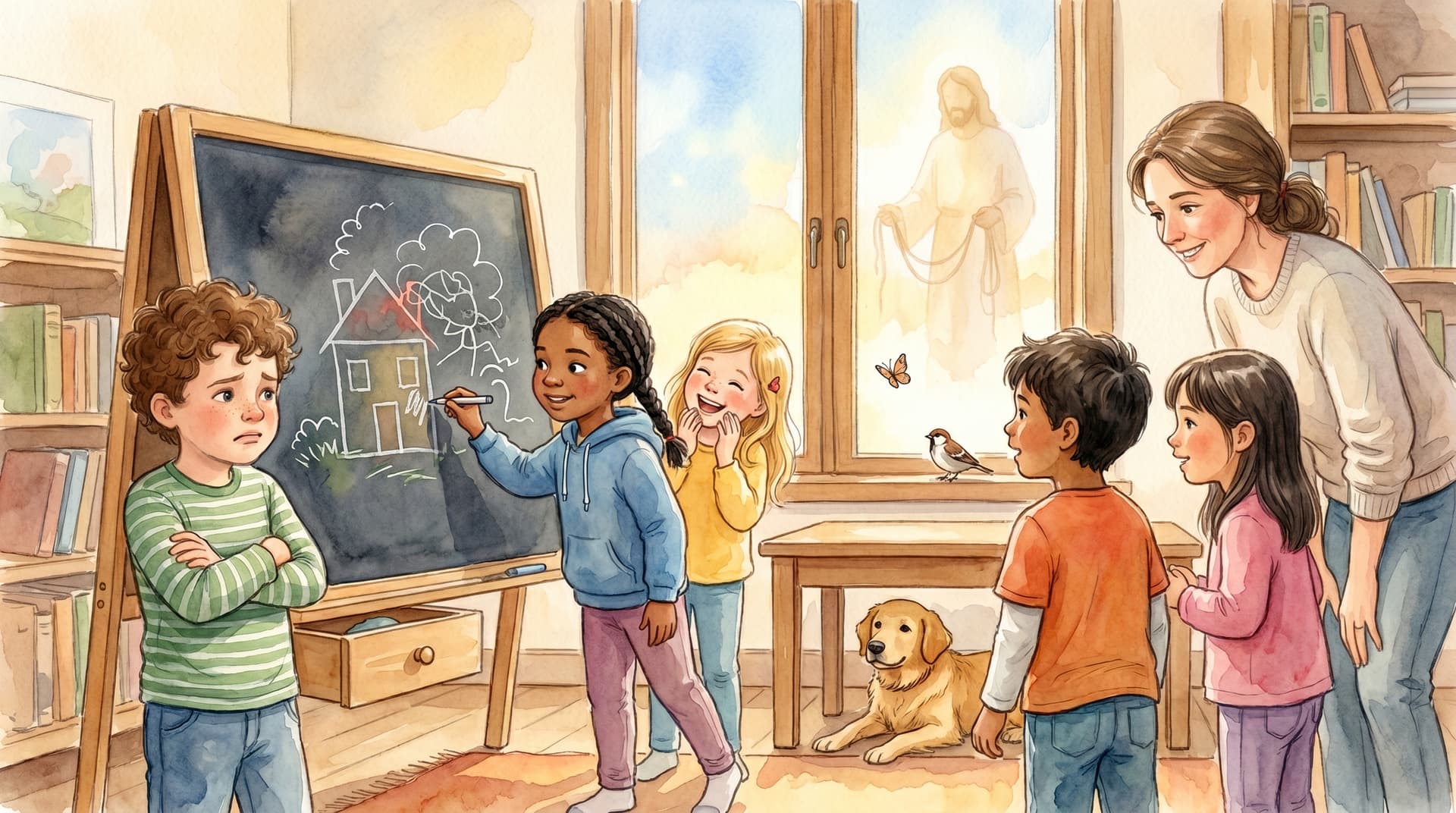
Why Kids Care
How does this truth intersect with their actual lives?
Movement 5: Why Should a 5-10 Year Old Care?
Passage: John 2:13-22
"What does this mean for their actual lives of play, fun, friendship, and family?"
This movement is a brainstorm -- a menu of angles, illustrations, and landing points for the teacher to pray through. The Spirit knows what your specific kids need. Pick what resonates, adapt freely, let the rest go.
The Lesson: The Day Jesus Flipped Tables
The Arc
Three truths John wants us to see:
1. "Jesus walked into his Dad's house and found people being kept out." The market was set up in the only courtyard outsiders were allowed to use. The system that "helped" some people made worship impossible for others.
2. "Jesus got angry -- and his anger had a job." He did not yell at random. He did not break things for fun. He cleared the courtyard so the people who had been pushed out could come back in.
3. "Jesus said, 'Tear me down, and I'll come back in three days.'" He was not talking about the building. He was talking about his body. From day one of his ministry, he knew he was going to die. And he knew he was going to come back. He told them ahead of time. They just did not understand until later.
The Role Play
Characters: Narrator (teacher), Jesus (volunteer), Merchants (3-4 kids with chairs/tables), Outsiders (2-3 kids stuck at the back), Religious leaders (2-3 kids), Disciples (2-3 kids).
Scene 1 -- The Setup. Set up "the Court of the Gentiles" -- a marked-off area where the outsider kids stand. Then have the merchants drag chairs and tables right into that area, blocking the outsiders. "The outsiders came to pray. But there's no room. The animals and the money tables are in the way."
Scene 2 -- Jesus Arrives. Jesus walks in. Looks around. Stops. Teacher: "What do you think Jesus is feeling right now?" Let kids guess.
Scene 3 -- The Whip. Jesus picks up "cords" (a piece of rope or yarn). Teacher narrates: "He braided a whip. Slowly. On purpose. This was not a sudden tantrum." Jesus says: "Take these out of here! Stop turning my Father's house into a market!" The merchants pick up their chairs/tables and exit. The outsiders step forward.
Ask: "Why did Jesus do this?" Let them think. Then: "He didn't get angry because someone bumped him in the hallway. He got angry because people who wanted to pray couldn't get in. His anger was love -- love for the people stuck at the back."
Scene 4 -- The Question. The religious leaders step forward: "Who said you could do this? Show us a sign!" Jesus: "Tear down this temple, and I will raise it up in three days." The leaders look at each other, confused. "It took 46 years to build this thing!"
Scene 5 -- Three Years Later. Teacher steps in: "Nobody understood what Jesus meant -- not even his disciples. Not until three years later, when Jesus died on a cross and came back to life on the third day. Then they realized: he wasn't talking about the building. He was talking about himself. He was the temple. He came to be torn down so that everyone could meet God in him."
Why Should They Care?
Angle 1: When Life Feels Rigged Against You
The kid's world: A kid who cheats at recess and gets away with it. A sibling who hits you and doesn't get in trouble because the parent didn't see. A teacher who plays favorites. A bully who never seems to lose. The feeling that the rules are bent against you and nobody is going to fix it.
The God-first landing: Jesus walked into the temple and saw exactly that -- people getting cheated by the ones in charge, with no way to fight back. He didn't shrug. He flipped tables, because his people were being hurt and he loved them too much to leave it alone. And here's the bigger thing: even when Jesus is not standing right there flipping tables, he still sees every unfair thing. The Bible says, "Vengeance is mine, says the Lord" (Romans 12:19). That means God promises to make every wrong thing right -- in the right way, at the right time. You don't have to fix it yourself. You don't have to make sure no one gets away with it. That's also how you can love an enemy -- not because what they did was okay, but because Jesus is angrier about it than you are, has more power to make it right than you do, and wants to make it right even more than you want him to. You can hand it to him and trust him with it.
Landing statement: "When something is unfair, you don't have to carry it. Jesus sees it, he is angrier about it than you are, and he will make it right. You can rest."
Angle 2: When You Try to Earn God's Love
The kid's world: Trying to be extra good before asking for something. Apologizing in a sweet voice when you do not really mean it. Hoping that if you do enough chores, your parent will be happier with you.
The God-first landing: The temple market had become a place where coming close to God required paying for it. Jesus shut that down. You do not have to earn God's love. You cannot pay for it. He already paid -- by being the new temple, the new meeting place, the one who got torn down so that you could come close for free.
Landing statement: "You cannot pay your way to God. You do not have to. Jesus already opened the door, and he is the door."
Angle 3: When You Realize You Are the One Being Kept Out
The kid's world: Being the new kid. Being left out of the group chat. Being too small for the game. Being told you do not belong.
The God-first landing: The Court of the Gentiles was for outsiders -- people who did not look like, talk like, or come from the same place as the insiders. And Jesus' first big public move was to clear out the people who were keeping the outsiders out. If you have ever felt like you are on the wrong side of a door, this story is for you. Jesus walks into the room and makes space for the people pushed to the back.
Landing statement: "Jesus makes room for you. There are no outsiders to him. He flipped tables to prove it."
Angle 4: When You Want a Sign
The kid's world: Wanting proof before you trust someone. "How do I know you'll keep your promise?"
The God-first landing: The leaders asked Jesus for a sign. He gave them the only sign that mattered: "Tear me down and I'll come back in three days." That is the proof. Not a magic trick. Not a lightning bolt. A death and a resurrection. Jesus' biggest promise to us is that he is not bluffing. He died. He came back. That is the proof his word holds.
Landing statement: "The proof that you can trust Jesus is that he died and came back. He told them ahead of time, and he did exactly what he said."
Object Lesson Option: The Rigged Game
Setup: Tell the kids you're playing pictionary -- teacher vs. kids. The rules: you draw something on the board. If they guess within 10 seconds, they get a point. If they don't, you get the point. First to five wins.
Play a couple rounds straight. Then start rigging it. Right when they're about to guess, erase a critical part of the drawing. Add a new shape that makes the answer ambiguous. Switch the drawing into something else at the last second so the timer runs out before they can lock it in. Take the point. Repeat. Keep doing it until they catch on and start protesting. Let them get frustrated. Let them tell you it's unfair. Let them feel the part where there's nothing they can do because you control the rules.
Debrief: "How did that feel? Unfair, right? Like there was nothing you could do because I kept changing the rules whenever it suited me?
That's the world Jesus walked into at the temple. The people in charge had rigged the system. They decided who got to come close to God, how much it cost, who had to stand in the back. The people who were supposed to be helping others worship were instead profiting off them and shutting them out. And the people stuck in the back? There was nothing they could do.
Jesus walked in, saw it, and got angry. Not because somebody broke a rule. He got angry because his people were being hurt by people who had rigged it in their favor. His anger was love with muscle. He loved the people stuck at the back too much to leave them there, and he had the power to do something about it. So he did.
Here's why this matters for you. When something feels unfair -- when a kid at school cheats and the teacher doesn't notice, when a grown-up plays favorites, when someone hurts someone you love and gets away with it -- you don't have to make it right yourself. The Bible says, 'Vengeance is mine, says the Lord' (Romans 12:19). That doesn't mean God shrugs. It means God sees it. God is more angry about it than you are. And he has the power to make it right -- in the right way and at the right time. You can rest. He won't miss it.
That is also how we love our enemies. Not because what they did was okay -- it wasn't. We can love them because Jesus is angrier about the harm than we are, has more power to fix it than we do, and wants to fix it even more than we want him to. We don't have to carry it. We can hand it to him and fully trust him with it. He doesn't just hate sin because it breaks the rules. He hates it because it hurts the people he loves. That's the heart that flipped the tables. And that's the heart you're handing your unfair stuff to."
Follow-Up Questions
- "Why do you think Jesus made a whip instead of just yelling?"
- "Have you ever been somewhere you didn't feel welcome? What did you wish someone would do?"
- "Is it scary that Jesus got angry? Why or why not?"
- "What did Jesus mean when he said, 'Tear down this temple'?"
- "If Jesus is the temple now, what does that mean for how we pray?"
Age Notes
Younger (5-6)
- Lean on the physical action: he flipped tables, he made a whip, he cleared the courtyard. Have them act it out (gently). The picture sticks.
- Skip the "destroy this temple" riddle if it confuses them. Land on: "Jesus made a path so we could come close to God."
- Landing: "Jesus is strong and kind. He moved the stuff that was in the way so you could come close to him."
Older (8-10)
- Push into the riddle. "Why didn't Jesus just explain himself? Why did he say something he knew they would not understand?" Let them sit with it.
- Connect it to Easter. "If this happened at his first Passover, what is going to happen at his last one?" Let them feel the foreshadowing.
- Wrestle with the anger. "Was Jesus losing his temper? How is his anger different from when we get angry?" This age can handle the distinction between protective fury and selfish rage.
What to Skip
- The historical tangent on Tyrian shekels and exchange rates. One sentence is enough: "The merchants were charging too much, and they were doing it in the one spot outsiders were allowed to pray."
- The debate over whether John's cleansing is the same event as the Synoptics' or a different one. Not useful for kids. Just teach John's account.
- A long explanation of Herod's temple architecture. Mention it was huge and still being built. That's enough.
Landing Statements
Format: God is/does ___. And because of that, you ___.
- "Jesus is the temple. You can come close to God anywhere, anytime, because Jesus is the meeting place."
- "Jesus' anger is love with muscle. You never have to be afraid of him being soft when something is hurting you."
- "Jesus made room for outsiders. There is no door you have to earn your way through. He already opened it."
- "Jesus told them he would die and rise three years before it happened. You can trust everything else he says, too."
- "You cannot buy your way to God. You do not have to. Jesus paid in himself."
Teacher Quick Reference
Framing Sentences
- The setting: "Jesus' first Passover as a teacher. He walks into the temple. And the first thing he does is flip tables."
- The reason: "The market wasn't just dishonest. It was set up in the only spot outsiders could pray. Jesus cleared the way for the people who had been pushed out."
- The riddle: "He said, 'Tear down this temple, I'll raise it up in three days.' He was not talking about the building. He was talking about his body."
- The proof: "Three years later he died and came back. The disciples remembered this moment and finally understood."
Themes Already in Kids' World
- Someone fierce on your behalf. A parent, a friend, an older sibling who shows up.
- Trying to earn love. Every kid has done this and it has never worked.
- Being the outsider. Every kid has been the new one, the small one, the left-out one.
- A promise that comes true later. "I told you so" -- but in a good way.
Kid Questions
"Why did Jesus get so angry?" "Because the people who were supposed to help others come close to God were getting in the way. He did not get angry because he was annoyed. He got angry because he loved the people being kept out. Anger that loves people is different from anger that hurts people."
"Did Jesus hurt anyone with the whip?" "The Bible doesn't say he hit anyone with it. He used it to drive out the animals -- the cattle and sheep. The whip was loud and clear, but it was for the animals, not the people. The people left because they saw who he was, not because he was hurting them."
"What did 'tear down this temple' really mean?" "He was talking about his body. The temple was where God met people. Jesus was saying he was going to become the new place where God meets people -- and he was going to do it by dying and coming back to life. Three years later, that is exactly what happened."
"Are we supposed to flip tables when we see something wrong?" "That is a great question. Jesus could do this because he was the Son of God in his Father's house -- he had the right and the wisdom to do it. We probably should not flip actual tables. But we can do the thing underneath it -- we can speak up when someone is being kept out, and we can make room for outsiders. That is the heart of what Jesus did."
"If Jesus is the temple, do we still need church buildings?" "Buildings are nice -- they give us places to meet together. But we do not need them to come close to God. You can pray in your room, in the car, on the playground. Jesus is the meeting place, and he goes everywhere you go."
The Bottom Line
This lesson gives kids a Jesus who is more than nice. He is fierce -- in love. He clears the path for outsiders. He claims the temple as his Father's house. And he announces, on day one of his ministry, that he came to be torn down so that everyone could come close.
The temptation will be to land on "be brave like Jesus" or "don't be greedy like the merchants." Resist that. The lesson is not that Jesus is a model for righteous anger. The lesson is that Jesus is the new temple -- and his fierce love and his willingness to die are the same love. He flipped tables so people could pray. He let himself be torn down so people could come home. The whip and the cross are the same heart.