
The Book of Nehemiah
A lesson preparation guide for teaching 5–10 year olds
The Original Audience
What did this mean to the people who first heard it?
Movement 1: The Original Audience
Book: Nehemiah
"What did this mean to the people who first heard it?"
Historical Situation
The exiles had been back in Jerusalem for nearly a century. The temple was rebuilt (thanks to Zerubbabel and Ezra's generation). But the city walls were still rubble. In the ancient Near East, a city without walls wasn't a city — it was a camp. No walls meant no protection, no legal standing among neighboring peoples, and no dignity. Jerusalem was technically inhabited but functionally humiliated.
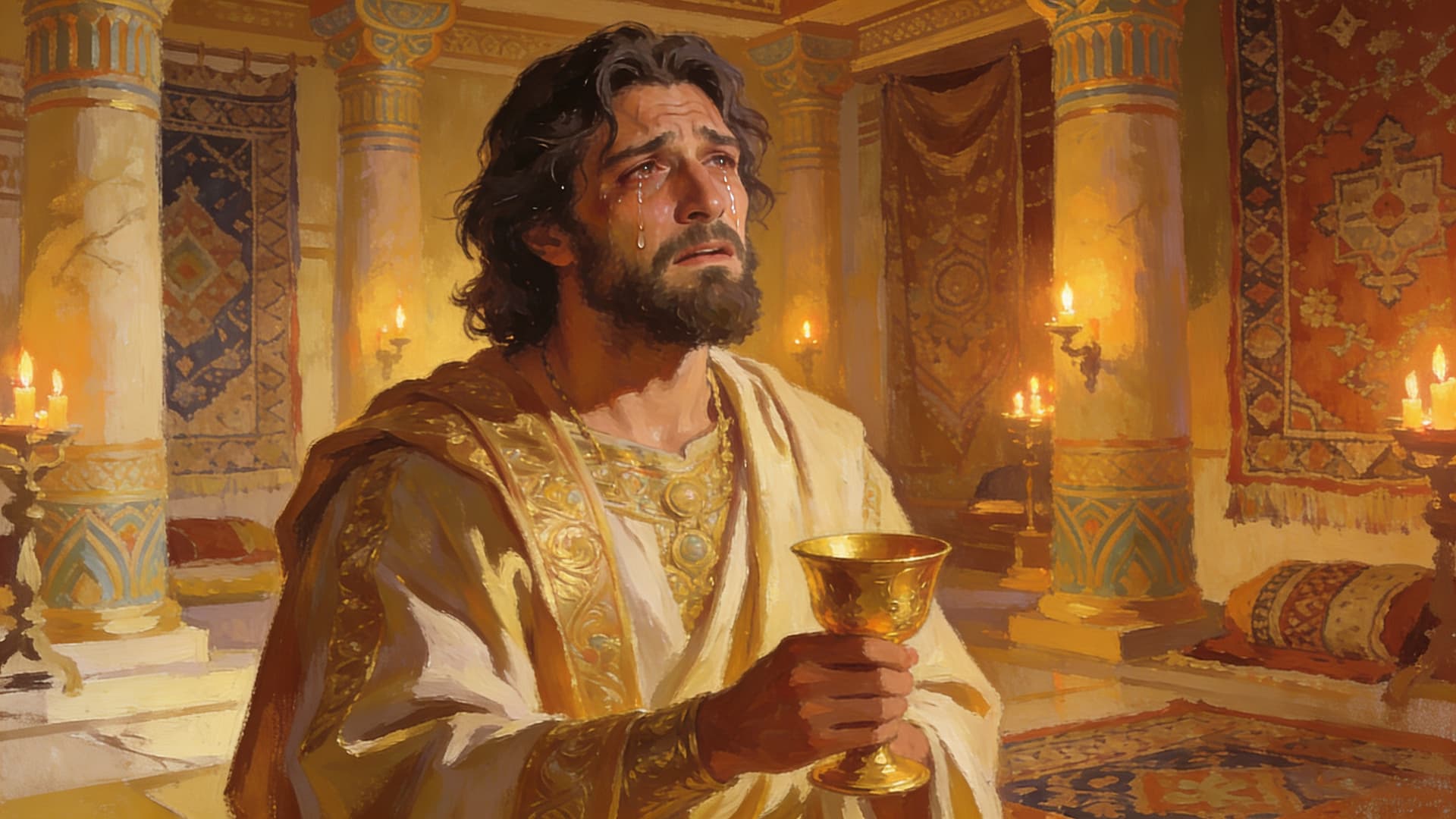
Nehemiah gets the news in Susa around 445 BC — roughly 90 years after the first wave of returnees. He's cupbearer to King Artaxerxes, one of the most trusted positions in the Persian court. He tastes the king's wine, stands in the king's presence daily. He is safe, comfortable, and important. The people back in Jerusalem are none of those things.
Cultural Assumptions Modern Readers Miss
Walls = identity. We think of walls as military infrastructure. They thought of walls the way we think of national borders, legal systems, and civic pride combined. A city with broken walls was an open wound — visible proof that God's people were still under judgment. Every neighboring nation could look at Jerusalem and say, "Your God didn't finish what he started."
The cupbearer's risk. Appearing sad in the king's presence could get you killed. Kings surrounded themselves with happy faces — a gloomy servant implied the king's household was unhappy, which was politically dangerous. When Nehemiah lets his grief show before Artaxerxes (2:1-2), he's not being emotional — he's risking his life. The text says explicitly: "I was very much afraid."
Opposition wasn't random. Sanballat (governor of Samaria), Tobiah (Ammonite official), and Geshem (Arab leader) weren't just bullies. They had political and economic reasons to keep Jerusalem weak. A rebuilt Jerusalem threatened their regional control. The opposition Nehemiah faced was organized, strategic, and relentless — mockery, threats, conspiracy, and infiltration through false prophets.
Emotional Temperature
Mixed and layered. The people in Jerusalem were living in a low-grade shame — they'd gotten used to the rubble. It had been decades. The ones who cared had probably stopped hoping. When Nehemiah shows up with letters from the king and a plan, the emotional shift is from resigned disgrace to cautious, fragile hope. But the opposition hits immediately, and the question becomes: Will this hope survive long enough to finish?
Nehemiah himself carries a different emotional weight — the grief of someone who had it good but couldn't enjoy it because his people were suffering. His comfort in Susa didn't numb him to Jerusalem's pain. That's the detail that makes him interesting.
Why This Matters for Kids: "Imagine your school got destroyed in a storm. And everyone said they'd rebuild it, but years and years went by and it was still a pile of bricks. Other schools made fun of yours. You just got used to it being broken. Then one day, someone who had a really important job far away heard about your school, and it made him so sad he cried. And then he didn't just feel sad — he left his important job to come help fix it. That's where this story starts."
The Author’s Intent
What is the author trying to do with this passage?
Movement 2: The Author's Intent
Book: Nehemiah
"What was the author trying to do with this text?"
The Core Argument
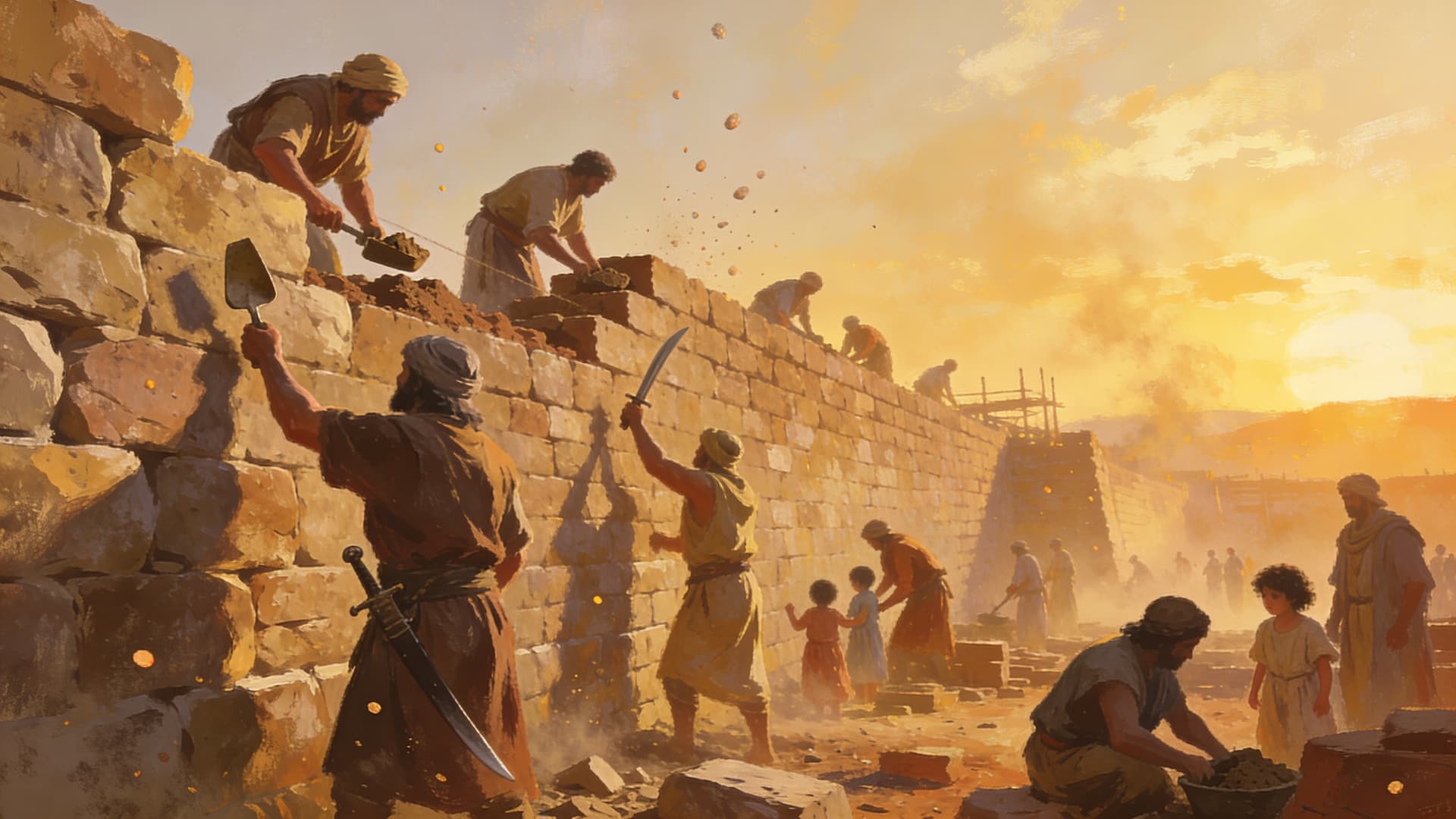
The author wrote this because the audience needed to understand that God rebuilds what's broken through people who pray before they plan, who work with a trowel in one hand and a sword in the other, and who refuse to let opposition — external or internal — define what's possible.
The book has a deliberate rhythm the author wants you to notice:
Problem → Prayer → Action → Opposition → Prayer → Perseverance → Completion.
This cycle repeats throughout the entire book. Nehemiah never skips the prayer step. He hears the walls are broken — he prays for four months before he acts. The king asks what he wants — "I prayed to the God of heaven" (2:4), mid-conversation, before he answers. Enemies threaten — he prays, then posts guards. The pattern is the point.
What the Author Wants Readers to Wrestling With
The danger of internal rot. Chapters 1-6 deal with external enemies. Then chapter 5 hits: the wealthy Jews are exploiting the poor ones. Charging interest on loans to their own desperate brothers. Taking their fields and vineyards as collateral. While they're all supposedly building the wall together, some of them are building wealth off their neighbors' backs. The author places this right in the middle of the construction narrative on purpose. The message: the enemies outside the wall are less dangerous than the greed inside it.
Leadership that costs something. The author draws a sharp contrast between Nehemiah and every previous governor. Former governors taxed the people heavily, and their servants lorded it over them (5:15). Nehemiah refused the governor's food allowance for 12 years, bought no land, and had his own servants working on the wall alongside everyone else. The author isn't just recording history — he's defining what godly leadership looks like: it bears the cost instead of passing it down.
Completion against all odds. The wall is finished in 52 days (6:15). Even the enemies recognized that "this work had been accomplished with the help of our God" (6:16). The author wants you to feel the weight of that — decades of rubble, months of organized opposition, internal betrayal, assassination plots, false prophets hired to intimidate — and then done in under two months. The speed isn't the miracle. The completion is.
The Author's Unique Voice
Nehemiah's memoir is remarkably personal for an Old Testament historical book. He records his own emotions ("I sat down and wept"), his own prayers (raw, honest, sometimes blunt), and his own frustrations. He's not writing detached history — he's giving testimony. The repeated refrain "Remember me, O my God" (5:19, 13:14, 13:22, 13:31) reveals a man who knows the work isn't ultimately about the wall. It's about faithfulness before God.
The Useful Test: "The author wrote this because the audience needed to understand that God's rebuilding projects face real opposition — political, social, and spiritual — but they cannot be stopped when the builders pray first, work together, and refuse to let internal compromise rot what external enemies couldn't destroy."
Seeing God
What does this passage reveal about who God actually is?
Movement 3: The Passage's Contribution to Seeing God
Book: Nehemiah
"What does this passage show us about God's beauty, glory, or character that we wouldn't see without it?"
What's Surprising About God Here
God cares about walls. Not just hearts, not just worship, not just theology — actual stone walls. Physical infrastructure. The security and dignity of his people's daily lives. Nehemiah doesn't get a vision of angels or a prophetic word about spiritual truths. He gets lumber permits and a military escort. God moves a pagan emperor to fund a construction project. This reveals a God who is not embarrassed by the material world. He cares that his people have doors on their gates and locks that work.
God is invisible in this book — and that's the point. Nehemiah has no miracles. No parting seas, no fire from heaven, no angelic visitors. God doesn't speak audibly once. Yet God is the most active character in the story. He moves Artaxerxes' heart (2:8 — "the good hand of my God was upon me"). He frustrates the enemies' schemes (4:15 — "God frustrated their plan"). He puts it into Nehemiah's heart to act (7:5). God is everywhere in Nehemiah — but always behind the scenes, always working through ordinary human decisions and actions. This is what God's faithfulness usually looks like: not spectacular, but unstoppable.
God fights through people who refuse to quit. "Our God will fight for us" (4:20) — but the people are holding swords while he does it. The theological tension is intentional. God is fighting. And the people are fighting. Both are true at the same time. Nehemiah doesn't choose between trusting God and posting guards. He does both. This isn't a lack of faith — it's a mature picture of how God partners with his people.
God's Emotions in This Book
God's emotions surface indirectly through Nehemiah's. When Nehemiah weeps over Jerusalem's walls (1:4), we're seeing a man whose heart is aligned with God's heart. The grief isn't just personal — it's prophetic. God grieves when his people live in unnecessary brokenness. God grieves when what should be whole is still in ruins.
And then the joy. Nehemiah 8:10 — after Ezra reads the Law and the people weep in conviction — Nehemiah tells them: "The joy of the LORD is your strength." Not your joy. Not happy feelings. The LORD's joy — God's delight in his people, God's pleasure in the rebuilding, God's gladness that they've come home and are listening again. Their strength comes from knowing that God is joyful over them, not from manufacturing their own happiness.
The Specific Facet of Beauty on Display
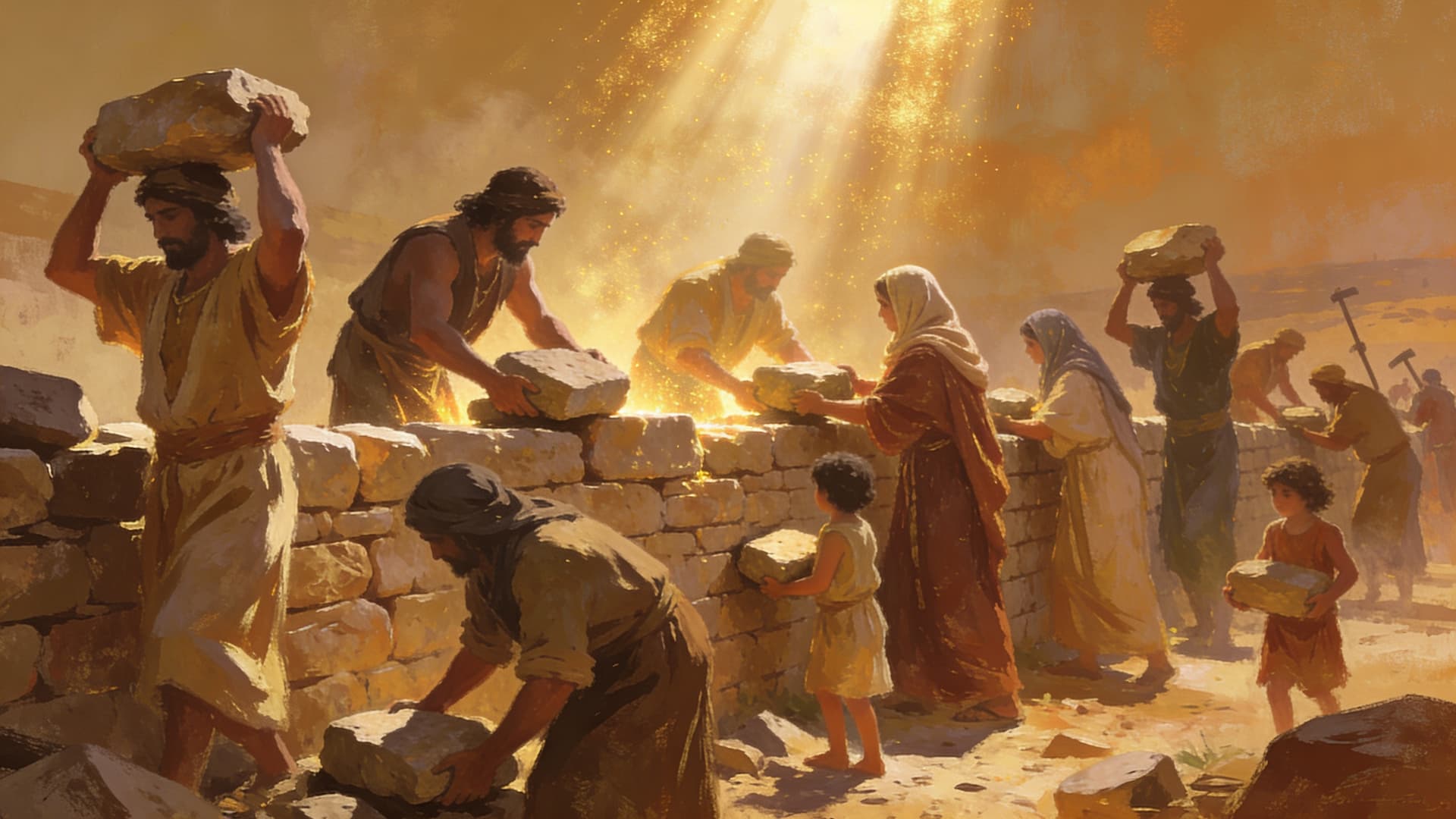
God's relentless commitment to finishing what he starts — not spectacularly, but faithfully, through imperfect people doing ordinary work. The wall gets built not by a miracle but by families working on the section nearest their own house (chapter 3). Priests, perfume-makers, goldsmiths, merchants — people with no construction experience — building a wall because God asked and Nehemiah organized. God's power in Nehemiah doesn't look like power. It looks like coordination, perseverance, and answered prayer. And it works.
The Worship Test: God is not waiting for conditions to be perfect before he acts. He works through a cupbearer's tears, a king's unexplained generosity, and families who've never laid a stone in their lives. He doesn't need spectacular. He needs willing. And when willing people pray and work, what was rubble for decades gets rebuilt in 52 days. That's not efficiency. That's God.

Gospel Connection
How does this passage connect to the gospel?
Movement 4: The Specific Gospel Connection
Book: Nehemiah
"How does Jesus fulfill, complete, or embody what this passage reveals — specifically, not generically?"
The Specific Fulfillment
Nehemiah left the most comfortable position in the known world — trusted advisor to the most powerful man on earth — because he couldn't bear that his people were living in disgrace. He gave up safety to enter brokenness. He bore the cost of leadership himself rather than passing it to the people. He stood between his people and their enemies. He interceded constantly.
Jesus is the greater Nehemiah. He didn't leave a Persian palace — he left heaven itself. Not because the walls were broken, but because we were broken. Nehemiah rebuilt stone walls in 52 days. Jesus is rebuilding an entire people — and an entire creation — and the project costs him not 12 years of unpaid governor's salary but his own life.
Nehemiah wept when he heard about Jerusalem's disgrace. Jesus wept when he looked at Jerusalem (Luke 19:41) — the same city, the same walls — knowing that the people inside still didn't recognize what God was doing among them. Nehemiah's tears led to rebuilding. Jesus' tears led to the cross. Both men grieved because they loved. But Jesus' grief carried a weight Nehemiah never could: he was grieving for people who would reject the very rescue he came to bring.
The Specific Brokenness This Exposes
Nehemiah reveals several layers of our brokenness:
We get used to rubble. The people had lived with broken walls for nearly a century. They'd normalized their disgrace. We do the same thing — with habits that damage us, relationships we've given up on, parts of our hearts we've written off as unrepairable. Jesus doesn't accept our rubble as permanent. "Behold, I am making all things new" (Revelation 21:5) — not some things, not just the spiritual things. All things.
We sabotage from within. The wealthy Jews exploiting the poor in chapter 5 is devastating because they're supposed to be on the same team. The enemies outside couldn't stop the wall, but internal greed almost did. We do this too — the things that damage us most aren't usually the attacks from outside but the selfishness, jealousy, and apathy inside. Jesus doesn't just defend us from external enemies. He transforms us from the inside out. "I will give you a new heart and put a new spirit in you" (Ezekiel 36:26).
We can't sustain it on our own. Nehemiah 13 is the heartbreaking epilogue. Nehemiah leaves Jerusalem for a while. When he comes back, everything has fallen apart. Tobiah (the enemy) has been given a room inside the temple. The Levites have abandoned their posts. The Sabbath is being violated. The intermarriage problem is back. The people couldn't hold it together without Nehemiah standing over them. They needed a leader who would never leave. Nehemiah always had to leave eventually. Jesus said, "I am with you always, to the end of the age" (Matthew 28:20). He is the leader who never steps away.
The Destination
The wall Nehemiah built eventually fell again. The city was destroyed by Rome in 70 AD. Every human rebuilding project is temporary. But Revelation 21 describes a city coming down from heaven — the New Jerusalem — whose walls are made of jasper, whose gates are made of single pearls, and which needs no temple because God himself is its temple. Everything Nehemiah built was a preview. The real city is coming. And this one won't need armed guards on the walls, because there will be nothing left to threaten it.
Kids who build sandcastles at the beach know the tide always comes. The New Jerusalem is the sandcastle the tide can't touch.
Anti-Moralism Checkpoint:
- Not "be brave like Nehemiah." Instead: God gave Nehemiah courage he didn't have on his own — and he gives it to you the same way, through prayer.
- Not "work hard and don't give up." Instead: God finishes what he starts, even when it takes longer than we'd like and looks different than we'd expect. Your job is to stay close to him, not to be the hero.
- Not "and this points to Jesus who died for our sins." Instead: Jesus is the rebuilder who never stops, never leaves, and never lets the enemy have the last word — and the city he's building will never fall.

Why Kids Care
How does this truth intersect with their actual lives?
Movement 5: Why Should a 5-10 Year Old Care?
Book: Nehemiah
"What does this mean for their actual lives of play, fun, friendship, and family?"
This movement is a brainstorm — a menu of angles, illustrations, and landing points for the teacher to pray through. The Spirit knows what your specific kids need. Pick what resonates, adapt freely, let the rest go.
Angle 1: "It's Too Broken to Fix"
The kid's world: A friendship that fell apart. A family situation that feels permanently messed up. A skill they've given up on. A mistake they think they can't come back from. Kids feel "too broken" more than we realize — they just don't have the vocabulary for it.
The God-first landing: God looked at a pile of rubble that had been sitting there for 90 years and said, "We're building this." He didn't say "it's been too long" or "you should have fixed this sooner." He sent someone who cared enough to cry about it and then get to work. God never looks at something broken and says, "That's too far gone." Not walls. Not people. Not you.
Possible illustration: Bring in something broken — a smashed-up LEGO set, a torn-up drawing, a tangled mess of string. Ask: "Who thinks we should just throw this away?" Then spend time rebuilding/untangling it together. The landing: "God doesn't throw broken things away. He rebuilds them. And he loves doing it."
Angle 2: When People Try to Stop You
The kid's world: The kid who says "you can't do that." The voice in your head that says "you're not good enough." Being laughed at for trying. Older siblings who mock. Classmates who exclude.
The God-first landing: Sanballat laughed at Nehemiah and said, "What are you building? A fox could knock it over!" (paraphrase of 4:3). The enemies sent threats, lies, and even fake friends to scare him into quitting. Nehemiah's response every single time: he prayed, and then he kept building. He didn't argue with the bullies. He didn't try to prove them wrong with words. He just kept building. And God made sure the wall got finished. When God gives you something to do, the people who laugh at you don't get the final say. God does.
Possible illustration: Build a tower out of blocks while volunteers try to distract the builder (not knock it over — just shout, wave, make noise, try to get them to stop). See if the builder can stay focused and finish. Debrief: "What helped you keep going? What made it hard?" Landing: Nehemiah kept going because he knew God was with him. The noise didn't stop because he was brave — it stopped mattering because he was praying.
Angle 3: Everybody Has a Section
The kid's world: Feeling too small to matter. "I'm just a kid, what can I do?" Seeing adults handle everything and wondering where they fit.
The God-first landing: Nehemiah chapter 3 lists every single person who worked on the wall — and they each worked on the section nearest their own house. Priests built. Perfume-makers built. Goldsmiths built. Daughters built (3:12). Nobody was too important or too unimportant. Nobody said "I'm not a construction worker, so I'll sit this out." God gave every person a section, and every section mattered. If one family didn't build their part, there'd be a gap in the wall — and the whole city would be vulnerable.
Possible illustration: Give every kid a piece of a large puzzle or a section of a mural to color. One or two kids secretly don't get a piece. When you assemble it, the gaps are obvious. "See that hole? That's what happens when someone thinks their part doesn't matter. God has a section for you. It might be small. It might be right outside your own front door. But the whole thing needs your piece."
Angle 4: Crying Is Part of It
The kid's world: Being told "don't cry," "be tough," "it's not a big deal." Feeling embarrassed about strong emotions. Thinking that strong people don't get sad.
The God-first landing: Nehemiah was one of the most powerful men in the Persian empire. He was tough enough to face down armed enemies and corrupt officials. And the first thing he did when he heard about Jerusalem's walls was sit down, cry, and pray — for four months. He didn't skip the sadness to get to the action plan. The crying was part of the plan. It's how he talked to God about what was breaking his heart. And God answered those tear-soaked prayers with one of the fastest rebuilding projects in history.
Possible illustration: This one might land best as a conversation rather than an activity. Ask: "Has anyone ever told you not to cry about something? How did that feel?" Then: "Nehemiah was strong AND he cried. Jesus was strong AND he cried. God isn't impressed by people who pretend things don't hurt. He's moved by people who bring their hurt to him."
Angle 5: God Works Behind the Scenes
The kid's world: "I prayed and nothing happened." Wondering if God is real because they can't see him doing anything. Feeling like God helps other people but not them.
The God-first landing: There are zero miracles in the book of Nehemiah. No fire from heaven. No angels. No audible voice from God. But God is the most active character in the whole story — he's just invisible. He moved the king's heart to say yes. He frustrated the enemies' secret plans. He put the idea in Nehemiah's heart to go. He coordinated thousands of people to build a wall in 52 days. God was doing everything — but if you were standing there watching, all you'd see is people carrying stones. That's how God usually works. Not loud. Not flashy. But unstoppable.
Possible illustration: The wind demonstration. Can't see it, but you can see what it does (blow a pinwheel, move a feather, fly a paper airplane). Or: put a seed in a cup of soil at the start of the lesson. "Nothing is happening, right? But something IS happening — you just can't see it yet." Landing: "God is always working. Even when you can't see it. Especially when you can't see it."
Angle 6: Joy When You Don't Expect It
The kid's world: Something hard is happening and someone says "be happy!" It feels fake. But also — the surprise of genuine happiness breaking through a bad day.
The God-first landing: After the wall is finished and Ezra reads God's word to the people, they start crying — they realize how far they've drifted from God. And Nehemiah says something unexpected: "Stop crying. Go eat good food, share with people who don't have any, and celebrate. Because the joy of the LORD is your strength." Not your joy. The LORD's joy. God is joyful over you — even when you're a mess, even when you've just realized how much you've messed up. And knowing that God is happy about you — genuinely delighted, not disappointed — that's where real strength comes from.
Possible illustration: This could be a moment rather than an activity. After telling the heavier parts of the story, pause and say: "And you know what God said to these people who were crying because they felt so far from him? He said, 'Throw a party. Because I'm not mad. I'm glad you're home.'" Let that land. Sometimes the best illustration is silence and a true sentence.
Notes for the Teacher
These angles overlap — you don't need all six. Pray through them during the week. One or two will light up for your specific group. Trust that.
The book of Nehemiah is unusually practical, which makes it tempting to turn into a "how to be a good leader" lesson. Resist that. The hero of Nehemiah is not Nehemiah — it's the God who moved a king's heart, frustrated enemy schemes, and turned 52 days of ordinary labor into something that made even the enemies admit God did it.
The kids don't need to leave wanting to be Nehemiah. They need to leave knowing that the God who rebuilt Jerusalem's walls is the same God who is rebuilding them — and he doesn't quit.